




TWI logo The Washington Institute for Near East Policy
logo
wordmark
Homepage

Main navigation

  • Analysis
  • Experts
  • About
  • Support
  • Maps & Multimedia
Trending:
  • Military & Security
  • Energy & Economics
  • Iran
  • Lebanon
  • Gulf States

Regions & Countries

  • Egypt
  • Gulf States
  • Iran
  • Iraq
  • Israel
  • Jordan
  • Lebanon
  • North Africa
  • Palestinians
  • Syria
  • Turkey

Issues

  • Arab & Islamic Politics
  • Arab-Israeli Relations
  • Democracy & Reform
  • Energy & Economics
  • Great Power Competition
  • Gulf & Energy Policy
  • Military & Security
  • Peace Process
  • Proliferation
  • Terrorism
  • U.S. Policy
TWI English
TWI Arabic: اللغة العربية Fikra Forum

Breadcrumb

  • Policy Analysis

Iran

Policy Analysis on Iran

Filter by:

Brief Analysis
Iran’s Drone Strategy (Part 2): Preventing Postwar Rebuilding and Advancements
Tehran’s drone ecosystem has been hit hard, but not at its roots—with help from Russia and China, the regime could restore many of the program’s capabilities within months while steadily working toward more dangerous next-generation models.
May 22, 2026
◆
  • Farzin Nadimi
Ships of the US Navy's Fifth Fleet on exercise in the Persian Gulf
Brief Analysis
Shifting from Diplomatic Urgency to Strategic Patience on Iran
For decades, Tehran has repeatedly exploited Western diplomatic urgency to extract concessions, buy time, and refill its coffers; the answer is to turn time itself against the increasingly vulnerable regime.
May 19, 2026
◆
  • Zohar Palti
A bread seller in Cairo walks past a sign promoting President Sisi - source: Reuters
Articles & Testimony
Is Egypt the Biggest Loser of the Iran War?
Cairo’s economic mismanagement has increased the country’s reliance on Gulf largesse, but that spigot may soon run dry for diplomatic and financial reasons.
May 18, 2026
◆
  • David Schenker
USS Boxer leads U.S. Navy ships transiting the Strait of Hormuz - source: Department of Defense
Brief Analysis
How to Accomplish U.S. Objectives in Iran
An agreement to open the Strait of Hormuz in exchange for lifting the U.S. blockade could make it easier to ultimately address more complex issues such as Iran’s uranium stockpile, missile program, and support for proxies.
May 14, 2026
◆
  • Michael Singh
Brief Analysis
For Iranians to Rise Up, a Clear Path for Regime Defectors Is Needed
Neither the United States nor Israel has offered the concrete incentives needed to spur high-level defections from the security, political, and clerical establishments—a crucial precondition for regime change.
May 13, 2026
◆
  • Holly Dagres
Chinese president Xi walks with U.S. president Trump in Beijing in 2017 - source: Reuters
Brief Analysis
Trump’s China Trip: Implications for the Middle East and Beyond
The first presidential visit to China in nearly a decade will cover trade, technology, and a range of other bilateral topics, including frank conversations on Middle East subjects such as Beijing’s support to Iran and the wider global repercussions of the Strait of Hormuz crisis.
May 13, 2026
◆
  • Grant Rumley
  • Henry Tugendhat
  • Elizabeth Dent
  • Anna Borshchevskaya
  • Souhire Medini
Articles & Testimony
Between Intent and Capability: Assessing the Lack of Iranian Attacks on the U.S. Homeland
Although the threat may be somewhat diminished by the damage inflicted on Tehran’s security and intelligence agencies, the regime will reconstitute those capabilities over time and may calculate that the benefits of attacking highly vulnerable targets inside the United States outweigh the risks.
May 6, 2026
◆
  • Matthew Levitt
Brief Analysis
Deniable, Disposable, Disruptive: Iran’s Hybrid Warfare in Europe Demands a Proactive Response
The low-sophistication, high-volume approach used in wartime attacks claimed by the front group HAYI has exposed critical vulnerabilities in Western efforts to harden soft targets, curb online recruitment, and protect Jewish communities amid spillover from the Middle East.
May 4, 2026
◆
  • Adrian Shtuni
The national flags of China and Iran fly in Tiananmen Square during Iranian President Ebrahim Raisi's visit to Beijing, China, February 14, 2023 - source: Reuters
Articles & Testimony
Is There a China Strategy Behind the Iran War?
The Trump administration’s inconsistent China policy is undermining efforts to parlay the conflict into a geopolitical win.
May 4, 2026
◆
  • Michael Sobolik
  • Grant Rumley
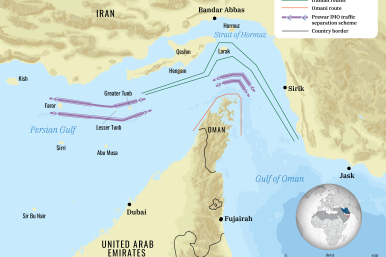
Screenshot from MarineTraffic showing the route of the Idemitsu Maru.
Maps & Graphics
Brief Analysis
Why Iran’s Navigational Order Will Be Difficult to Overturn
Tehran has upended traditional maritime arrangements in the Strait of Hormuz and remains in the driver’s seat despite U.S. pressure, so authorities cannot expect to reverse this shift quickly even if the war ends soon.
May 1, 2026
◆
  • Noam Raydan
Iranians shop in a Tehran market ahead of Nowruz celelbrations in 2024 - source: Reuters
Articles & Testimony
Self-Destruct Mode: Why Government Incompetence Means Even Immediate Peace with the U.S. Would Not Save Iran
Tehran’s ongoing failures in critical areas such as fiscal responsibility, energy, and infrastructure repair are doing even more damage to the country’s economic position than the war itself.
Apr 30, 2026
◆
  • Patrick Clawson
Mojtaba Khamenei - source: Reuters
Articles & Testimony
Let Iran Defeat Itself
Bailing out the regime’s new batch of hardline leaders would only help them remain a regional menace, so Washington should be very selective about whatever peace deal it signs, leaving room for the Iranian people to seek change themselves.
Apr 28, 2026
◆
  • Richard Nephew
Chinese Foreign Minister Wang Yi greets Russian Deputy Foreign Minister Sergey Ryabkov and Iranian Deputy Foreign Minister Kazem Gharibabadi in Beijing in March 2025 - source: Reuters
Video
Brief Analysis
Wartime Support to Iran: Implications for the Middle East and Beyond
Three experts explore the regional and global implications of Russian and Chinese support for Tehran, including how much this assistance actually affects U.S. efforts to weaken the regime’s capabilities and bring the crisis to an end.
Apr 24, 2026
◆
  • Hasan Alhasan
  • Nicole Grajewski
  • Matthew Tavares
A British sailor salutes the Royal Navy flag - source: Department of Defense
Brief Analysis
Encouraging European Military Efforts to Reopen the Strait of Hormuz
Although the new European-led military initiative signals a divergence from the current U.S. approach, Washington could still harness Paris and London’s ability to mobilize international action on the shared goal of preventing Tehran from flexing its leverage over global energy markets.
Apr 24, 2026
◆
  • Souhire Medini
Articles & Testimony
Iran’s Support for Russia and Lessons Learned from Ukraine
By taking urgent steps to institutionalize the wartime partnerships formed with (and between) Ukraine, the Gulf states, and Syria, Congress can strike heavy long-term blows against hostile Russian influence in the Middle East.
Apr 21, 2026
◆
  • Aaron Y. Zelin
Articles & Testimony
He Dreamed of Regime Change
The diplomat Uri Lubrani was renowned for his persistent assertion that such an outcome in Iran was not only feasible but inevitable.
Apr 17, 2026
◆
  • Martin Kramer
Vice President Vance arrives in Pakistan for talks with Iranian counterparts in April 2026 - source: Reuters
Video
Brief Analysis
Moving from War to Diplomacy: What’s Next for Iran, Lebanon, and Gaza?
Amid major diplomatic milestones and major international security threats, three experts explore what it will take to achieve success on multiple negotiating tracks at once.
Apr 16, 2026
◆
  • Michael Herzog
  • Robert Satloff
  • Hanin Ghaddar
Jordanian flag
Brief Analysis
Jordan’s Wartime Balancing Act
The economic, political, and diplomatic fallout of the Iran crisis is bending the kingdom in multiple directions, but Washington can do much to ease the domestic stress, avoid bilateral friction, and address Amman’s growing rift with Israel.
Apr 15, 2026
◆
  • Ghaith al-Omari
  • David Schenker
Brief Analysis
Egypt’s Gulf-Iran Dilemma
Cairo has put a premium on de-escalation in order to end the war as soon as possible and lessen the economic and energy shocks afterward, but this approach could backfire with its longtime benefactors in the Gulf states.
Apr 15, 2026
◆
  • Ben Fishman
Articles & Testimony
In Iran Negotiations, the White House’s Military Options Are Dwindling
Rather than pushing for the unrealistic goal of reaching a comprehensive deal in two weeks, the Trump administration should take the necessarily more patient approach of working through America’s strong network of allies to strengthen its hand.
Apr 14, 2026
◆
  • Dana Stroul

Pagination

  • Current page 1
  • Page 2
  • Page 3
  • Page 4
  • Page 5
  • Page 6
  • Page 7
  • Page 8
  • Page 9
  • …
  • Last page Last »
  • Next page Next ›
Supported by the

Viterbi Program on Iran and U.S. Policy

Today, the Islamic Republic of Iran poses the most serious and urgent set of security challenges to the United States and its allies in the greater Middle East. Since the Khomeini revolution in 1979, Iran has sought to export its radical ideology through the use of terrorism, subversion, and support to ideological fellow-travelers throughout the Muslim world.

Sign Up for Email Updates from The Washington Institute

Never miss a breaking event on U.S. policy interests in the Middle East. Customize your subscription to our expert analysis, op-eds, live events, and special reports.

Sign up

Featured experts

Farzin Nadimi
Farzin Nadimi
Farzin Nadimi, a Senior Fellow with The Washington Institute, is a Washington-based analyst specializing in the security and defense affairs of Iran and the Persian Gulf region.
Holly Dagres
Holly Dagres
Holly Dagres is the Libitzky Family Senior Fellow in The Washington Institute's Viterbi Program on Iran and U.S. Policy.
Patrick Clawson
Patrick Clawson
Patrick Clawson is the Morningstar Senior Fellow and Research Counselor at The Washington Institute.
Background image with TWI branding
logo
wordmark
Homepage

1111 19th Street NW - Suite 500
Washington D.C. 20036
Tel: 202-452-0650
Fax: 202-223-5364

Footer contact links

  • Contact
  • Press Room
  • Subscribe

The Washington Institute seeks to advance a balanced and realistic understanding of American interests in the Middle East and to promote the policies that secure them.

The Institute is a 501(c)3 organization; all donations are tax-deductible.

Footer quick links

  • About TWI
  • Support the Institute
  • Alumni

Social media

  • The Washington Institute on Facebook facebook
  • The Washington Institute on X x
  • The Washington Institute on YouTube youtube
  • The Washington Institute on LinkedIn linkedin

© 2026 All rights reserved.

Footer

  • Employment
  • Privacy Policy
  • Rights & Permissions