- Policy Analysis
- PolicyWatch 4261
How Iran Might Rebuild Its Devastated Military: Courting Risk by Reinforcing Success
Tehran will likely double down on missiles and drones—its most effective weapons during recent conflicts—creating path dependencies that could become critical vulnerabilities if U.S. and partner countermeasures improve further.
In two wars waged over the past year and a half, the United States and Israel have inflicted massive damage on Iran’s armed forces. Yet Tehran’s missile and drone forces have proved highly resilient and landed painful blows in response. Iran’s ability to build on these achievements will depend largely on whether Washington and its regional partners can disrupt efforts to rebuild and expand these missile and drone forces, as well as counter them more effectively. Turning Tehran’s growing dependence on these weapons into a critical vulnerability should therefore be a central focus of U.S. strategy going forward.
The Wages of War
As the dust settled from last year’s June war and the major combat phase (February-April) of this year’s ongoing conflict, the toll on Iran’s military capabilities has become clearer. Its nuclear infrastructure was largely destroyed, setting the program back years and yielding the very outcome that its nuclear hedging strategy sought to avoid. Likewise, U.S. government assessments in April asserted that nearly all known above-ground factories producing one-way attack drones and their key components were hit, while more than 80 percent of facilities producing missiles and solid-propellant rocket motors were damaged. Yet Iranian officials claim that underground production facilities—which proved impervious to U.S. and Israeli penetrator munitions—remain active, and that they have replaced missiles faster than they have used them. And despite efforts to rubble tunnel entrances, Iranian missile and drone forces continued to operate throughout both wars, imposing significant costs. Iran is believed to possess an arsenal of over 1,000 missiles and several thousand drones, which it continues to expand through the assembly of missile components that escaped destruction and foreign procurement of complete drones and components. And while it may have already resumed production of drones, resuming full-scale missile production might take a few years.
Iran’s air and naval forces took heavier hits. According to U.S. officials, more than 80 percent of the country’s air defenses were destroyed, along with most of its air force. U.S. and Israeli strikes also obliterated most of Iran’s naval forces and infrastructure, sinking more than 160 surface ships and submarines and roughly half of the 1,000 small boats operated by the Islamic Revolutionary Guard Corps (IRGC). More than 90 percent of its 8,000 naval mines were reportedly destroyed as well.
For years, maintaining these forces had absorbed much of Iran’s scarce trained manpower, spare parts, dockyard capacity, and foreign currency—resources that can now be devoted to more effective military capabilities such as missiles and drones. And with most of its aircraft destroyed, the air force is now allowing early retirement of nonessential personnel and downsizing into a more agile drone-centric force featuring next-generation drones and hardened support facilities.
The toll that Israel’s post-October 2023 wars have inflicted on Tehran’s regional proxies has been even greater. Hamas’s forces in Gaza have been decimated, and around 80 percent of Lebanese Hezbollah’s 150,000-plus arsenal of rockets, drones, and missiles was reportedly destroyed. Those setbacks have stripped Iran of much of the proxy-dependent strategic depth that once complemented its missile force. The Houthis are the clear exception; they remain useful in the Red Sea and against Israel and Saudi Arabia because of their effective use of almost the full range of Iran’s missile and drone technologies. Much the same can be said of Tehran’s most capable Iraqi militia proxies regarding their use of drones. Both cases underscore the point that these proxies are dependent on missiles and drones for extending their own—and, by extension, Iran’s—strategic reach.
Strategic Evolution
In assessing how recent events will influence the future trajectory of Iran’s armed forces, it is instructive to look at how they have evolved since 1979. Following the Islamic Revolution, the regime inherited a large, modern military with balanced conventional ground, air, and naval forces equipped largely with U.S.- and British-produced weapons and tactics. Yet years of sanctions, arms embargoes, and attrition made this force structure difficult to maintain, so Tehran rebuilt its military around an asymmetric deterrence and warfighting triad overseen by the IRGC.
This triad consisted of (1) an arsenal of long-range missiles and drones controlled mostly by the IRGC; (2) a littoral navy controlled by the IRGC, capable of threatening shipping through the Strait of Hormuz and, with help from the Houthis, the Bab al-Mandab; and (3) heavily armed proxy militias surrounding Iran’s regional enemies, all of them trained and equipped by the IRGC-Qods Force. Meanwhile, Tehran’s nuclear hedging strategy provided latent deterrence by raising the risk of a breakout if its vital interests were threatened.
Organizationally, this evolution prioritized the IRGC over the Artesh, whose formations pre-date the revolution. The Artesh fielded more personnel but remained chronically under-resourced and more dependent on older platforms (e.g., tanks, fighter aircraft, larger warships) that proved costly to maintain under sanctions. The IRGC monopolized the strategic missile force and enjoyed preferential access to hard currency and dual-use networks, though it (reluctantly) shared the drone and sea-denial portfolios with the Artesh. The near-total destruction of Iran’s fleet of fixed-wing aircraft, major surface combatants, and associated maintenance infrastructure in recent months will further reduce the Artesh’s ability to compete for scarce resources.
Three Paradoxes
Despite—or in certain ways because of—the damage wrought by the war, U.S. officials are now faced with three unexpected paradoxes. First, even as its naval forces were being systematically destroyed, Iran effectively closed the Strait of Hormuz in March by striking just twenty oil tankers and cargo ships. It also roiled markets around the world by striking onshore oil and petrochemical facilities with the relatively small number of drones and missiles that penetrated air and missile defenses. Iran has proven that hundreds of such weapons (assuming that about 10 percent will get through) can impose heavy costs, though thousands would be required for a protracted campaign against targets protected by robust defenses.
Second, just as the pruning of fruit trees enables them to concentrate energy on more productive branches, the destruction of Iran’s air force and navy will likely spur it to focus scarce resources on its much more effective missile and drone capabilities. Thus, even a diminished Iranian military will remain a significant threat to the global economy and regional order.
Third, and most consequentially for U.S. policy, Iran’s future reliance on these niche capabilities will deepen path dependencies that could be turned into a single point of failure if the United States and its partners develop and deploy even more effective air and missile defenses. Indeed, some Iranian regime commentators have warned about the dangers of resting the country’s entire security paradigm on a single pillar (though others have sought to downplay the importance of missiles and drones, attributing the regime’s resilience to religious zeal).
Rebuilding the Military-Industrial Base
Historically, states forced to innovate under pressure have often emerged with more capable militaries. For example, Germany’s post-Versailles emphasis on mobility and combined arms enabled its 1939-40 victories in Poland, France, and the Soviet Union. China’s mass retirement of obsolete fighter aircraft, surface combatants, and ballistic missiles in favor of more modern A2/AD (antiaccess/area-denial) and C4ISR (command, control, communications, computers, intelligence, surveillance, and reconnaissance) systems has better prepared it for possible conflict in the Pacific. Iran has a narrower industrial base and tighter finances, yet the incentive is identical: shed legacy forces and capabilities that no longer deliver decisive effects and concentrate on those that do.
Tehran will seek to restore at least some of its prewar production capacity. It will likely try to repair or cannibalize damaged equipment and machine tools recovered from bombed-out surface facilities, as Germany did during World War II and Iraq did after the 1991 Gulf War, and move them to underground research, development, and production sites. Items beyond repair will be replaced using clandestine procurement networks in China and elsewhere that have proven resilient during prior rounds of sanctions and war.
Organizationally, the war has further consolidated IRGC dominance while merging and streamlining decisionmaking processes, reducing inter-service friction, and accelerating production of ballistic and cruise missiles, loitering munitions, and one-way attack drones. Officials are also stepping up efforts to support C4ISR and electronic-warfare systems, including through artificial intelligence, cyber operations, and space-based capabilities. Given Iran’s extensive experience reconstituting under scarcity, it has a deep institutional memory for adaptive recovery.
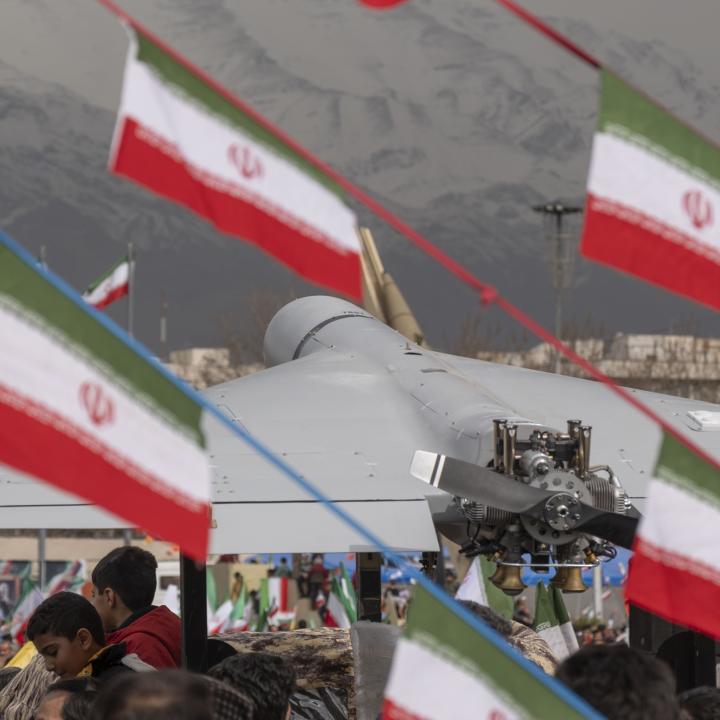
Missiles and drones. Iran will seek to further increase the range, accuracy, and reliability of its missiles while refining its saturation tactics, its use of cluster warheads to penetrate enemy defenses, and its use of ballistic missiles to hit moving ships. Its future missile force may also include decoys, chaff, or low-power electronic countermeasures. The same logic applies with greater urgency to drones—Iran will likely ramp up production of first person view (FPV) drones and loitering munitions, develop a capability to employ AI-enabled autonomous drone swarms, and produce warheads optimized for targeting critical infrastructure.
The nuclear option. Iranian commentators who advocate a more aggressive pursuit of nuclear weapons may feel vindicated by recent events and call for a new deterrence equation with the United States and Israel. Yet proponents of continued hedging may have a stronger case: Iran remains vulnerable to attack from the air, and any attempted breakout would almost certainly trigger renewed strikes. Therefore, Tehran will likely seek to preserve its nuclear option while rebuilding as much conventional capacity as possible without crossing Israeli or American red lines. A reconstituted missile and drone force combined with residual leverage over the Strait of Hormuz might reduce the near-term urgency of acquiring a nuclear weapon. Yet the same pressures that are reshaping its conventional military-industrial base could apply to the nuclear program. If so, Iran’s new leaders might try to go for the bomb once they consolidate their rule.
Policy Recommendations
Iran has emerged from the past two wars with a much leaner military whose capabilities still threaten vital U.S. interests. Yet its extreme path-dependence on missiles and drones is a potential vulnerability. If Washington and its partners can develop and field cheap, highly effective means to counter these capabilities, they may transform Iran’s growing dependence on missiles and drones into a single point of failure. In the meantime, U.S. policy must counter Iran’s ongoing efforts to reconstitute and enhance those capabilities through a variety of measures:
- Aggressive supply chain disruption. Expand secondary sanctions and export controls against firms (based largely in China, Hong Kong, and elsewhere) that supply machine tools, solid-propellant precursors, guidance components, and composites to Iran. Also target the financial and logistics nodes that enable procurement via cryptocurrency or bartering networks.
- Kinetic solutions. Enhance capabilities to detect and destroy emerging missile and drone production nodes, underground facilities, and related infrastructure inside Iran.
- Boost maritime and onshore defenses. To curtail Iran’s ability to disrupt Gulf oil exports and other vital economic activities, rush the development and deployment of uncrewed maritime and aerial vehicles armed with anti-drone and close-in defense systems. This could facilitate freedom of navigation through the Strait of Hormuz while also bolstering the onshore defenses that protect critical infrastructure.
- Conditionality. Link any eventual Iranian sanctions relief to verifiable constraints on its production of missiles and unmanned systems.
Michael Eisenstadt is the Kahn Senior Fellow at The Washington Institute and director of its Military and Security Studies Program. Farzin Nadimi is a senior fellow at the Institute, specializing in the security and defense affairs of Iran and the Gulf region.