Dana Stroul is Director of Research and Shelly and Michael Kassen Senior Fellow at The Washington Institute for Near East Policy.
Brief Analysis
Leaders in Washington and Jerusalem are increasingly aligned on the objective of ending such aid, but the hard work of charting the next phase of the defense partnership remains.
As Americans voted on November 3, President Trump preempted the expected congressional debate over military aid to Israel by announcing that the annual U.S. allocation of nearly $4 billion would be halted by year’s end. This proclamation seemingly upended Washington’s current ten-year aid agreement, which does not expire until 2028. It also upped the ante tendered months ago by Prime Minister Binyamin Netanyahu, who vowed to “wean Israel off” this funding within a decade.
The debate has now shifted from reducing aid over time to stopping it altogether. Yet while the current focus is on whether Trump will move forward with his surprise announcement, an equally pressing question is missing from the debate: how the bilateral partnership fits into the U.S. approach to the Middle East going forward. During the president’s final two years in office, his administration should work closely with Congress to answer this question, while also working with Jerusalem to set a new course for America’s most important defense partnership in the Middle East.
A Thirty-Year National Security Argument for Military Aid
For the past three decades, successive memorandums of understanding (MOUs) anchored the U.S.-Israel security relationship. Washington’s long-term commitment of billions of dollars in aid assured Israel that it would have a predictable source of funding to acquire the capabilities needed to defend itself from current and future threats—an important signal to enemies and partners alike. These agreements also benefited the United States by reflowing a large share of the aid back into the American economy, boosting domestic employment and the U.S. defense industrial base.
The first MOU—signed in 1999 and committing the United States to provide at least $21.3 billion in military aid—initiated the gradual phaseout of direct economic assistance to Israel. Negotiated during the Clinton administration, this package was made in the context of addressing Israel’s security needs as the country took steps toward peace with the Palestinians. The administration paired its Israel funding with hundreds of millions of dollars in economic development for the Palestinian people.
In 2007, the Bush administration negotiated a second MOU that increased the top line in U.S. funding to $30 billion in military aid. Although the administration did not explicitly link U.S. aid to any other file, it convened the Annapolis peace process to push for Israeli-Palestinian talks in the same year.
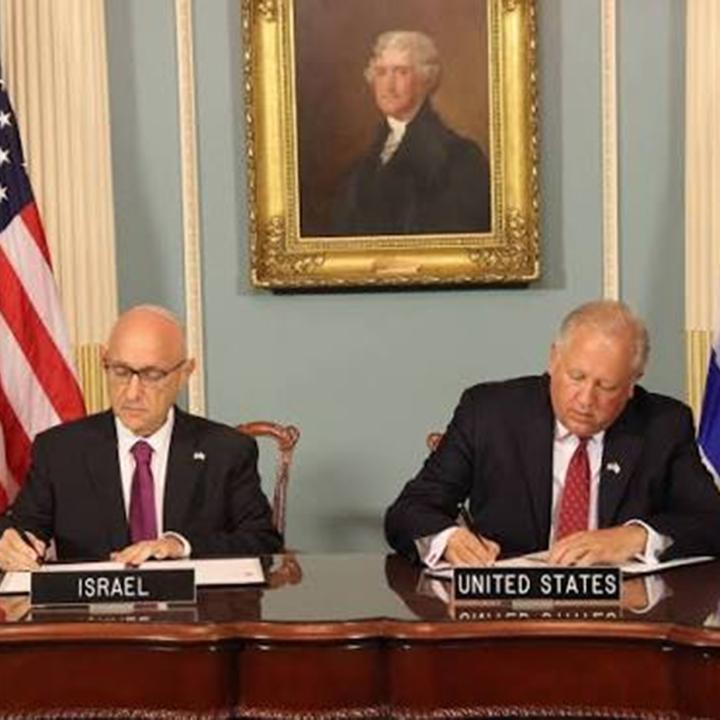
The current MOU was signed during the Obama administration, covering 2019-28 and further increased the top line to $38 billion in military aid, including $33 billion in Foreign Military Financing (FMF) grants and $5 billion for missile defense programs. This agreement was designed to upgrade Israel’s military capabilities following the Iran nuclear deal. The agreement also began phasing out Off-Shore Procurement (OSP), which allowed Jerusalem to spend a portion of U.S. military aid on purchases from Israeli defense manufacturers.
In general, the primary goals of U.S. military aid for Israel were to help the country obtain the U.S. equipment and training needed to address threats in its neighborhood, and to develop its capabilities in peacetime so that it can partner with the United States during wartime. In the Middle East, Washington needs competent partners to address a host of particularly pressing challenges, including terrorism, maritime security, and Iran-associated threats. The U.S. investment in Israel has delivered when measured against these objectives, producing a capable partner willing to fight both independently and as a peer military. Especially in the years since the October 7, 2023, Hamas terrorist attacks, Israel has demonstrated that it is capable of defending its territory and people against external threats while joining the United States in combined military operations against Iran.
Why U.S. Aid to Israel Can End
First, Israel’s military performance positions it to graduate from FMF—a U.S. funding mechanism that could use reshuffling anyway for broader national security reasons. FMF funds come from a fixed pot of State Department money programmed years in advance, with rigid rules for spending. For decades, most FMF has been earmarked for Israel and a few other countries in the Middle East, leaving little flexibility to respond to emerging threats elsewhere. For the past five years, the State Department’s FMF account contained around $6 billion per year, and Israel’s share was approximately 50 percent of the entire pot. Combined with FMF commitments to Egypt and Jordan, only about 15-20 percent of the funding was available for other countries. This meant that aid was often too little and too late in response to urgent needs and crises anywhere else. Given Israel’s advanced military capabilities, FMF can be better spent on other countries. A separate issue is whether Washington will continue providing $500 million per year in missile defense funding, in part because these efforts include joint production arrangements between American and Israeli firms.
Second, Israel is economically resilient enough to compensate for the loss of U.S. funds. Its advanced, innovation-driven economy yielded a gross domestic product of approximately $611 billion in 2025 (or $60,000 per capita), placing it among the world’s highest-income countries. And since the October 7 attacks, Israel has dramatically increased its defense spending, which nearly doubled to around $50-55 billion in 2026 compared to prewar levels. This figure represents roughly 25 percent of Israel’s total government spending, up from 16 percent in 2022. Put another way, U.S. aid as a proportion of Israel’s defense spending decreased from 9 percent in 2023 to 6 percent in 2025, according to unpublished data obtained from Congressional Research Service.
Third, Israel now has its own thriving defense industry and is an exporter of advanced systems to others, including the United States. Its foreign defense sales reached a record $19.2 billion in 2025—an increase of nearly 30 percent since 2024. Despite international criticism of Israeli government policies, global demand remains high for its missile defense systems, precision weapons, and surveillance capabilities. Israeli defense subsidiaries are also present throughout the United States and are using Israeli technology to produce military hardware in American factories.
Toward a New Framework
Although U.S.-Israel defense relations should evolve, heeding the increasingly vocal calls to downgrade the partnership would harm America’s national security interests. The relationship remains mutually beneficial considering the persistent threats from Iran and continued instability in the Middle East. Israel’s defense innovation, industrial base, military capabilities, intelligence collection, and willingness to fight make it an invaluable partner for an American military looking to maintain its technological and tactical edge while shifting burdens to others. Indeed, Israeli capabilities have improved U.S. operations and saved American lives—among numerous other examples, Israeli expertise helped U.S. forces lessen the threat of improvised explosive devices in Iraq and Afghanistan; Israeli armor helped protect U.S. service members in those same theaters; Israeli innovations in battlefield medicine are used regularly by the United States; and Israeli operations during the Iran war have provided multiple lessons on effectively integrating intelligence, missile defense, radars, and fighter jets into a coherent system for meeting complex battlefield situations. Israel’s contributions to regional defense against Iranian missile and drone threats further underscore that its capabilities are enhancing not only America’s security, but also that of its neighbors.
The U.S. defense industry likewise needs trusted, capable partners given the growing pressure to accelerate production timelines, replenish depleted munitions and missile interceptor stockpiles, diversify supply chains, expand manufacturing capacity, and innovate to meet future threats. Israel and the United States can help each other meet these challenges through coproduction, building on their bilateral Security of Supply Arrangement (SOSA), which gives both countries priority access to each other’s goods and services when in need. The U.S. defense industry is already turning to Israel’s skilled workforce for help with developing munitions, armored tank protection, and air defense, while Israeli defense manufacturers are fulfilling urgent needs when production constraints and lengthy delivery timelines prevent the United States from meeting demand quickly (e.g., selling the jointly developed Arrow 3 ballistic missile defense system to Germany; deploying Iron Dome missile defense systems to the United Arab Emirates).
An updated partnership framework should build on these achievements, establishing a new paradigm for each country to continue meeting one another’s needs and those of their partners. Most immediately, the United States should fulfill the commitments it made in the current MOU so that (1) Israel has time to plan its defense spending without U.S. direct support, and (2) U.S. officials can avoid exacerbating perceptions that Washington is an unreliable partner.
Toward those ends, the Trump administration should urgently initiate a discussion with Israel regarding its near-term defensive needs and acquisition priorities, in part to determine whether a final U.S. aid transfer is necessary to alleviate fiscal stress. Administration officials should also consult with the U.S. defense industry on how ending aid might affect existing contracts, with billions of U.S. dollars in procurement for Israel currently flowing to American manufacturers. At the same time, the administration’s discussions with Israel and Congress will need to account for the changed political circumstances in both countries. In the United States, increasing public and congressional concern about certain Israeli government policies that contribute to regional destabilization and exacerbate humanitarian crises must be addressed. While changes in Israeli government actions should not be tied to upgrading the defense partnership, they should proceed urgently alongside talks on expanding coproduction and codevelopment. Without meaningful adjustments in Israeli policies, it will be increasingly difficult to maintain U.S. domestic support for the defense partnership as an anchor of security in the Middle East.
In the medium term, Washington should consider how it will manage the risk that Jerusalem might seek to diversify its defense purchases if it is no longer obligated to buy American. For example, if the U.S. and Israeli militaries are no longer directed to invest in shared air defense capabilities, their ability to support bilateral and regional defense could be compromised. To avoid that scenario and protect decades of investments in this sector, the two allies should outline a process for assessing the future security environment and identifying areas for increased cooperation based on the comparative strengths and needs of each country’s military and defense establishment. Such a process is more urgent now that Russia, Iran, and China are actively exchanging defense technology, wartime tactics, and intelligence—a development that has enabled Moscow and Tehran to endure extreme pressure in recent years. The United States needs steady partners of its own to counter this cooperation by adversaries, and Israel remains the most capable such partner in the Middle East.
Finally, moving too hastily to implement Trump’s aid announcement would add to a growing list of broken U.S. security commitments. In the past year alone, the United States has paused military aid and missile defense to Ukraine, slowed an arms sale package to Taiwan, and canceled security funding for Baltic states. The president’s unplanned proclamation further exacerbates doubts about the value of U.S. partnership while emboldening adversaries—leaders in Iran may see the announcement as an invitation to escalate because the United States is backing away from Israel, while Russia and China will likely seize the opportunity to publicly underscore Washington’s pattern of unfulfilled commitments. Therefore, as soon as the new leadership in Congress and the next government in Israel are in place, the Trump administration should initiate consultations with both, making clear that the phaseout of U.S. military aid will move forward in tandem with efforts to update the partnership for the next decade of challenges.
Dana Stroul is the director of research and Kassen Senior Fellow at The Washington Institute. Previously, she served as deputy assistant secretary for the Middle East at the Pentagon.