Ambassador James Jeffrey is the Philip Solondz Distinguished Fellow at The Washington Institute. Previously, he served as U.S. special representative for Syria engagement and former U.S. ambassador to Turkey and Iraq.
Brief Analysis
Given this month’s shifting threat picture, the administration should push for another compromise deal similar to the June MOU—though getting Iran back to the table will require accepting certain escalatory risks and providing more concrete security guarantees to increasingly vulnerable Gulf partners.
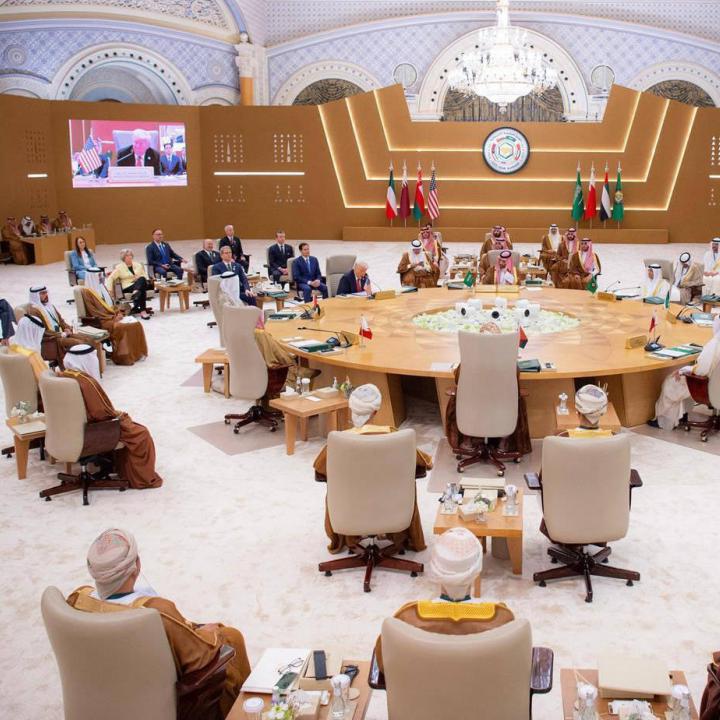
On September 22, President Trump will meet with leaders of the Gulf Cooperation Council (GCC) states on the sidelines of the UN General Assembly to discuss the way forward with Iran. So far, the administration has given few details about his thinking. While the president has publicly signaled major military escalation against the regime, a more probable—and likely more successful—approach would be to pitch a compromise resolution similar to the June memorandum of understanding (MOU), since this could achieve basic American goals without trying to force a currently implausible Iranian surrender. But the GCC states will be critical partners in any such approach, so the president must first convince them—beginning with Saudi Arabia—that he will stand with them against Iran and its proxies.
Negotiation the Only Answer
If a U.S. escalation is truly in the cards, the president is unlikely to receive much GCC support if he goes that route, as seen under similar circumstances in early August. Particularly after the bombing of Saudi Arabia’s East-West Pipeline earlier this month, Gulf leaders see their infrastructure as acutely vulnerable to Iranian and proxy retaliation for any new American strikes. They would also reasonably ask how Iran’s current de facto leaders—battle-tested veterans of the Islamic Revolutionary Guard Corps (IRGC)—will be brought to their knees by another round of escalation when previous rounds made no apparent progress toward that goal.
Prior to the past couple weeks, the administration’s strategy appeared to be working, albeit slowly. Washington was pressuring Iran through new sanctions and a renewed blockade on its ports while ameliorating its counter-pressure tactics on the global economy, in part by facilitating greater exports of Gulf oil under fire. Yet recent attacks by two Iranian partners—a Houthi lightning offensive along the coast of the Bab al-Mandab Strait, and Iraqi militia strikes on the main Saudi pipeline to the Red Sea—called that American strategy into question as oil prices climbed rapidly and experts argued that the energy squeeze would grow much worse. The New York meeting is thus an opportunity to craft a new approach through negotiation and mobilize partners to support it.
The administration still has cards to play. While it remains unclear how much the blockade and other economic actions are affecting Iran’s leaders, the impact is dramatic on the country’s economy and people. These effects are almost certainly not sufficient to compel Tehran’s surrender, but they might be enough to convince it to accept another compromise solution, as it did briefly with the June MOU. Assuming the Trump administration does not opt for either major escalation or withdrawal, a return to the June approach is the best option.
Yet this approach is bound to fail again unless the administration and its Gulf partners outline a specific path that focuses on the following components:
A reiteration of U.S. strategic interests in the conflict.
A strategy for advancing these interests in light of this month’s shifting developments.
A game plan for moving Iran to a yes on a new compromise.
Specific asks of GCC states that are critical to American success.
Clarifying U.S. Interests and Strategy
The overarching U.S. goals in this conflict should align with the core interests America has pursued in the Middle East for decades: stabilizing the region, avoiding dominance by a single hostile power, and reducing the need for repeated U.S. military surges. Iranian and proxy offensives against Israel and other states since October 7, 2023, underline the criticality of these interests.
Fortunately, much has been accomplished since that date. The Assad regime has fallen; Hamas and Hezbollah have been militarily defeated to various degrees; and the Houthis and Iraqi militias are still constrained from directly attacking U.S. targets or Israel, despite their recent strikes on Saudi Arabia. Meanwhile, Iran’s nuclear program is largely destroyed (at least for now), its missile arsenal is degraded, and its one powerful ace in the hole—closing the Strait of Hormuz—remains porous and comes at the high economic price of a blockade on its own oil exports.
Pushing for the unrealistic goal of Iranian surrender is therefore unnecessary to advancing America’s overall containment and stability goals. Instead, Washington could lock in containment and deterrence by negotiating a compromise to calm the situation, with a focus on ending efforts to close regional waterways and, once that imperative is achieved, beginning talks on the future of Iran’s nuclear program. Such a solution was essentially attained in the previous MOU. And despite criticisms of that document, some variant of the June deal should be the basis for America’s new approach to the crisis.
What Should the Next Deal Include?
Despite its advantages, the June MOU was too hastily drafted and too imprecise, and it probably offered Iran more concessions than were necessary at that point. An improved approach based on that document could include the following initial terms:
Immediately and permanently terminating cross-border attacks on all fronts by Iran, the United States, and their state and nonstate allies and partners.
Opening the Strait of Hormuz to all traffic.
Ceasing military action of any sort—including mining and electronic warfare—by any party against any vessel or aircraft within that waterway.
Returning the strait to its prewar status.
In a second phase to begin at a fixed point after completion of the above terms, the United States should insist on direct talks with Iran regarding a permanent nuclear agreement, with no explicit time limit on the negotiations. Here, the U.S. position could draw on elements of the June MOU:
Pending a final agreement, Iran will maintain the status quo on its nuclear program. At minimum, it should be expected to forgo new uranium enrichment.
Iran must commit to disposing of its existing stocks of high-enriched uranium, at minimum by downblending this material onsite under the supervision of the International Atomic Energy Agency.
Washington should insist that any new agreement lock in commitments by both sides in perpetuity.
Once the nuclear phase of this diplomatic effort is under way, Washington should negotiate separately with Iran regarding limits on its long-range missiles.
In return, the United States would do the following once the Strait of Hormuz is fully open: lift its blockade on Iranian ports; terminate all sanctions related to Iranian hydrocarbon production, processing, shipment, and sales; and unfreeze some of the funds generated by past sales.
During the nuclear negotiations, Washington would commit to avoiding the imposition of new sanctions or the deployment of additional military forces to the region. Once an agreement is reached, Washington would end all nuclear-related sanctions on Iran, ask other countries and the UN to terminate their own nuclear-related sanctions, and return all frozen hydrocarbon-related funds to Tehran.
Persuading Iran and the GCC
To improve the chances that Iran will actually consider such a deal, Washington must make the offer explicit and direct, and provide commitments that it will not renege on any agreements reached—a concern that Iranians raise frequently given the periodic changes between (in some cases during) different U.S. administrations. Of course, the terms proposed above will be less attractive to Tehran than those of the June MOU. To nudge the regime toward accepting them anyway, Washington will likely need to continue its current policy of applying economic pressure and escorting more oil out of the Gulf under fire.
To deter new Iranian and proxy strikes on Gulf infrastructure during this perilous pre-negotiation period, Washington and its partners will need to accept additional serious risk by warning Tehran that its own energy infrastructure will be hit hard if such strikes continue. Otherwise, the entire U.S. strategy will collapse as oil prices soar and Gulf states make unfavorable unilateral deals with Iran. Most important, Washington needs to be patient during this process, consult more frequently with its skeptical partners to communicate a consistent position, and clarify its goals for the uneasy American public.
To be sure, the GCC states will be dangerously exposed during this process, both through cuts to their economic lifeline and potentially more serious attacks. Washington must therefore acknowledge the unique existential risks they are facing. At the same time, however, these states are well aware that the United States remains their only true security guarantor in this conflict, despite the mixed allied success rate at intercepting Iranian missiles and drones.
Hence, President Trump’s highest priorities at this week’s meeting should be to reassure Gulf leaders of the enduring American security role while winning them over on the new Iran strategy outlined above. The administration must be ready to back up these reassurances with concrete action if Iran or its proxies conduct further major attacks on these states. This includes potential U.S. retaliation on Iran itself and greater military support to Riyadh against the Houthis. The president could also green-light GCC efforts to work out side deals with Iran on the Strait of Hormuz, but only if they keep Washington informed of any such talks, preserve the waterway’s international status, and avoid establishing any de facto toll system in which Tehran receives major payments for shipments.
Finally, Washington needs the perennially divided GCC states to speak with a single voice during this crisis. They must also be willing to harden both their own military bases and local U.S. bases, and allow the stationing of American offensive systems on their soil to deter new Iranian attacks.
Ambassador James Jeffrey is the Philip Solondz Distinguished Fellow at The Washington Institute. One of America’s most distinguished diplomats, his career has included multiple Iran-focused posts in the State Department and White House.