Soner Cagaptay is the Beyer Family Senior Fellow and director of the Turkish Research Program at The Washington Institute.
Brief Analysis
Ankara appears to be moving toward greater alignment with U.S. sanctions, but its willingness to commit to full cooperation remains in question.
On September 4, the U.S. Treasury Department sanctioned Turkey’s Golden Global Bank, a relatively small institution, for having “facilitated tens of millions of dollars’ worth of transactions for the Islamic Revolutionary Guard Corps-Qods Force (IRGC-QF).” Shortly thereafter, on September 19, Turkey revoked the operating license of Bank Mellat, a major (and oft-sanctioned) Iranian financial institution with a decades-long presence on its soil.
Ankara has often turned a blind eye when Iran evaded sanctions through Turkish financial institutions, especially the large, publicly owned Halkbank. For this reason, the Trump administration made Turkey a priority partner in Operation Economic Outcast, and Ankara appears to have been responsive. But it is still not clear whether the steps Turkey is taking indicate a real change in its position toward illicit Iranian financing or just another move on the diplomatic seesaw.
Turkey’s Troubling Role in Iran Sanctions Evasion
Turkey boasts an advanced and diversified economy, the largest in the Middle East and East Mediterranean. It often acts as a clearinghouse for regional and global financial transactions, including for Iran. Although the two countries engage in extensive competition over various regional issues, Turkey’s direct proximity to Iran, integration into global markets and international aviation, and open economy have enabled Tehran to carry out significant financial activity there. Ankara’s propensity to look the other way—demonstrated by Bank Mellat’s continued presence there despite years of U.S. and European sanctions—has further enabled Iranian financial activity.
The case of Halkbank, which directly facilitated Iranian sanctions evasion throughout the previous decade, is one of the clearest demonstrations of Turkish institutional support for Iran and the impact it has on U.S.-Turkish ties. As part of the Halkbank scheme—which some analysts describe as the “largest sanctions evasion scheme in modern history”—various actors in Turkey provided gold in exchange for Iranian natural gas and oil, while Halkbank processed the subsequent transactions of gold to foreign currencies. Between March 2012 and July 2013, this scheme provided Iran with $13 billion. It was then expanded to include falsified food trade transactions, generating millions of dollars for the perpetrators.
The scheme also involved direct use of the U.S. financial system, a criminal act. For this reason, the U.S. government took Halkbank and its officials to court rather than cutting off ties, filing charges in the Southern District of New York in October 2019. Prior to opening the criminal case, U.S. Attorney Geoffrey Berman stated that “the bank’s audacious conduct was supported...by high-ranking Turkish government officials, some of whom received millions of dollars in bribes to promote and protect the scheme.”
Halkbank was the most prominent sanctions evasion case to emerge worldwide during this period—an especially concerning development given Turkey’s status as a NATO member and U.S. ally. Ankara’s inconsistent cooperation with U.S. sanctions against terrorist groups like Hamas and Hezbollah has been troublesome as well. Yet Washington has long viewed Turkey as an important potential partner for sanctions cooperation, believing that if Ankara cooperated more fully, the benefits could be substantial.
Developments Under Operation Economic Outcast
As noted, Turkey has begun to take more action against Iranian financial activity, cracking down on Bank Mellat in the wake of the Golden Global Bank sanctions. On September 16, Turkey seized a 99.98 percent stake in Golden Global; the next day, it liquidated six of the funds managed by the bank. This, along with the September 19 action against Bank Mellat, may signal the start of a wider process of denying Iran access to the Turkish financial sector.
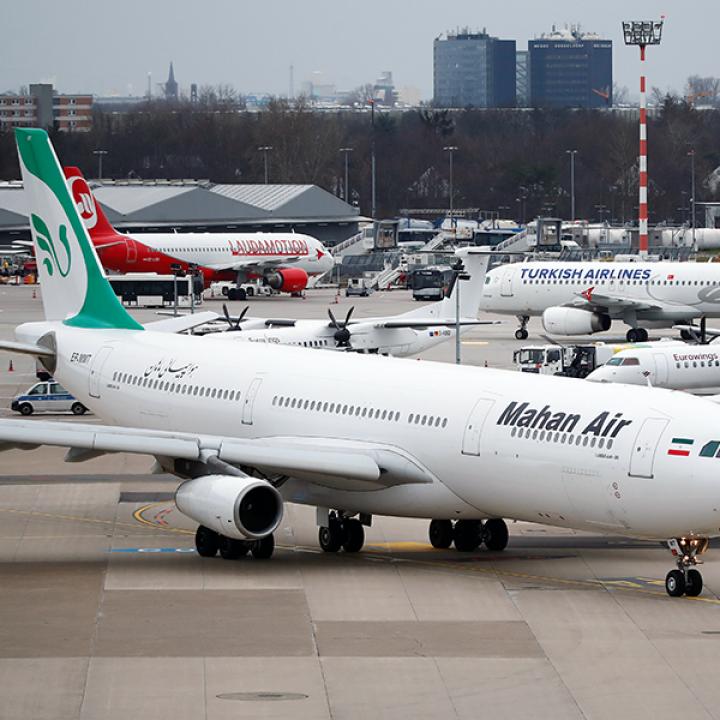
Ankara also seems to be taking some steps to deny Iranian access to its commercial airspace. On September 18, it announced the cessation of Mahan Air flights to Turkey due to U.S. sanctions concerns. The airline, one of Iran’s largest, is involved in smuggling for the IRGC. In addition, three Turkish airlines—the publicly owned, low-cost AJet, the privately owned Pegasus Air, and the flag carrier Turkish Airlines—reportedly canceled all flights to and from Iran until March 2027. (These flights still appear to be operating at the time of writing.) Turkish authorities also recently impounded an Iranian aircraft with unpaid operating debts, seizing the plane on September 28 after passengers boarded.
Around 50 to 100 flights travel weekly between Iran and Turkey, which is a destination for Iranian businesspeople and tourists as well as a hub for those continuing to other destinations. Perhaps more important, Iran receives cargo flights from Turkey (which can be used for smuggling), while the ability to fly over Turkish territory gives it physical access to otherwise inaccessible locations. If Ankara takes further steps to block Iranian access to its commercial airspace, this will have key ramifications for the regime’s domestic standing and ability to conduct illicit transactions.
The Big Picture: U.S.-Turkey Ties and Iran Sanctions
Ankara’s willingness to take initial steps in support of Operation Economic Outcast seems driven by several factors: its policy of positive engagement with the Trump administration; the chemistry between Presidents Erdogan and Trump; U.S. concessions to Turkey, such as the June agreement to settle the Halkbank case and drop the charges; and Ankara’s policy of leveraging the previous two dynamics to secure coveted U.S. F-35 fighter jets. It is not yet clear, however, whether these limited steps are sufficient for a tougher vigilance regime.
Another issue of concern is Turkey’s natural gas imports from Iran. As a G20 economy with no nuclear power or major hydrocarbon deposits, Turkey relies on large energy imports to fuel its growth. This includes last year’s purchase of 8.17 billion cubic meters of natural gas from Iran, equivalent to nearly 13 percent of its overall gas consumption. Washington is sensitive to this need and has avoided sanctioning Iran’s gas exports to Turkey; the occasional disruptions in that supply are mainly due to Iran’s struggles with internal distribution, not any U.S. restrictions. Yet the twenty-five-year Iran-Turkey gas deal expired in July, and both governments have been silent on whether a new deal is in process. According to a report in IranWire, “it remains unclear whether a clause permitting an automatic five-year extension has been triggered.”
Natural gas sales rely on long-term contracts and costly infrastructure that takes years to build. Even if Ankara wished to completely wean itself off Iranian supplies, it would not be able to do so overnight. Perhaps in order to signal good faith to Washington, it started buying large amounts of liquefied natural gas from the United States; in 2025, it imported 9.19 billion cubic meters, making it the largest European consumer of U.S. LNG.
Of course, Turkey is unlikely to ever cut economic ties to Iran completely, especially as some of their traded goods, such as food and medicine, are covered by U.S. sanctions waivers. This means that Turkish financial institutions and regulators will need to exercise heightened vigilance to make sure these ties are not abused.
U.S. Policy Recommendations
To help transform Turkey’s initial sanctions moves into a potentially wider and more effective strategic shift, Washington should use its positive dynamics with Ankara to seek deeper bilateral alignment on Iran policy. Three areas stand out as immediate priorities:
Ask Turkey to enforce a strict screening and inspection regime at the Iranian border. This would help prevent contraband from getting through, especially as pressure builds at congested crossings. In particular, Washington is concerned about Iran importing goods that could support its missile and drone forces. This should be the priority for Turkish monitoring.
Push Turkey to adopt a far more stringent approach to local Iranian banking activity. Turkey need not adhere to U.S. sanctions to make this change. As a member of the Financial Action Task Force, it is already operating under a request to “apply effective countermeasures on Iran,” which would include measures to prevent Iranian banks or virtual asset service providers from establishing subsidiaries and branches in Turkey. The last FATF mutual evaluation report for Turkey showed progress but also deficiencies, particularly in the implementation of measures to prevent sanctions evasion.
Intensify cooperation to shut down IRGC-related networks in Turkey. The IRGC and related groups have used Turkish territory to evade sanctions, support terrorist groups, and target dissidents. Expanded U.S.-Turkish collaboration to roll up those networks should be an element not only of Operation Economic Outcast, but also of the broader bilateral approach to countering threats from Iran.
Establish a high-level bilateral working group on diversifying Turkish natural gas imports. Although U.S. officials should avoid pushing Ankara to immediately stop importing Iranian gas, the two governments should form a working group on this issue as soon as possible.
More broadly, while seeking greater Turkish cooperation on a pressure strategy is important, Washington should keep in mind that this is probably not sufficient to change the overall financial picture for the Iranian regime. Other countries, especially China and the United Arab Emirates, are more significant economic partners for Iran. Nevertheless, an increased Turkish contribution to a sanctions pressure strategy would be meaningful.
Richard Nephew is the Bernstein Adjunct Fellow at The Washington Institute and former U.S. deputy special envoy for Iran. Soner Cagaptay is the Institute’s Beyer Family Senior Fellow and director of its Turkish Research Program.