- Policy Analysis
- PolicyWatch 4275
A Conversation with Samir Geagea: How to End Lebanon’s Cycle of War and Build a Sovereign State
A major Lebanese political leader explains why Beirut’s exaggerated fears of “civil war” with Hezbollah are no excuse for stalling efforts to confront the group and its Iranian patron.
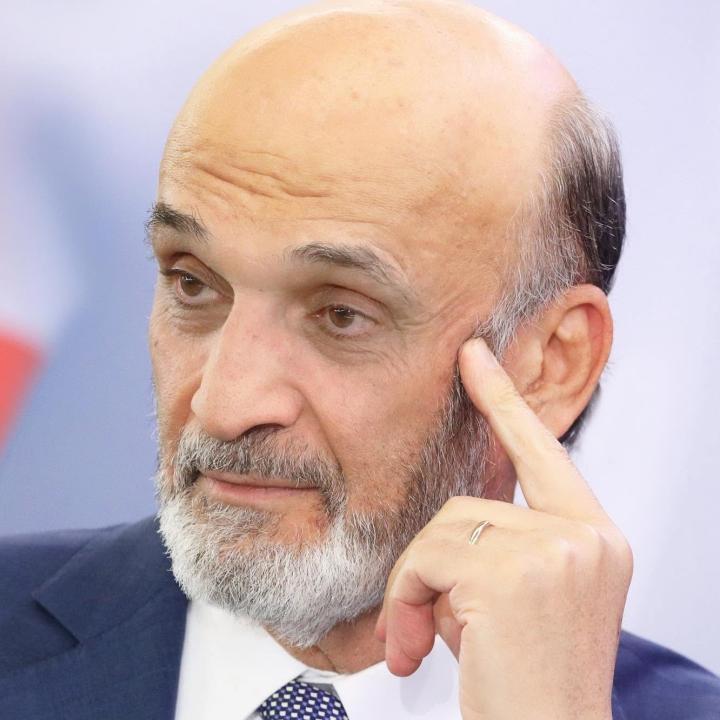
On October 6, The Washington Institute held a virtual Policy Forum with Samir Geagea, the leader of the Lebanese Forces party, a Christian faction with the largest contingent in the country’s parliament. The following is a rapporteur’s summary of his remarks, drawn from his opening presentation and subsequent question-and-answer session with Institute scholars Robert Satloff, Hanin Ghaddar, and David Schenker. For his verbatim remarks, use the event video player on this page.
On “Stockholm Syndrome” and the Deep State
Wars have long prevented Lebanon from taking advantage of opportunities to secure a peaceful future. However, the core problem today is Hezbollah, which maintains substantial influence over the state despite its reduced power and popularity, and which refuses to cooperate with the government’s decision to exert sovereignty nationwide and impose a monopoly on arms. After forty years living under Syrian occupation and Hezbollah domination, many government and security officials suffer from a Lebanese variety of Stockholm syndrome, making it difficult to imagine removing the group from politics and embracing the potential for state sovereignty.
Meanwhile, in the weeks since the Trilateral Framework with Israel was announced in June, a powerful deep state composed of Hezbollah sympathizers and old-time traditionalists—led by Speaker of Parliament Nabih Berri—has prevented Lebanon from meeting its commitments under that agreement, particularly its promise to disarm and dismantle the group. Just days ago, for example, the Lebanese Armed Forces (LAF) discovered and confiscated explosives along the eastern frontier, but they made no arrests, which shows a stunning lack of accountability.
The government’s inaction is often justified by fears of civil strife—even civil war—but these fears are exaggerated. It would not be “civil war” for any state to enforce its decisions on an outlaw organization; and in any case, the government can do what is necessary without resorting to armed confrontation with Hezbollah.
On Avoiding Urgent Decisions
Instead of moving ahead with the serious work of disarmament, many in Lebanon hope that the Hezbollah problem will be resolved through some other means, such as a U.S. agreement with Iran or further Israeli military action. Yet this is just avoiding reality—ultimately, the Lebanese government will have to do what is necessary to dismantle the group.
Likewise, some say that the LAF is not strong enough to disarm Hezbollah or lacks the resources to do the job effectively. This, too, is a mistake because the central issue is not lack of military strength, but institutional resistance and a lack of political will. Decisionmakers need to realize that approximately three-fourths of the Lebanese public supports the idea of disarming Hezbollah and ridding the country of Iran’s negative influence.
For these reasons, Beirut must purge the “deep state” from the bureaucracy, security apparatus, and LAF if it hopes to fulfill its commitments under the framework agreement. Weapons are only part of the problem—authorities must also dismantle Hezbollah’s key financial institution, al-Qard al-Hassan, which enables the group to provide services and essentially buy loyalty from a certain percentage of the Shia community. That percentage is shrinking, however.
On the Need for Tough Messages from Washington
The Trump administration needs to move beyond the niceties of diplomatic language and deliver tough messages to Beirut about implementing the framework agreement. This includes imposing conditionality on future aid to the LAF. A more blunt, forceful, and public approach is necessary to get results.
On the Politics of the Shia Community
If the next parliamentary election occurs as scheduled in May 2027, the Lebanese Forces party will support one or two Shia candidates who oppose Hezbollah. But it is important to realize that any Shia members of parliament elected thanks to Christian votes will likely lack credibility among the Shia community. The real political solution for Shia representation in Lebanon will come when Hezbollah is disarmed and dismantled.
On Hezbollah and the IRGC
It is a mistake to think of Hezbollah as a Lebanese actor—it is an arm of Iran’s Islamic Revolutionary Guard Corps. When Hezbollah was strong, it was roughly the equivalent of a division in the IRGC; now that it is weakened, it seems more like a regiment. Either way, no one should forget that its leadership is in Tehran, not Beirut.
For this reason, dismantling Hezbollah must be viewed as a Lebanese necessity, not a concession to Washington, Israel, or Arab states. Any idea of integrating the group into the LAF is not a real solution, since a loyal Lebanese soldier and a Hezbollah fighter hold irreconcilable worldviews.
On Israel-Lebanon Peace
The framework agreement calls for “full and lasting peace” between Lebanon and Israel, and this will eventually happen, but it will be a gradual, step-by-step process. The first step is to end decades of hostility between the two countries—a path toward which is provided in the agreement.
In this regard, there is some logic to the argument that Lebanese politicians need not fight the parliamentary battle over abolishing the anti-normalization laws that prohibit contact between Israeli and Lebanese citizens, since that outcome will eventually come to pass anyway with the success of the Trilateral Framework. The primary goal now is to work as hard as possible on implementing the framework, which begins with dismantling Hezbollah.
On What Should Follow UNIFIL
The only real impact of winding down the UN Interim Force in Lebanon is that it will cost about 500 local jobs in the south. Beyond that, it is hard to identify what UNIFIL has achieved over the past decade. The force certainly cannot be credited with preventing cross-border conflict or stopping Hezbollah from establishing military positions throughout the south.
Because of this record, the Lebanese Forces party did not sign the parliamentary petition asking to extend UNIFIL’s mandate. Once final arrangements take shape via implementation of the Trilateral Framework, there may be a need for some observers or other forces. But the Lebanese government should be focused on disarming and dismantling Hezbollah, not finding foreign forces to relieve it of its responsibility.
This summary was prepared by Virginia MacArthur, Fiona Hood, and Caelan Stewart. The Policy Forum series is made possible through the generosity of the Winkler Lowy Foundation.