- Policy Analysis
- PolicyWatch 4272
One Year After the Gaza Ceasefire (Part 2): How Hamas Has Kept Its Grip on Governance
Part of a series: One Year After the Gaza Ceasefire
or see Part 1: Chapeau: Assessing the Gaza Ceasefire, Year One
Despite relinquishing official authority, Hamas has maintained decentralized systems of governance and financing in Gaza and is attempting to expand its influence in the West Bank as well.
This PolicyWatch is part of a Washington Institute series analyzing the risks and opportunities in Gaza since the October 2025 ceasefire and offering recommendations for policymakers going forward. See the full series.
Over the past year, Hamas has reorganized itself and maintains effective civil and political control in the Gaza Strip, despite having relinquished formal governmental authority, and despite its military weakness. This PolicyWatch analyzes how the group has built a de facto decentralized government, enabling it to remain the dominant actor in Gaza and, increasingly, to influence the broader Palestinian arena.
From Formal to Informal Control
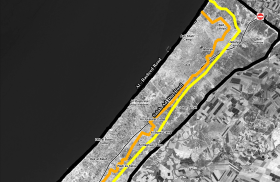
The October 2025 ceasefire created a new reality in Gaza: Hamas no longer holds formal governmental authority, yet it continues to exercise territorial control, albeit over less than 40 percent of the Strip. The group is significantly weaker militarily, but it compensates through its political and especially civil institutions.
Hamas’s agreement to formally relinquish governance, which in the West was viewed as a concession, has become an advantage. Instead of a weakened centralized government, it now operates a decentralized organizational structure. This reduces its exposure to Israeli military and intelligence pressure, international scrutiny, and direct accountability for administrative and civil failures, while allowing it to maintain political, economic, and social control through networks of influence rather than official institutions. This arrangement is also possible because there is no alternative government authority in Gaza, which reinforces public perceptions that Hamas is here to stay.
In July, Hamas formally dissolved its government and transferred authority to a Palestinian technocratic body known as the National Committee for the Administration of Gaza. Yet as described in the introductory essay of this series, the NCAG has been unable to take on these responsibilities because Israel insists that Hamas disarm first.
Clear distinctions have emerged between areas where Hamas maintains strong governance capacity and areas where its capacity has eroded. According to the private Israeli monitoring firm Nisaba, Gaza’s central districts have maintained basic bureaucratic continuity and operational capacity, while its northern and southern districts suffer from territorial fragmentation, administrative disconnection, and a sharp rise in clan conflicts and criminal activity. In these areas, there is almost no visible Hamas police presence. This has forced the group to rely on covert enforcement mechanisms such as Quwat al-Radaa, a clandestine internal deterrence and discipline unit that monitors dissent, suppresses criminal activity, and reasserts Hamas authority where formal policing has broken down.
In areas where higher levels of governance have been maintained, local civil servants affiliated with Hamas continue to administer basic services, including population registry functions, humanitarian aid distribution, management of essential municipal infrastructure, and limited local tax collection. However, these activities have been significantly reduced, and the focus now is primarily on essential services.
In addition, UN agencies and dozens of international NGOs are operating in Gaza, providing food assistance, medical services, water and sanitation support, and logistical coordination. Among the most prominent are the World Food Programme, UNICEF, World Health Organization, International Medical Corps, and World Central Kitchen.
During the war, Israel categorically rejected any form of civil coordination with Hamas and actively pushed back against humanitarian organizations that attempted to work with the group. This policy has shifted over the past year, however. With no functioning alternative governing authority, and with Israel preventing NCAG members from entering Gaza, Hamas has become the main actor able to provide access and maintain the administrative mechanisms and distribution channels required for humanitarian aid delivery. As a result, international organizations operating in Gaza now coordinate with Hamas, sometimes knowingly and sometimes with tacit Israeli acceptance. What was once treated as an unacceptable liability has become an operational necessity.
Hamas’s Informal Governance Model
Although Hamas no longer holds formal governmental authority, it continues to exercise control through a variety of mechanisms:
Order through managed chaos. Rising crime—murders, theft, looting, and drug-related activity—is causing deep insecurity for Gaza’s population. Hamas does not respond to crime so much as manage it. According to recent UN reports, it has allowed certain criminal groups to operate in specific areas to weaken rival clans and present itself as the only actor capable of restoring order. Crime thus becomes a tool of governance: Hamas generates controlled chaos, then offers partial order on its terms.
Economic control, with scarcity as a governance tool. Over the past year, Hamas has significantly reshaped its revenue structure. According to recent analysis by the Israel-based institute Mitvim, the group’s primary source of income now derives from direct control over the import of emergency aid and commercial goods entering Gaza. It imposes heavy taxes on goods brought in by private traders, who have accounted for 20-30 percent of all cargo entering the Strip since the ceasefire. To illustrate the scale, between 500 and 600 trucks enter Gaza each day. The tax rate imposed by Hamas ranges from 15 to 25 percent of the value of the goods, with the average tax per truck estimated at more than $15,000. In addition, Hamas seizes portions of the international aid shipments entering Gaza and sells the goods at high market prices, while also generating substantial profits from fuel brought in by aid organizations for special needs and resold at elevated prices. Total daily revenues from these activities exceed $2 million.
Hamas operates an extensive smuggling network for prohibited goods as well, particularly cigarettes and various dual‑use materials. It charges high fees on money transfers conducted through local digital payment applications, with commissions sometimes reaching 40 percent. Because cash has become a scarce commodity in Gaza—due to the collapse of banking services, restrictions on currency flows, and growing reliance on digital payments—a large share of transactions now takes place through these local apps, enabling Hamas to expand its fee‑collection mechanisms and tighten its control over financial flows. In parallel, Hamas has renewed the transfer of funds from international charity networks using traditional mechanisms like hawala, which are difficult to track electronically and are operated by Hamas supporters abroad.
This economic control is reinforced by civil governance and international aid. Hamas continues to pay salaries to tens of thousands of “government” employees, regulate economic activity in the areas under its control, and operate policing mechanisms and other enforcement networks. These practices create direct public dependence on its governing structures and strengthen its economic and civil grip. Moreover, aid organizations increasingly rely on intermediaries linked to Hamas to distribute food, medical supplies, and shelter materials in areas where no alternative authority exists. This dependency enables Hamas to determine which communities receive assistance first, which clans gain access to scarce resources, and which local actors are rewarded or punished. Humanitarian aid thus becomes part of Hamas’s broader resource‑allocation strategy, deepening public dependence and strengthening its influence over civil affairs.
Digital control, with a decentralized virtual administration. After parts of Gaza’s governmental infrastructure collapsed, Hamas developed a decentralized digital governance system based on informal communication networks. Through closed Telegram and WhatsApp groups, encrypted distribution channels, and online coordination mechanisms, Hamas manages civilian life without a continuous physical presence, largely relying on public fear to ensure compliance. These networks coordinate the entry of goods, tax collection, public messaging, and clan dispute resolution in areas where visible governance has eroded.
Penetration of civil institutions without formal authority. Relinquishing formal governmental authority has not entailed relinquishing control over government institutions. By infiltrating loyal appointees and clan‑based intermediaries in these institutions, Hamas is able to influence municipalities, planning committees, water and electricity distribution, commercial licensing, and more. In the education system—much of which is now improvised due to the war—Hamas influences appointments and content through social media and local brokers.
Political engagement with rivals and partners. Hamas recently held a series of meetings in Egypt with various Palestinian groups, most prominently Mohammad Dahlan’s Democratic Reform Current. The goal was to build a “national alliance” ahead of planned November elections for the Palestinian Legislative Council and institutions of the Palestine Liberation Organization. So far, these alliances appear to be tactical rather than ideological, aimed at creating a political presence independent of the Palestinian Authority. As such, these discussions weaken the PA and help Hamas maintain political relevance, positioning the group as an indispensable actor in any future Palestinian political arrangement.
Expanding Influence in the West Bank
Recent developments in the West Bank—from rising violence by extremist settlers to land seizures and urban changes—have become assets for Hamas, which consistently frames itself as the defender of Palestinians and the authentic representative of “resistance,” in contrast to the PA. Every incident is rapidly transformed into videos, statements, sermons, and calls to action distributed online, in mosques, and through clans. In addition, Hamas has been:
- building religious‑social infrastructure in the West Bank (mosques, charities, study circles, universities);
- exploiting the PA’s legitimacy crisis, especially in places where its security forces are seen as cooperating with Israel;
- linking two Palestinian narratives that have become increasingly widespread over the past year: “Gaza’s endurance” and “the West Bank is under attack.”
Conclusion
One year after the ceasefire, Hamas has reorganized itself and maintains effective civil control in Gaza. It has rebuilt key levers of power—economic, social, security, and digital—and implemented a decentralized governance model that enables it to manage daily life in the Strip without a formal government. It has also preserved deep public dependency by controlling scarce resources, applying various enforcement methods, infiltrating institutions, and presenting itself as the only actor capable of providing basic services and maintaining order. This has been possible because Gaza lacks a functioning alternative governing authority.
If the United States and Israel hope to stem this worsening problem in Gaza and its spillover effects in the West Bank, a genuine alternative governing structure must be established in the Strip—one capable of dismantling Hamas’s mechanisms of control and reducing public dependency on the movement. This requires empowering the NCAG, reversing Hamas’s infiltration of civil institutions, creating aid distribution and movement mechanisms not dependent on Hamas, relocating populations from Hamas‑controlled areas, and taking steps to dry up the group’s revenue streams. Every policy for Gaza must also be evaluated by its impact on the broader Palestinian arena, particularly in preventing Hamas’s entrenchment in the West Bank.
Neomi Neumann is an adjunct fellow with The Washington Institute, focusing on Palestinian affairs. Her previous positions include head of the research unit at the Israel Security Agency.