Dennis Ross, a former special assistant to President Barack Obama, is the counselor and William Davidson Distinguished Fellow at The Washington Institute.
Two former senior U.S. officials look back at what the ceasefire has produced—and failed to produce—in its first year of implementation, focusing on the underused leverage provided by the July 30 “roadmap” agreement with Hamas.
This essay serves as an introduction to a special Washington Institute series analyzing the risks and opportunities in Gaza since the October 2025 ceasefire and offering recommendations for policymakers going forward. New contributions will appear on the series hub page as they are published throughout this week.
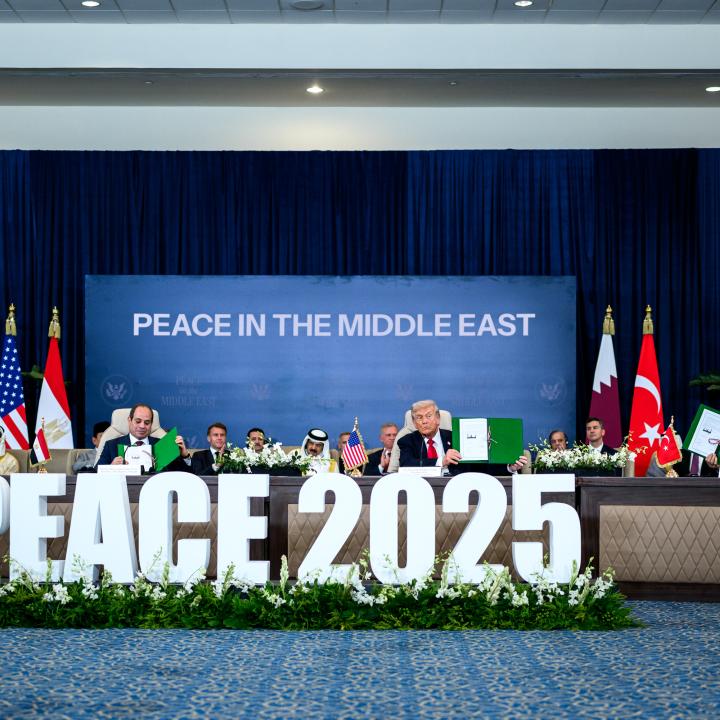
On September 29, 2025, President Trump unveiled his twenty-point plan to end the Gaza war. Ten days later, he announced that Israel and Hamas had “signed off on the first phase.” A year later, the plan retains its promise but remains far from full implementation. If carried out, it could transform the Gaza Strip and restore hope for a different Israeli-Palestinian future. For now, however, both the twenty points and the more recently negotiated implementation roadmap remain largely paper exercises. If President Trump wants his plan to succeed, he will need to invest much more political and diplomatic capital.
Early Achievements, Then Deadlock
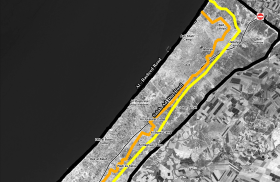
The ceasefire plan cannot be judged solely by the gap between promise and delivery. Soon after it was signed, twenty living Israeli hostages were returned home, along with the bodies of twenty-eight others. Israel released 250 Palestinian prisoners serving life sentences and another 1,700 Gazans detained after October 7. Humanitarian assistance increased to 4,200 trucks per week. And the Israel Defense Forces (IDF) withdrew to a new “Yellow Line” separating the heavily populated coastal areas still under Hamas control and the remainder of Gaza controlled by Israel.
Meanwhile, the U.S.-led Board of Peace (BoP) was established as the primary mechanism for overseeing and expediting implementation of the rest of the plan—raising reconstruction money; mobilizing contributors to the proposed International Stabilization Force (ISF); making sure Palestinian police are recruited, vetted, and trained; and helping the technocratic National Committee for the Administration of Gaza (NCAG) move into Gaza and begin governing. The BoP was also intended to address the various political obstacles that could delay the above tasks, and to ensure that the plan’s basic formula—Hamas demilitarization in exchange for Gaza reconstruction and Israeli withdrawal—is realized. The sequencing was clear: the board would convince Hamas to fulfill its obligations on turning over its weapons, and this in turn would set other phases of the deal in motion.
Some of these elements have been achieved in form, if not yet in substance. The fifteen Palestinian technocrats who make up the NCAG began developing plans for administering Gaza during the transition period. UN Security Council Resolution 2803 endorsed the BoP, its authority to oversee the NCAG, and the twenty-point plan, endowing them with international authority. The BoP then appointed Nickolay Mladenov—an experienced diplomat who knows the region, its players, and its problems extremely well—as high representative to work with the NCAG.
Once the technocratic committee enters Gaza, its first role will be to restore basic services and begin providing interim housing before full reconstruction. Yet many Gazans are still living in rodent-infested tents amid sewage and devastation. So long as this crucial restoration process remains open-ended—with no major improvements in sight and no clear timetable for the NCAG’s arrival—the committee will be unable to build its legitimacy or erode Hamas’s control. On September 23, the BoP unveiled a $2.45 billion plan to support this process, setting forth a six-month timetable focusing on shelter, water, hospitals, schools, power, roads, and jobs. Yet the board also admitted that it needs more funding to implement this plan.
The gap between aspiration and reality is clearest when looking at the security challenge. While Albania, Kosovo, Morocco, and possibly other countries have agreed to contribute to the ISF, the stabilization force is still far from actually deploying in Gaza. Similarly, officials aim to form a 16,000-member Palestinian police force trained in Egypt, but implementation has been delayed. Cairo argues that it cannot conduct further training until Israel guarantees that new police cadets will be allowed to return to Gaza, while NCAG members are still stuck in Egypt as well—unable to enter the territory they are supposed to administer until sufficient numbers of police are trained and the decommissioning of Hamas weapons has begun.
As a result, Hamas remains Gaza’s only functioning government one year after the ceasefire. Its members are still armed, it still controls roughly 40 percent of Gaza, and nearly all of the territory’s population still resides in its area of control after wartime displacements. The NCAG can hardly fulfill its role of replacing Hamas rule until it is adequately protected, but that requires a reliable Palestinian police force backed by the ISF.
This interdependence between highly sequenced steps explains the present paralysis. NCAG cannot replace Hamas until security exists; security cannot be established until Hamas weapons are decommissioned; decommissioning will not occur until verification and consequences for cheating have been worked out; and reconstruction will not be funded until these other processes are verifiably in motion. The lesson for U.S. and allied officials is clear—the Trump plan’s parts cannot be implemented independently; each component must move in a carefully calibrated process backed by sustained American leverage.
The July Roadmap: Breakthrough or Paper Deal?
On July 30, after months of talks, the BoP announced an agreement with Hamas on a roadmap for implementing the Trump plan. Negotiated by board members from the United States, Turkey, Egypt, and Qatar, the roadmap flows from the core principle that reconstruction and Israeli withdrawal cannot happen until Hamas’s weapons have been decommissioned. Indeed, no country will invest billions in rebuilding Gaza if it remains militarized and almost certain to explode again.
The roadmap approaches the thorny challenge of decommissioning by dividing the Hamas-controlled portion of Gaza into five zones beginning in the north and south and progressing toward the center, each with a distinct timeline. Weapons are to be turned over to Palestinian police backed by the ISF, in a process monitored by a verification mechanism to ensure compliance. After that, the NCAG and additional Palestinian police are to enter the cleared zone, and Israel is to withdraw. Once all five zones are demilitarized, the IDF will be expected to pull back to a narrow perimeter inside Gaza, with the ISF positioning itself between NCAG-administered territory and Israel.
This approach is intended to make compliance measurable rather than merely rhetorical, enabling the BoP to verify that Hamas is fulfilling its commitment to surrender weapons one zone at a time—the prerequisite for Israel to pull back zone by zone. (The exact scope of each phased Israeli redeployment has not yet been clarified, but the initial withdrawals will begin in the areas right outside Gaza’s main urban zones and proceed gradually toward areas closer to the border with Israel.) Rather than gambling on an all-or-nothing effort, the parties can use success in the first zone to build confidence and momentum. Any violations would be identifiable, giving Washington and the BoP grounds for assigning responsibility rather than simply watching the parties trade accusations. Toward that end, the board plans to establish an international verification committee composed solely of BoP members; this body will be responsible for monitoring and verifying compliance with the decommissioning campaign.
Decommissioning is essential not just to permit reconstruction and Israeli withdrawal, but to prevent Hamas from continuing to intimidate the people of Gaza. It is also the first step in the territory’s wider demilitarization—meaning the destruction of Hamas’s residual tunnel infrastructure, weapons depots, and production facilities.
On paper, Hamas leaders accepted the idea of weapons decommissioning by agreeing to the roadmap. Some BoP officials attributed this decision to the fact that negotiators presented Hamas with a unified front, preventing the group from exploiting any differences among them.
As the parties consider how best to actually implement this plan, the board must ensure that all decommissioned weapons are kept beyond Hamas’s ability to reclaim them. Knowing Israel’s deep skepticism about Hamas’s intentions, BoP officials have noted that the decommissioning process will include steps to immediately render weapons inoperable once they are turned in.
Clearly defining weapon categories is crucial as well. During the negotiations, Hamas seemed ready to turn over heavy military weapons such as missiles, mortars, and crew-served machine guns. Yet the board made clear that the roadmap’s decommissioning process will also include rifles, citing Palestinian Authority law prohibiting individuals from possessing such weapons. Allowing Hamas to retain rifles would leave it with a potent tool for continuing to coerce the population, suppress rivals, control aid deliveries, and otherwise foil the NCAG’s efforts to establish control. Hence, the BoP is correct in insisting that the decommissioning process address more than just heavy weapons capable of striking Israel.
Why the Process Has Not Begun
Serious questions remain about the viability of the decommissioning plan. Many of Hamas’s remaining weapons are hidden in tunnels—will it provide the board with a complete map of those tunnels, and will it actually surrender the core of its arsenal when the time comes? U.S. envoy Jared Kushner has told the group that any cheating will stop the process and invite Israeli military action. Another complication is Hamas’s demand that authorities also confiscate the weapons that Israel distributed to rival Palestinian clans.
Moreover, the previously described sequencing dilemma persists—decommissioning cannot begin without the presence of a Palestinian police force backed by the ISF. Israel agreed in principle to Egypt training an initial batch of 5,000 Palestinian police officers, and some of these personnel have completed their training. Yet Prime Minister Binyamin Netanyahu’s government has not allowed these vetted graduates to return to Gaza, nor permitted any new candidates to enter Egypt for training.
When President Trump announced the July 30 agreement, he stated that Israel was happy with it, but that has proven incorrect. Netanyahu publicly rejected the roadmap on August 9—his political base opposed it, and with an election approaching, he was unwilling to appear soft on Hamas given broad public distrust that the group would actually disarm. As such, he told the BoP that he could not facilitate police training at this time, apparently fearing that far-right rivals would use it against him. Board officials now seem to be waiting until after Israel’s October 27 election to begin implementation.
Yet previous delays have given Israel excuses not to act on its commitments. For example, since the IDF’s initial withdrawal from certain parts of Gaza, it has expanded its presence from roughly half of the territory to more than 60 percent. Additionally, it was supposed to reopen the Rafah crossing but has not, and some of the equipment needed to remove rubble and clear roads has been barred from entering. The election cycle has also led Israel to block projects called for in the Trump plan, such as scaled-up assistance and construction in areas outside of Hamas control (e.g., an Emirati-funded housing project for 50,000 displaced Palestinians near Rafah and the Yellow Line). Moreover, Israel resumed military strikes after pausing them in early August, even though the July 30roadmap called for a halt to all such operations.
That led Mladenov to air his frustrations during a UN Security Council meeting on August 26: “After three years of war and twenty years of military operations, I ask, will another strike on a munitions depot stop Hamas from rearming or tightening its grip on Gaza? It will not. It only delays the demilitarization that would happen, and it obstructs the civilian transition that should take place to ensure that remilitarization will not be possible in the future.”In his view,Israel is missing the bigger picture. He was not saying that Israelis should trust Hamas. Rather, he was saying that the roadmap offers a means of putting Hamas to the test and potentially demilitarizing Gaza, while IDF strikes cannot achieve either goal.
Indeed, that is the roadmap’s main value: substituting verification for trust and making Israeli steps conditional on proven Hamas performance. By permitting authorities to train more Palestinian police and deploy them into the first proposed zone, Israel would preserve its security requirements while forcing Hamas to choose between verifiable disarmament and exposure as the party blocking reconstruction. The police would need at least some degree of ISF support in this effort, both to backstop them psychologically and for deterrence reasons (though ISF contingents are not going to fight Hamas). The IDF would then pull back to an established perimeter just inside of Gaza. Yet Netanyahu’s refusal to even begin this process forfeits the potential diplomatic advantage, keeping the onus on Israel when it should be on Hamas.
David Makovsky is the Ziegler Distinguished Fellow at The Washington Institute, director of its Project on Arab-Israel Relations, and host of the podcast Decision Points. Dennis Ross, the Institute’s counselor and Davidson Distinguished Fellow, formerly served as a senior U.S. official in the Reagan, Bush, Clinton, and Obama administrations.