David Makovsky is the Ziegler Distinguished Fellow at The Washington Institute and director of the Project on Arab-Israel Relations.
Articles & Testimony
The success of his latest trip should be measured by whether he can expedite preparations for practical issues like policing and weapons collection so that the Gaza transition plan remains viable after Israel’s election.
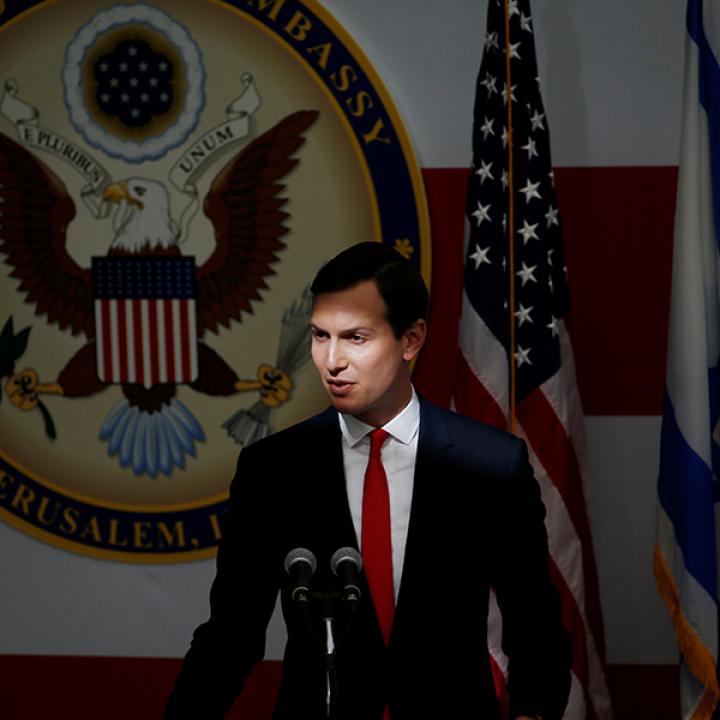
Jared Kushner, US President Donald Trump’s Middle East envoy and son-in-law, is making his first trip to Israel since January, where he is expected to focus on what increasingly seems like the forgotten front: Gaza. The visit matters precisely because President Trump has been largely silent about Gaza since the ceasefire took effect almost a year ago.
The immediate backdrop is the prospect of Hamas disarmament raised by the Board of Peace in its 15-point roadmap on July 30. The announcement suggested an opening, but an opening is not a plan.
The real test of Kushner’s trip is whether he can convert this first tentative opening on Hamas disarmament into the practical architecture needed to make disarmament real.
Expectations are low. Many believe Hamas will never truly disarm, since armed struggle is central to its identity; at most, they expect rhetorical concessions designed to buy time. Israel is also in an election season, and Prime Minister Benjamin Netanyahu is making clear he is unlikely to defy his political base before Israelis vote on October 27. No comprehensive plan is expected before then.
That is precisely why the building blocks need to be put in place now. Kushner’s trip should be measured by whether he can assemble them so something actionable remains after the election.
Kushner’s visit also demonstrates that the United States still cares about the Gaza ceasefire. Some will view Trump’s silence as indifference or distraction amid the Iran conflict; others as recognition that little can be achieved before Israel’s election. But in the Middle East, time rarely stands still. Without sustained American involvement, the tentative promise of July 30 can dissipate, and a fragile ceasefire unravel.
Netanyahu has not walked back his commitment to Trump to avoid major strikes in Gaza unless Israeli soldiers’ lives are threatened. Yet that commitment was conspicuously absent when Netanyahu recently circulated a video declaring that Israel would not withdraw from the Yellow Line—the area where Israeli forces are currently positioned—until Hamas completely disarms. Washington therefore cannot assume Israeli restraint will continue indefinitely.
Two issues should be high on Kushner’s agenda. The first is the Palestinian police force intended to provide security in postwar Gaza. They cannot credibly collect Hamas weapons without training.
Some 5,000 Palestinian police officers are slated to receive training in Egypt, which has prepared interior ministry facilities for that purpose. Israel has vetted the proposed officers for security concerns but has yet to assure Egypt that they will be permitted to return to Gaza once their training is completed. The process has therefore stalled.
That gap needs to be closed. According to media reports, Kushner will also visit Egypt. One practical deliverable should be to finalize the arrangements, begin training and set a timetable for deploying the force back into Gaza. A postwar security structure cannot be built around police officers who exist only on paper. Progress would also allow Kushner to reassure the Palestinian technocrats of the National Committee for the Administration of Gaza, or NCAG, whom he will reportedly meet in Cairo, that Washington is committed to giving them the means to govern.
The second issue is what happens to Hamas’s weapons once they are collected. Any emerging arrangement will depend on whether the NCAG—and its still-untrained police—can securely collect and dispose of Hamas weapons. Transferring guns from fighters to warehouses inside Gaza is not enough.
The danger is obvious: What prevents Hamas, once it has regrouped and reconstituted, from raiding weapons depots and reclaiming the arms it surrendered? Some argue Hamas is financially exhausted and cannot afford an indefinite confrontation. Perhaps. But no strategy should rest on the assumption that an organization for which armed struggle has been central to its identity will permanently abandon violence merely because it is temporarily weakened.
Yes, Hamas leader Khalil al-Haya waited until the group’s internal elections were completed in July before greenlighting the Board of Peace statement, and Hamas may now be on a charm offensive, with figures suggesting it could play by political rules by joining the PLO. Yet we have heard such hints before, to no avail.
Kushner should therefore seek clear understandings about both the scope of weapons collection and what happens afterward. Hamas certainly does not want to hand its arsenal directly to Israel, which it would portray as abject surrender. But Washington should be equally wary of the opposite danger: a largely symbolic decommissioning process, allowing Hamas to claim compliance while preserving the ability to rearm.
The standard should be straightforward: decommissioning must be genuine, verifiable and irreversible. Weapons could be destroyed under international supervision. Alternatively, Egypt or members of the International Stabilization Force, such as Morocco, could remove them from Gaza. The mechanism matters less than the principle: Hamas cannot retain physical control or an easy path to recovering the weapons.
Kushner’s trip, therefore, should be about more than demonstrating American attention. It should begin turning the ceasefire’s broad understandings into concrete arrangements. Who collects the weapons? Who verifies what has been surrendered? Where are the weapons stored—or destroyed? Who ensures Hamas cannot reclaim them? And what are the consequences if Hamas refuses to comply?
Without answers, the ceasefire risks becoming an extended pause rather than a transition to something more durable. The alternatives are hardly attractive: renewed fighting or a Gaza in which Hamas retains its arsenal and the ability to threaten another war.
Nobody has gone broke being pessimistic about Hamas’s intentions. Still, testing whether a genuine, verifiable path to disarmament exists—with minimal Israeli security risk as Israel considers major further withdrawals from Gaza—is preferable to simply assuming that it does not.
Trump may be relatively quiet about Gaza today. But if the ceasefire unravels, he is unlikely to remain so. Ending the Gaza war is one of his signature foreign-policy achievements. Whether it becomes the foundation for a different future for Gaza—or merely an intermission before another war—will depend on what happens next.
Kushner’s task is to ensure that the time between now and Israel’s election is used to build the architecture for what comes afterward, rather than allowing time to become the enemy of the ceasefire his father-in-law brokered.
David Makovsky is the Ziegler Distinguished Fellow at The Washington Institute, director of its Project on Arab-Israel Relations, and host of the podcast Decision Points. This article was originally published on the Times of Israel website.