- Policy Analysis
- PolicyWatch 4248
Hamas Accepts the Gaza Roadmap: Political Breakthrough, Implementation Uncertainty
Despite the group’s assent, major gaps remain with Israel over sequencing, disarmament, and oversight, casting doubt on the agreement’s feasibility.
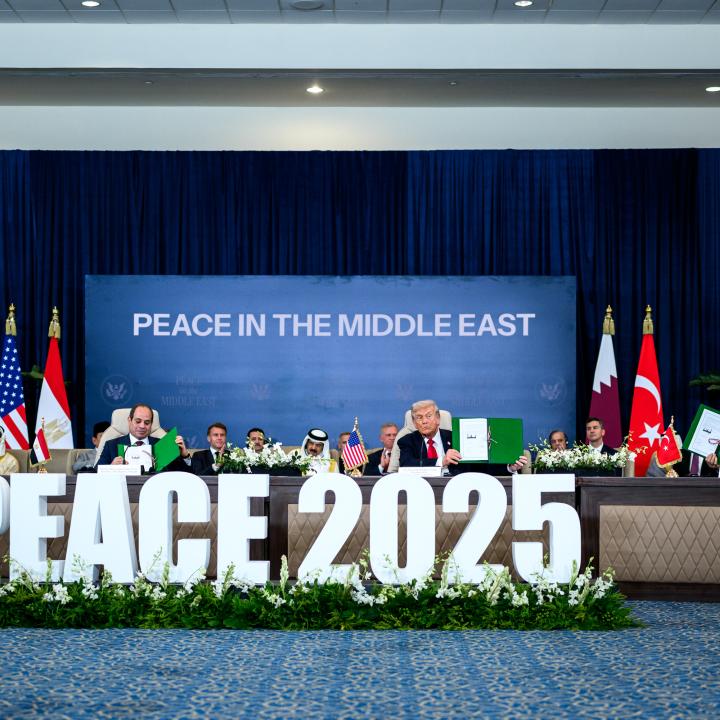
Hamas’s acceptance of the Gaza roadmap may not be a “monumental” event, as President Trump described it, yet it is undeniably a significant development. Presented by UN High Representative Nickolay Mladenov, the roadmap offers a plan for implementing the second phase of the Trump administration’s Gaza peace plan. For the first time, Hamas has formally and explicitly agreed to a process that is meant to culminate in its full disarmament within three years—and even earlier in the transfer of all governing, civil, and security authority to a technocratic Palestinian body, the National Committee for the Administration of Gaza (NCAG), with no Hamas representation.
Why Did Hamas Finally Accept a Deal?
The group’s decision followed nearly ten months of negotiations and appears to stem from several cumulative pressures. First, sustained Israeli military pressure eroded Hamas’s territorial control and inflicted continuous losses on its operatives. According to most assessments, its area of control shrank from roughly 47 percent of Gaza in October 2025 to approximately 36 percent today.
Second, Turkey and Qatar, which are both close to Hamas, applied political pressure on the group in order to demonstrate their value to the Trump administration and stabilize the broader regional situation. They also appear intent on preserving a pathway for Hamas to transition into a “legitimate” political actor rather than remaining solely an armed movement.
Third, recent leadership changes in Hamas culminated in Khalil al‑Hayya’s rise to power. This has provided the internal legitimacy needed to accept the roadmap.
Fourth, preparations have begun for legislative elections to be held this fall. This created an incentive for Hamas to reenter formal Palestinian politics through institutional channels.
Implementation Obstacles
Despite these drivers, Hamas is not in deep crisis or acting from a position of strategic desperation. On the contrary, it is already signaling its intention to fight over the agreement’s wording, particularly regarding disarmament and proposed linkage between Israeli and Hamas obligations. Tough, prolonged negotiations are therefore expected—not only during the fourteen days allotted for finalizing the text after Israel’s initial approval, but throughout the entire implementation period. According to various reports, the disarmament phase alone is expected to last roughly eight months, during which disagreements over definitions, sequencing, and verification are likely to intensify.
Immediately after reports of Hamas’s acceptance, the U.S.-led Board of Peace and the mediating states—Egypt, Turkey, and Qatar—condemned increased Israeli strikes in Gaza. Mladenov framed these strikes as an obstacle to negotiations, and mediators said they were a violation of Israel’s commitments under phase 1 of the Trump plan.
Beyond general references to ongoing security needs, the Israel Defense Forces provided no public information about the timing or nature of the threat that justified its latest operations, which allowed critics to portray the strikes as politically motivated or harmful to the diplomatic process. A recent Israeli cabinet decision instructed the IDF to scale back offensive activity in Gaza to allow for progress on phase 2. This was not a ceasefire but a change in the decisionmaking mechanism. Any offensive action now requires approval from the chief of staff—a limited adjustment that was made at Mladenov’s request during an August 3 meeting with Prime Minister Binyamin Netanyahu and was intended to facilitate the diplomatic process.
Israel is unlikely to formally limit its freedom of operation, viewing military pressure as an essential means of influencing Hamas’s negotiating posture. Still, Jerusalem will need to focus on immediate threats only and reduce nonessential strikes to preserve diplomatic momentum and maintain coordination with Washington.
Regarding Israeli withdrawals, Jerusalem’s objections to language in the original roadmap led to a significant change in the Board of Peace’s position. The initial document implied that Israeli withdrawal and Hamas disarmament would occur in parallel. Following the Mladenov-Netanyahu meeting, the board shifted toward Israel’s preferred sequencing by clarifying that withdrawal from the Yellow Line—the 2025 ceasefire boundary—would occur only after verified disarmament. In addition, the board avoided repeating the previous commitment to a “full withdrawal,” effectively adopting Israel’s interpretation that the process would end with a security perimeter near the border. Jerusalem and Washington have been coordinating on this issue, and there is still room for different scenarios to unfold: a withdrawal from the Orange Line, where Israeli forces are currently deployed; a return to the Yellow Line; or, at minimum, reliance on a recently completed IDF ground barrier that lies between these two lines. In any of these scenarios, Palestinian authorities will be expected to implement their obligations under the roadmap in parallel.
Disarmament is likely to be the central point of contention. The roadmap uses the term “decommissioning,” which Hamas interprets as controlled storage of weapons inside Gaza, while Israel insists on physical removal from the territory. The roadmap does not define what constitutes prohibited weapons, whether personal firearms will be permitted, who can carry them and under what conditions, or what effective oversight will look like. Under Palestinian law, “personal weapons” refers exclusively to licensed handguns—not weapons held by members of terrorist organizations such as rocket-propelled grenades, Kalashnikovs, or other assault rifles. Mladenov likely relied on this legal definition in shaping the board’s position, yet the clause is ambiguous. Officials must clarify it to prevent Hamas from interpreting the wording too broadly or attempting to preserve its military capabilities while claiming it is simply maintaining “personal weapons.”
For its part, Israel will need to set clear red lines on disarmament to keep the group from maintaining such capabilities. This includes establishing a precise definition of “decommissioning,” a prohibition on storing weapons inside Gaza, and clear criteria for effective verification. As things currently stand, Israel Security Agency chief David Zini has warned the cabinet that Hamas’s agreement to proceed with the disarmament agreement may just be a “trap.”
Additional disputes are expected to occur over the dismantling of tunnels, weapon production sites, and militia infrastructure—not just those belonging to Hamas, but also those belonging to militias operating in Gaza under Israeli auspices. The roadmap does not specify how the latter groups will be handled or who will supervise their disarmament.
Another major practical obstacle is the absence of a functioning civilian security mechanism in Gaza. There is no police force, and the proposed International Stabilization Force and NCAG security arm have not yet been formed. Without such forces, implementing the roadmap is not feasible. The board should prioritize funding and building a functioning civilian security mechanism, and Israel should not prevent it from doing so.
In addition, there is a significant disconnect between high‑level board policy and the work of the Civil-Military Coordination Center, which has been largely paralyzed since the Iran war erupted. Without a coordination mechanism, even small‑scale civilian projects remain frozen, and there is a risk that the roadmap will remain purely theoretical.
What to Do Next?
To address these gaps, Israel needs to conduct consistent and firm negotiations with the Board of Peace, leveraging the flexibility already achieved on sequencing and pushing to further anchor its positions—all while maintaining stable relations with Washington. This entails sharing relevant public and classified information whenever Washington raises concerns about Hamas activities or Israeli actions that may affect the roadmap.
Notably, the roadmap focuses exclusively on Gaza and makes no reference to the West Bank. This means that Hamas could encourage or finance violence in that territory without formally violating the agreement. To prevent the West Bank from becoming Hamas’s next arena of conflict, there must be a clear U.S.-Israeli understanding that any Hamas‑linked terrorism there would constitute a direct violation of the roadmap—with no interpretive ambiguity.
In the Palestinian political arena, top figure Mohammad Dahlan was among the first to welcome the roadmap and even hinted that he had been involved in the negotiations. He has also reportedly been in direct communication with U.S. envoy Jared Kushner, which may influence how the Trump administration interprets the roadmap going forward. Dahlan emphasized that Palestinians expect the administration to ensure that Israel halts strikes in Gaza in order to enable reconstruction and political progress.
In addition, Dahlan has recently shown great interest in holding elections for the Palestinian Legislative Council. These are currently scheduled to take place in November, and his associates are apparently taking significant steps to organize campaign efforts and mobilize voters. He may even be coordinating on this issue with Hamas, which in principle does not reject the idea of elections.
Successful implementation of the roadmap could create the conditions for holding these elections in November as planned, in both Gaza and the West Bank. Yet Israeli objections on certain electoral issues—for example, to voting by East Jerusalem residents—could become the principal obstacle to advancing a process that some would say is essential to broader Palestinian Authority reform efforts. As the prospects of advancing phase 2 of the Trump plan increase, it is important for Israel to coordinate its position on such issues with relevant regional and international actors, especially the United States. This includes agreeing on clear conditions for holding elections and addressing the sensitive matter of East Jerusalem voting.
Indeed, Israel will need to shape its policies toward the roadmap process carefully. It must avoid appearing to undermine an initiative in which the U.S. president has invested significant political capital, while preventing Hamas from retaining military or political leverage. At the same time, if Washington wants the plan to succeed, it will need to clarify its vision of Hamas’s political future after disarmament—if, in fact, disarmament takes place. The current ambiguity on key issues has enabled regional actors to advance differing, sometimes conflicting, interpretations. Although Turkey and Qatar may continue to play diplomatic roles in the process, their involvement in on‑the‑ground monitoring mechanisms should be limited to avoid providing Hamas with additional room to maneuver. Ultimately, the success or failure of the roadmap will depend on whether Israel and the United States can create an implementation framework that does not legitimize or empower Hamas, but instead strengthens Palestinian governance and accountability while contributing to long‑term regional stability.
Neomi Neumann is an adjunct fellow with The Washington Institute, focusing on Palestinian affairs. Her previous positions include head of the research unit at the Israel Security Agency.