Grant Rumley is the Meisel Senior Fellow and Director of the Diane and Guilford Glazer Foundation Program on Great Power Competition and the Middle East at the Washington Institute for Near East Policy.
Elizabeth Dent is the Nathan and Esther K. Wagner Senior Fellow at the Washington Institute for Near East Policy, where she focuses on U.S. foreign and defense policy toward the Gulf states, Iraq, and Syria.
Brief Analysis
Washington should use this summit to convince China to put more pressure on Iran and establish safeguards on AI, but without conceding on other critical issues like Taiwan.
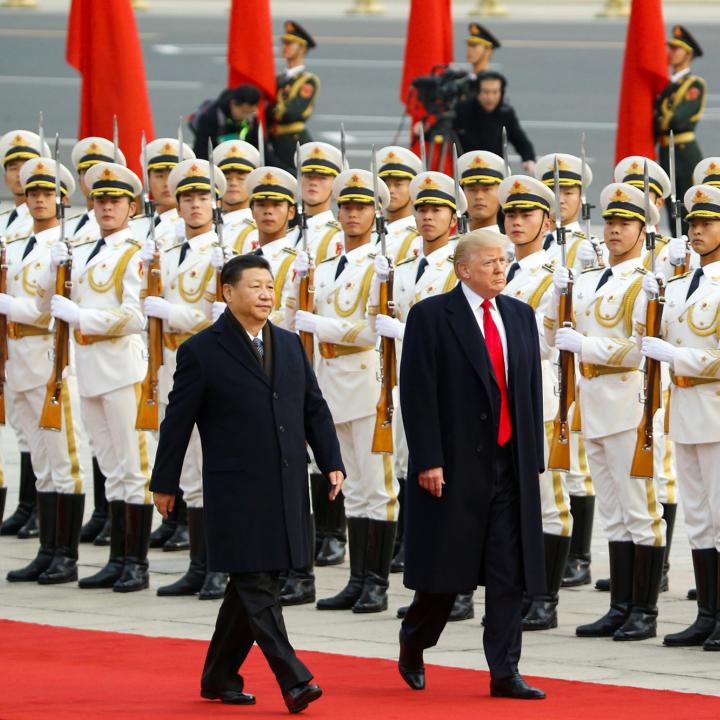
This week, the White House will host Chinese President Xi Jinping for his first visit to the United States since 2023. During his previous two meetings with President Trump over the past year—in China this May and South Korea last October—the focus was on managing their escalating exchanges over tariffs and export controls, and those issues will likely remain at the top of the agenda this week. Yet the Middle East will play a role in the talks as well.
Since Xi and Trump last met, a U.S.-Iran memorandum of understanding was signed and then abandoned, leading Washington to implement a blockade on Iranian ports and heavier economic sanctions. China has nevertheless continued to support Tehran in various ways while attempting to portray itself as an impartial actor. Looming in the background is an escalating competition between the two great powers over artificial intelligence, a sector in which the Middle Eastern market is a coveted prize. How will these issues factor into Trump and Xi’s attempts to establish a stable framework for future relations?
China’s Support for Iran
Since the Iran crisis began in February, a flurry of reporting has covered the varying degrees of Chinese wartime support for Tehran. Economically, Beijing remains the regime’s top economic lifeline. Although the flow of Iranian oil has dropped since the U.S. blockade took force, China has long been the top customer by far for these supplies, going to great lengths to circumvent Western sanctions and compensate Tehran for deliveries that do get through.
Militarily, the Trump administration has regularly sanctioned Chinese entities for providing sodium perchlorate and other precursor materials to support Iran’s missile program. And media reports continue to highlight U.S. accusations that Iran has used Chinese imagery to support its targeting of American positions throughout the region. Beijing even reportedly instituted a unique arrangement whereby personnel from Iran’s Islamic Revolutionary Guard Corps (IRGC) could independently task a Chinese satellite with remote sensing of specific locations.
The Trump administration has consistently downplayed such support, however. In July, Secretary of State Marco Rubio said, “Nothing that China has done has in any way changed the trajectory of the...conflicts with Iran,” then claimed Beijing had “actually been quite cooperative...in regards to what they potentially could have done but didn’t do.” That same week, President Trump noted in a Truth Social post that Xi had promised “he would not, under any circumstances, give or sell weapons” to Iran. Days later, after Reuters reported that China had initiated the transfer of man-portable air-defense systems to Tehran, Trump called the news “surprising,” but said “things like that happen.” And when asked last week about Chinese imagery support for Iranian strikes, Trump responded, “They basically do what we do. When they say China spies on us, I say you’re right and we spy on them too.” Such statements bolster the notion that the Trump administration does not want the Iran war to upset its broader objective of stabilizing relations with China for the remainder of his term.
U.S. actions seem to back this assumption as well. Treasury Secretary Scott Bessent’s recent unveiling of “Operation Economic Outcast” was notable in that it did not directly target Iran’s most important economic lifelines in China. In fact, despite heavy administration rhetoric about direct actions and secondary sanctions, Washington has given the Chinese plenty of wiggle room to navigate the announced “economic D-Day.” Simply put, this campaign will almost certainly be stillborn without Beijing’s consent at minimum. Failing that, the administration will likely remain unwilling to target all the ways in which China circumvents Western sanctions to keep the Iranian regime afloat, and U.S. pressure on Tehran will be blunted.
AI and the Middle East
The summit will also unfold against the backdrop of an emerging contest for AI and technological dominance in the Gulf. Saudi Arabia, the United Arab Emirates, and other regional partners are racing to secure advanced microchips, build data centers, and attract foreign investment in order to become regional power brokers in this sector. In response, Washington has loosened export controls and investment screening hurdles in an effort to keep American companies—and thus American technology infrastructure—at the center of the Gulf’s emerging AI build-outs, while China is offering cheaper hardware and software, more open AI models, and fewer political conditions—a particularly attractive feature for Gulf leaders who continue to insist on strategic autonomy and sovereignty over their AI ecosystems.
To maximize their potential benefits, these leaders are eagerly seeking technological advancements from both great powers. Saudi Arabia has partnered with U.S. companies such as Nvidia, AMD, and Cisco through its state-backed AI firm HUMAIN, while also using Chinese AI models and maintaining ties with Chinese technology providers. The UAE has pursued a similar strategy in practice, despite declaring the United States as its partner of choice on sensitive technology. For instance, it has teamed up with Microsoft, Nvidia, and Amazon to build out much of its tech infrastructure, while relying on Chinese companies such as Huawei for telecommunications infrastructure, among other deals.
Trump and Xi have also looked elsewhere in the region for capital and investment in their respective domestic industries. For example, ahead of Xi’s trip to Cairo last month, Huawei reportedly offered to build AI data centers and supply advanced chips to the Egyptian government. The United States countered with an Nvidia offer to build a $1 billion, 200-megawatt AI data center, which Cairo plans to pursue.
Whether or not these offers come to fruition, both leaders clearly see the region as a key theater in the technology competition. Washington must therefore come out of this summit with confidence that it can retain America’s technological edge over China, including on AI. Although the newly announced “U.S.-China AI dialogue” can help establish the guardrails necessary for engagement, it will not determine which country supplies the pieces necessary for emerging AI ecosystems in the Middle East. Maintaining deep access to capital-rich markets like the Gulf is key to winning that competition, as is prioritizing the protection of sensitive U.S. technologies in markets where China is also operating.
Policy Recommendations
Ending the Iran war on terms favorable to the United States will entail putting more pressure on Tehran than Washington has been able to thus far. China is still Iran’s most important external lifeline, so President Trump should use the summit to secure tangible, verifiable commitments that Beijing will reduce this support and use its considerable leverage to bring Tehran back to the negotiating table. To secure such commitments from Xi without conceding on other critical issues such as Taiwan, U.S. officials should consider using the following leverage points:
Declassify and disseminate information on China’s imagery support. Although Trump may press Xi to stop the provision of Chinese satellite imagery and related intelligence to Iran, this is unlikely to completely stymie Tehran’s access to such information, since the blending of commercial and state outlets that can supply this kind of intelligence is unique to China. Instead, Washington should “name and shame” the responsible Chinese entities by publicizing its findings across the Middle East. By showing the various ways in which this imagery has boosted Iranian strikes in the Gulf and beyond, Washington could rally these countries to help pressure Beijing on this issue. This would also help remind them that China is not the impartial actor it portrays itself to be.
Gradually expand secondary sanctions under Operation Economic Outcast. It is difficult for the United States to directly sanction China without indirectly damaging its own interests, since their economies are heavily intertwined and Beijing has developed specific tools to resist such sanctions. In April, for instance, Washington designated the Chinese “teapot” refinery Hengli Petrochemical for providing vital wartime support to Iran, only for Beijing to invoke a new law blocking compliance with Western sanctions. China and Iran’s unique barter system has added an additional level of resiliency on this front. Yet Washington can still apply significant indirect pressure on Beijing by more strictly enforcing secondary sanctions against third-party entities that deal with select Chinese institutions.
Ask Beijing to support a public commitment to freedom of navigation in the Strait of Hormuz and Bab al-Mandab Strait. Although a joint declaration on this ostensibly shared international principle seems unlikely, Washington has good reason to push for it anyway. Any Chinese statements this week on freedom of navigation would send a warning shot to Iran and its Houthi partners in Yemen that Beijing’s support is not unlimited. Moreover, Chinese government statements are routinely littered with rhetorical pledges to safeguard the free flow of commerce, so Washington should call Beijing’s bluff—if Xi signs onto a joint statement condemning attacks on oil tankers and other civilian targets, any further Iranian or Houthi attacks on such entities would force Beijing to choose between publicly reinforcing this position or appearing hypocritical. Obtaining such a declaration would require patient, concerted diplomacy at the summit, but the effort would be worthwhile given the fruit it could bear for America’s regional position in the long term. Xi might even prove receptive to the idea, as recent reports suggest Beijing may have pressured Iran to rein in the Houthis.
Use the new “AI dialogue” to protect America’s technological advantages in the region. U.S. officials should leverage this mechanism to establish clear guardrails around AI-related risks and develop the proposed “alert” system for incidents involving AI that could threaten national security, including events involving military or dual-use systems that could trigger miscalculation or unintended escalation. Yet they should keep the broader strategic competition separate. In particular,Washington must preserve its decision space to coordinate with Middle Eastern partners on export controls, advanced chips, data storage, and the protection of other sensitive infrastructure, ensuring that it can continue offering more attractive and advanced alternatives to Chinese technology.
Grant Rumley is the Meisel Senior Fellow at The Washington Institute and director of its Diane and Guilford Glazer Foundation Program on Great Power Competition and the Middle East. Elizabeth Dent is the Institute’s Wagner Senior Fellow. Both previously served in the Office of the Secretary of Defense.