- Policy Analysis
- PolicyWatch 4270
One Year After the Gaza Ceasefire (Part 1): U.S. Priorities for Year Two
Part of a series: One Year After the Gaza Ceasefire
or see Part 1: Chapeau: Assessing the Gaza Ceasefire, Year One
The Trump administration should be prepared to push a suite of concrete actions immediately after Israel’s election, from delivering urgently needed interim housing to convening high-level meetings with regional mediators and avoiding steps that signal abandonment of the PA.
This PolicyWatch is part of a Washington Institute series analyzing the risks and opportunities in Gaza since the October 2025 ceasefire and offering recommendations for policymakers going forward. See the full series.
When President Trump’s twenty-point peace plan was announced last year, it seemed quite ambitious under the circumstances. If fully implemented, it offered a path toward not only transforming the war-torn Gaza Strip, but also changing the realities between Israelis and Palestinians. That was never going to be easy—the aspirations were high and the obstacles to fulfilling them were formidable. But the Trump administration did take the crucial step of beginning the implementation process, and as noted in the introductory essay to this series, it has been trying to close the gap between aspirations and desired outcomes ever since. What mechanisms have U.S. officials used to activate the twenty-point plan, and what substantive challenges must they overcome to accelerate that process and achieve the president’s goals?
A Mixed Record on Coordination
Reflecting the Trump administration’s norms, there was no effort to put together a large interagency team when the peace plan was first announced. Instead, follow-up implementation has been guided by a small, highly motivated team tied to the president’s personal envoy and son-in-law, Jared Kushner.
Two mechanisms were designed to act on the core elements built into the twenty points. The first was the Civil-Military Coordination Center (CMCC), which was set up and run by the U.S. military. Based in Kiryat Gat, Israel, it has since been renamed the International Gaza Support Center. Today, two dozen countries are represented there, including Egypt, Jordan, Morocco, and the United Arab Emirates. Its missions include facilitating humanitarian relief supplies; making plans for the removal of rubble and unexploded ordnance; developing steps to resume education, commerce, and other civilian activities; monitoring the ceasefire; overseeing all materials going into Gaza; and playing a crisis-management role to quickly douse any flare-ups. President Trump wanted the mission to be military-led, seemingly putting more faith in U.S. Central Command than in America’s diplomatic corps.
This mechanism yielded early signs of success, especially with regard to restoring humanitarian assistance and commercial activity. Moreover, each country represented at the CMCC assumed responsibility for developing work plans to be managed by the Palestinian technocrats on the National Committee for the Administration of Gaza (NCAG), enabling that body to hit the ground running once it arrived in Gaza.
As described in the introductory essay, however, the committee has yet to arrive—it remains stuck in Cairo. And while NCAG members will still be able to make good use of all the preparatory work done so far, the early promise of the CMCC and International Gaza Support Center has waned, in large part because authorities are taking so long to get the NCAG, Palestinian police, and the International Stabilization Force (ISF) into Gaza. The spirited atmosphere and sense of urgency that the authors witnessed upon visiting the CMCC early this year have clearly been dampened by ongoing delays on decommissioning Hamas’s weapons—a prerequisite to reconstruction and new governance in Gaza.
For the Trump administration, the International Gaza Support Center was not the intended mechanism for this decommissioning process. Instead, the U.S.-led Board of Peace was given responsibility for spearheading diplomatic efforts to convince Hamas that it must turn over its arms. For months, Hamas leaders resisted this idea, but they finally agreed to an implementation-focused roadmap for disarmament and related processes on July 30. This was due to relentless and tightly unified efforts by the board’s high representative, Nickolay Mladenov, and officials from the United States, Egypt, Qatar, and Turkey.
Getting the Process Rolling in 2026 and Beyond
Although no significant steps toward implementation are likely until after Israel’s October 27 election, the Trump administration needs to think through how it will address the most daunting challenges posed by the July roadmap.
First, to make clear that the roadmap is the only credible path forward, Israeli, Palestinian, and Arab officials will need to show their publics that this mechanism is ready to make tangible progress soon after Israel’s election. Any genuine decommissioning process will necessarily be a long one, so the Board of Peace must proactively engage people on all sides, asking the public to be patient while simultaneously delivering real progress on the ground. Israelis will require credible decommissioning, measured by the scope and quantity of seized Hamas weapons and the destruction of the group’s military infrastructure. Their skepticism will be difficult to dispel because the core mission that has defined Hamas for decades—from its founding charter to its heinous acts on October 7, 2023—is to eliminate the state of Israel. As such, its weapons must not only be confiscated, but also publicly destroyed or rendered inoperable so that Hamas cannot simply reclaim them later.
For their part, Palestinians and Arabs will need proof that the NCAG is beginning to produce a different Gaza. As zones are cleared of Hamas weapons and infrastructure, the committee must quickly remove rubble, restore basic services, and provide interim housing for civilians who have been living in deplorable tent camps for years.
Second, Washington must ensure that every party fulfills its commitments. This will require sustained, high-level attention from the Trump administration, including the president himself. Israel and the mediators on the Board of Peace must see that he is paying close attention and holding each side accountable, regardless of pressing U.S. policy demands elsewhere in the region. Once Israel’s election is over, the president should show everyone that he is eager to finally implement the Gaza peace plan—the signature foreign policy achievement of his second term.
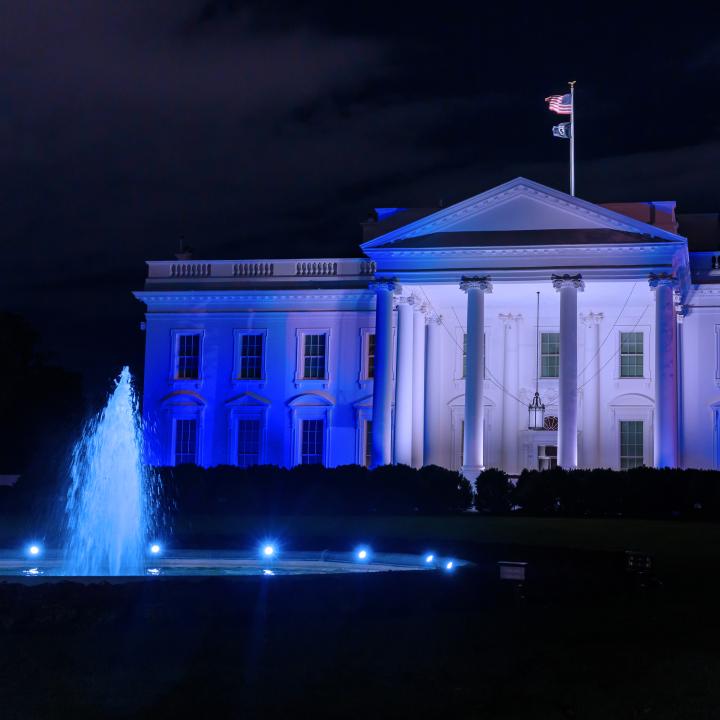
Since the president favors personal diplomacy, he could invite the key players—the members of the Board of Peace and the NCAG, along with the leaders of the countries that make up the ISF (Albania, Kosovo, Morocco, and possibly other countries)—to the White House to take stock of where things stand and lay out milestones that need to be reached within the next three to six months. Prior to that meeting, Kushner’s team should work with NCAG donors to ensure that when the president convenes everyone in Washington, they are able to show that the committee is making initial progress—at minimum, directing deliveries of prefabricated housing alongside the humanitarian assistance that has been entering the Strip.
The White House meeting could also be used to outline the performance standards that Israel’s next government and Hamas will be held to. The mediators should be held to a common standard as well—thus far, Egypt, Qatar, and Turkey have had no problem calling out Israel for nonperformance on the peace plan’s terms but have never publicly criticized Hamas’s noncompliance. The twenty-point plan made clear that these mediating countries are supposed to serve as guarantors of the Trump plan, so the president and his counterparts on the board should be very clear and specific when they lay out what they will do to jump-start implementation in the coming months. Washington should be prepared to lean on all parties—including Jerusalem whenever verified Palestinian steps require a reciprocal Israeli move.
Third, the Trump administration must not abandon the Palestinian Authority. Although U.S. officials have dealt directly with Hamas in recent months, it is the PA that will ultimately return to Gaza and take over from the transitional leadership. Of course, this is assuming that the PA takes its reform commitments seriously. Point 19 of the Trump plan states that “when the PA reform program is faithfully carried out, the conditions may finally be in place for a credible pathway to Palestinian self-determination and statehood.” So far, however, PA reform is still being treated as a slogan, not a process. To fix that problem, Arab leaders—particularly in Saudi Arabia, Egypt, Jordan, the UAE, Morocco, and Qatar—will need to assume more responsibility for pushing the PA on reform.
One way for the Trump administration to build a collective Arab approach is for Secretary of State Marco Rubio to hold joint meetings with his regional counterparts and present the tangible reform steps that need to be taken. For example, a good starting point would be for the PA to create a transparent process on foreign investment in the territories, which will make it possible to stop the payoffs that are required for doing business today. Secretary Rubio could then hold follow-up meetings for all parties to report on progress—or the lack thereof. This type of high-level American attention would also show that the administration is not anointing Hamas as the new representative of the Palestinian people—a message inadvertently conveyed when U.S. officials met with Hamas but denied PA President Mahmoud Abbas a visa to attend the UN General Assembly. In addition, signaling support for the PA would send a clear message that Washington opposes those members of the Netanyahu government who blatantly seek the PA’s collapse.
Conclusion
Ultimately, the Trump administration needs to remind Israel of the mutual bilateral interest in moving quickly after the October election and testing Hamas’s commitment to the July roadmap. This includes allowing the small number of Palestinian police officers who have completed training to return to Gaza, letting the next wave of 5,000 police candidates travel to Egypt for training, and facilitating the deployment of the NCAG and ISF. None of these steps would substantially threaten Israeli security, since they will be conducted in zone-by-zone phases that require verified decommissioning of Hamas weapons before the IDF is expected to withdraw from a given area. Rather, allowing these processes to begin would shift the diplomatic burden squarely onto Hamas, whose public statements about genuine demilitarization remain ambiguous.
Hamas members—not to mention the people of Gaza—stand to lose a lot if the group does not follow through on its commitments. If it keeps dodging repeated opportunities to comply with the decommissioning process, the Trump administration will likely give Israel a green light to resume major military operations. This possibility should also give Egypt, Qatar, and Turkey extra incentive to press Hamas.
One year later, Trump’s plan still offers a workable sequence: verified Hamas demilitarization, followed by Palestinian governance and policing, reconstruction, an international security presence, and phased Israeli withdrawal. What the plan lacks is not architecture, but sustained U.S. execution.
Dennis Ross is the counselor and Davidson Distinguished Fellow at The Washington Institute. Previously, he served as a senior U.S. official in the Reagan, Bush, Clinton, and Obama administrations. David Makovsky is the Institute’s Ziegler Distinguished Fellow, director of its Project on Arab-Israel Relations, and host of the podcast Decision Points.