- Policy Analysis
- PolicyWatch 4177
The Wartime Role of Iran’s “Axis”: Countering Proxy and Terrorist Threats
by
Assaf Orion, Hanin Ghaddar, Michael Knights, April Longley Alley, Michael Jacobson, Matthew Levitt
Mar 5, 2026
Also available in
Brief Analysis
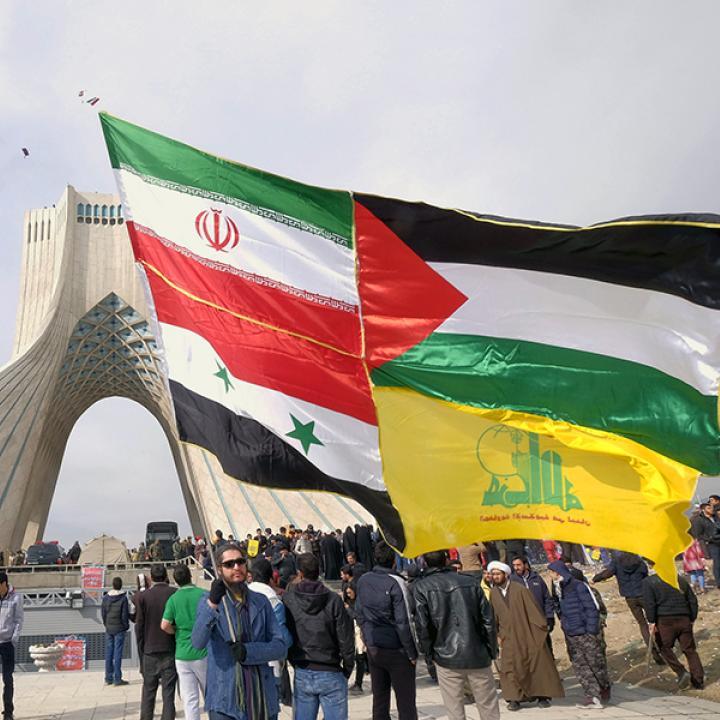
Washington Institute fellows assess how Hezbollah, the Houthis, Iraq’s Hashd, and other Iranian proxies and allies are responding to the war, as well as how the Trump administration and partner governments might counter the risk of terrorist attacks given Tehran’s long track record of foreign plots.
Israel vs. the Iranian Axis—This Time an Allied Campaign
By Assaf Orion
As allied officials consider the possibility of additional foreign groups entering the war on Iran’s behalf, they should keep in mind the degree to which multifront fighting can strain military force size. Similarly, protracted warfare can test endurance, strain stockpiles of ammunition and spare parts, and test a country’s wider logistical and economic resilience. Shortages in forces can be overcome by phasing fronts—after October 7, for example, Israel attacked the Gaza Strip and defended on the Lebanese front at first, then pivoted to major offensive operations against Hezbollah in September 2024 and Iran in June 2025.
Israel’s main challenge in the current war with Iran is twofold: to continue striking targets there while simultaneously defending the home front against missiles and drones. Hezbollah’s decision to enter the conflict—possibly to be joined by the Houthis later on—will challenge Israel’s defense systems and stockpile of interceptors even more. Attacking enemy threats at their source (e.g., hunting down launchers: destroying warehouses, stockpiles, and production plants further upstream) is a cost-effective way to remove threats and save more limited and expensive defense resources.
On the Lebanon front, Israel will be able to use its full array of land and sea forces against Hezbollah, since these assets are not currently required in Iran. Yet it will have to divide its air power between the two fronts depending on how they develop. So far, the Israeli Air Force has been striking hundreds of targets per day in Iran and only dozens in Lebanon, reflecting its current priorities and urgency. Meanwhile, the army must still defend Israel’s frontiers in Gaza, the West Bank, and elsewhere. If a new round of Houthi missile fire begins, Israel’s response can be shaped and timed according to the requirements of other theaters. Through it all, Israel will no doubt lean on the most unique element of this war: its unprecedented combined operations with the United States, which provide for a more robust response in terms of intelligence, force size, operational punch, stockpiles, and endurance.
How to Impede Hezbollah’s War Strategy
By Hanin Ghaddar
Before Hezbollah joined the war, the general belief in Lebanon was that the group would probably avoid risking its already fragile domestic infrastructure and support base unless it was attacked directly. What this assessment missed is the fact that Iran’s Islamic Revolutionary Guard Corps created Hezbollah decades ago for this exact moment. In the IRGC’s view, the group’s sole role is to defend the Iranian regime—not Lebanon, and not itself. Sources close to Hezbollah circles told the author that the Qods Force—the IRGC’s main external operations branch—made the decision to open the Lebanese front.
By creating another front for Israel, the IRGC’s goal is to divert some military pressure from Iran and signal that the regime will activate all of its regional proxies if allied attacks continue. The price of this strategy, however, is more intensive Israeli operations in Lebanon that are already weakening Hezbollah further and threatening to isolate it politically. On March 2, the Lebanese cabinet formally prohibited the group from conducting domestic military operations, even defensive actions. Meanwhile, Hezbollah’s Shia political base is giving loud signs of discontent, especially since the group has not provided any kind of assistance to the thousands of locals displaced by the previous two-and-a-half years of Israeli attacks.
The next phase will be crucial for Lebanon, so Beirut would be wise to focus on four key issues:
- The Lebanese Armed Forces need to implement the government’s latest decision by deploying to areas where they can stop Hezbollah from launching rockets and drones at Israel.
- Lebanese authorities need to issue arrest warrants for every Hezbollah member who defies the government’s decision.
- The cabinet needs to reconsider its decision to focus solely on banning Hezbollah’s military activities, since this focus enables the group to continue taking part in the government’s political decisions—a role that helped Hezbollah regenerate itself after past conflicts with Israel. The May parliamentary election has been postponed indefinitely due to the war, so additional cabinet actions may be the only way of curtailing the group’s political influence for now.
- Lebanese leaders need to follow up on their previous calls for negotiations by communicating to the Trump administration—via Ambassador Michel Issa—that they are ready to talk directly with Israel about a peace agreement that would end the perpetual war between the two countries.
If Beirut is serious about its Hezbollah military ban and proves bold enough to contain the group’s attacks, the United States should be prepared to reenergize and expand the ceasefire mechanism created in November 2024. This functional mechanism already has a significant degree of Israeli and Lebanese civilian participation and could help facilitate a more comprehensive peace agreement. Yet it would need to be widened even further, since another mechanism focused solely on ceasefire enforcement would only postpone rather than prevent the next war between Israel and Hezbollah.
Deterring Iraqi Militia Attacks
By Michael Knights
The relationships between the Iranian regime and Iraq’s militia “resistance” groups are almost as old as the Iran-Hezbollah partnership, yet most of these Iraqi groups have proven to be far less capable and trustworthy military actors. This makes the few effective militias—Kataib Hezbollah (KH), Harakat Hezbollah al-Nujaba (HaN), and Kataib Sayyid al-Shuhada (KSS)—doubly keen to impress their patrons in Tehran and genuinely motivated to avenge the death of Supreme Leader Ali Khamenei.
Since the war erupted last weekend, these three groups have stuck to their long-established areas of responsibility. KH has handled drone and missile launches into Jordan, which became a target-rich environment once most U.S. aircraft in the region were moved there recently. (They wound up at Muwaffaq Salti Air Base, an alternative to Gulf bases that were denied for U.S. wartime use and would have been perilously close to Iran anyway.) KH and KSS—the latter through its Saraya Awliya al-Dam brand—are seemingly targeting the Gulf states, especially Kuwait, from launch points in the southern Iraqi provinces of al-Muthanna and Basra. And all three have pounded the Kurdistan Region of Iraq with scores of drones and rockets. Saraya Awliya al-Dam might even be employing its new guided close-range ballistic missile—a weapon with five times the payload of a typical drone and pinpoint accuracy at ranges over 100 kilometers. (Yesterday, security forces in Basra captured an unfired twin launcher for this system.)
In response, allied forces appear to be striking back, but not vigorously enough to deter the escalating militia launches. The United States should therefore consider resurrecting the successful approach it used the last time these militias were launching lethal attacks against American forces in early 2024. At the time, U.S. forces targeted upper-level militia leaders, including two high-profile strikes in Baghdad: against HaN’s Abu Taqwa al-Saaedi (killed January 4, 2024) and KH’s Abu Baqr al-Saeedi (February 7, 2024). These strikes stopped a deadly sequence of militia attacks on U.S. personnel.
In the current war, allied forces could seek a similar effect by targeting the following individuals:
- HaN leader Akram Kaabi
- KH operational commander Abu Fadak (aka Abdul-Aziz al-Mohammadawi)
- KH operational commander Abu Hussein (aka Ahmad Mohsen Faraj al-Hamidawi)
Moreover, the militia launch complex in Samawa, operated by the U.S.-sanctioned Muhandis General Company, should be targeted more intensively in order to screen the Gulf states from worse damage.
What Will the Houthis Do?
By April Longley Alley
The war is presenting Yemen’s Houthis with some hard choices. Their leader, Abdul-Malik al-Houthi, has offered rhetorical support such as condemning U.S.-Israeli “criminality,” mourning Khamenei’s death, and pledging solidarity with Tehran. But he has stopped short of promising a military response, instead noting that the “Iranian stance is steadfast and the response is strong.” On March 1, the Houthis organized a “march of solidarity with the Iranian people” in Sanaa.
Inside the movement, supporters are no doubt debating whether they should enter the fray militarily. Many Houthi ideologues likely want to resume attacks on Israel, the Red Sea maritime space, U.S. targets, and possibly America’s Gulf allies as part of what they believe is a battle for the region’s future. Regardless of the costs, they may feel obligated to prevent Israel and the United States from defeating Iran and removing a major bulwark against what they see as a “hegemonic” project. Part of the Houthi popular support base will likewise expect military engagement given years of chest-thumping rhetoric—not primarily in support of Iran but against the United States and Israel. By doing nothing, the movement would risk looking weak at a critical moment. Some may also assess that they are already on an Israeli-U.S. target list as one of Iran’s “proxies,” so they may as well enter the war on their terms. And anti-Houthi Yemenis suggest that the group will engage militarily to distract from deteriorating economic conditions, though the Houthis’ iron grip on the security situation means this would not be the only factor.
In contrast, Houthi pragmatists may argue that the movement has much to lose if it joins the fight. The Houthis have an ongoing dialogue with Saudi Arabia and the chance to secure an understanding that may enable them to play a prominent role in postwar Yemen. Taking Tehran’s side militarily at a time when Iran is attacking Saudi targets could reverse those gains and open room for Houthi opponents in the Yemeni government. Although the government failed to take advantage when the Houthis were under heavy U.S. and Israeli fire last year, author conversations with Yemeni officials indicate they are working to better coordinate their ranks so that they are not caught flat-footed at the next opportunity.
Some Houthi elements might also see the war as a chance to show some daylight between them and Tehran. By sitting out this fight, they believe the movement can demonstrate its independent decisionmaking, thereby showing the populace that Houthis prioritize Yemen over their foreign patron.
None of the above options would be easy for the movement. The final choice will reside with Abdul-Malik, who has shown a propensity to prioritize regional and ideological battles since the Gaza war. For now, he is keeping his head down—and Yemenis in suspense.
Assessing the Wartime Terrorist Threat in the Homeland and Abroad
By Michael Jacobson and Matthew Levitt
Three days into the war, Iran’s IRGC said the quiet part out loud: its Qods Force has long carried out terrorist plots around the world, including in the United States, and it intends to intensify that activity now. A Qods Force statement carried on Iranian television warned that it will soon target Americans within the homeland and abroad: “The enemy should know that their happy days are over and they will no longer be safe anywhere in the world, not even in their own homes.”
This threat came hours after President Trump said the war could last another month, potentially leaving ample time for dangerous plots to be developed and carried out, or for plans under way to be brought to fruition. Such threats must be taken seriously despite the destruction of key IRGC and Intelligence Ministry facilities and the targeted killing of many intelligence operatives who oversaw the regime’s external operations. Notably, even during last year’s relatively short twelve-day war, European authorities exposed at least two Iran-linked terrorist plots: one targeting Israeli and American interests in Sweden, and another targeting Jewish institutions and individuals in Germany. The regime now appears to be repeating that model. On March 3, Qatar announced the arrest of two IRGC cells; seven of the suspects had been gathering intelligence on critical infrastructure and military installations, while three others were tasked with conducting sabotage operations.
The United States has attempted to rally the international community against such threats since as far back as 2011, when it disrupted an IRGC plot to assassinate the Saudi ambassador in Washington. Although U.S. officials were met with deep foreign skepticism at the time, such doubts have largely dissipated over the years due in part to the frequency of plotting attempts by the Qods Force, the Intelligence Ministry, and Lebanese Hezbollah.
In the past five years alone, U.S. authorities have disrupted at least seventeen Iranian-linked plots in the homeland involving regime operatives and/or terrorist and criminal proxies. Previously, the case of Ali Kourani—a Hezbollah operative convicted in New York in 2019—offered a chilling warning of what could lie ahead. Kourani described himself as a sleeper agent carrying out preoperational surveillance in the United States and Canada. When asked under what circumstances his cell might be ordered to conduct attacks, he said that would come if the United States went to war with Iran.
Regarding this week’s attack in Austin, Texas, in which three people were killed and many others injured, authorities are looking into the war as a possible motive. Yet it is much more likely to be an “inspired” attack rather than an Iranian-directed plot.
Whatever the case, U.S. authorities are on high alert for Iranian plots and should remain so indefinitely given the risk that some plots may take time to develop. The more concerned Tehran becomes about the regime being toppled, the greater the likelihood it will employ external operations to raise the costs of the war and press for a ceasefire.
Foreign authorities must remain vigilant as well. Over the years, persistent State Department engagement has helped educate them on how to effectively detect, disrupt, and prosecute Iran-backed terrorism, including through State-funded training programs run by the Justice Department, FBI, and Treasury Department. State also created the two main international forums dedicated to these issues—the Law Enforcement Coordination Group and the Countering Transnational Terrorism Forum—thereby enabling practitioners to compare tradecraft notes and refine their methods for sanctioning Iranian and Hezbollah terrorist actors, freezing assets, and sharing actionable intelligence on a timely basis both within their governments and with other partners.
Yet despite being more prepared to deal with potential wartime terrorist plots from Iran or Hezbollah, foreign countries still have significant blind spots to such activity. The Trump administration should therefore urge partner governments to increase their intelligence and law enforcement focus on Iranian and proxy elements, underscoring that even if their own citizens are not the targets of new attacks, they could still be among the victims. Foreign governments should also be reminded that this type of activity represents an extraordinary Iranian violation of their sovereignty and should have real consequences—a principle that some officials have been relatively slow to grasp. As for those partners who are still concerned about potential retaliation from Iran or Hezbollah, the administration should point out that historically, actions like law enforcement arrests and sanctions have not resulted in military or terrorist attacks.
About the Authors






Share