- Policy Analysis
- PolicyWatch 4222
Beyond Disarmament: How the IRGC Keeps Hezbollah in Power Despite Its Military Losses
Although disarming the group is still crucial, negotiators need to realize that they will never really break Hezbollah’s hold on Lebanon so long as it retains Iranian support and key political allies and government posts in Beirut.
With Israeli and Lebanese negotiators scheduled to meet again starting next week, they face the sobering reality that disarming Hezbollah has been the main obstacle in every previous round of talks. Since the November 2024 ceasefire agreement, U.S. policy has focused on whether the Lebanese Armed Forces could, or would, take on that mission. So far, LAF leaders have refused to confront the group, and Israel cannot complete this task by itself even with substantial military escalation. This impasse will continue complicating diplomacy until all actors realize that dealing with the post-2024 Hezbollah requires a different set of tools.
Shortly before the third round of talks opened earlier this month, Israeli Ambassador Yechiel Leiter proposed a two-track framework to address this issue: “One track is to conduct negotiations for full peace as though Hezbollah does not exist—borders, embassies, visas, tourism, everything. An agreement like that could be reached within a few months. But it would be contingent on the success of the second track—dismantling Hezbollah.” Recent statements by Lebanese President Joseph Aoun indicate that Beirut may see this as a good approach as well. Indeed, disarmament should once again be a priority when each country sends security delegations to meet at the Pentagon on May 29.
Yet neither Leiter’s proposal nor other recent efforts have addressed two other major stumbling blocks:
- The political decision. The Israeli and Lebanese governments must agree on a security framework that includes guarantees to disarm Hezbollah. This is not only about the LAF’s capabilities; it is also about the civilian leadership in Beirut publicly making a clear political decision to proceed with disarming the group even if that entails military confrontation. Although the Lebanese public is concerned about potential armed hostilities with Hezbollah, they are much more concerned about the prospect of having to fight that fight without U.S. help against the group’s patrons in Iran. In their view, this scenario could materialize soon if the Trump administration tries to end the Iran war with a deal that releases billions of dollars to Tehran but does not address its decades-long support for foreign terrorist proxies.
- Hezbollah’s capacity to rearm. Even if the group were somehow completely disarmed in the near term, Lebanon’s existing political and economic circumstances ensure that Hezbollah would still have the capacity to rearm and regenerate. Over the years—and with deepening direction and assistance from Iran—the group has established a far-reaching ecosystem of military, political, and financial power inside Lebanon. Targeting its military infrastructure while ignoring the political and economic pillars is a recipe for helping Hezbollah continue bouncing back after every conflict.
How Hezbollah Has Dug Into the State and Economy
With its military infrastructure substantially degraded, its communication networks heavily infiltrated by Israeli intelligence, and its command structure shattered, Hezbollah is a shaky, tired shadow of itself at the moment. Its goal is to survive and rebuild while maintaining a minimal level of kinetic action against Israel. One crucial factor in achieving this goal is continued Iranian funding.
Despite all their mutual setbacks, Tehran was still able to send Hezbollah an estimated $1 billion last year in the period between major Israeli campaigns. The group used this money to import military materiel, produce more missiles and large quantities of cheap, unjammable drones, recruit more fighters, and pay salaries to its existing fighters and essential staff.
This influx was made possible in part by Hezbollah’s continued control over key Lebanese security and financial channels—a situation enabled by its top political ally Nabih Berri, who heads the Amal movement and has held onto his post as speaker of parliament for more than three decades. When Lebanon formed a new government in February 2025, Hezbollah—via Berri—insisted on choosing friendly officials to head both the General Security Directorate (GSD) and the Ministry of Finance.
As long as Hezbollah retains these domestic levers and access to its patrons in Iran, it will find a way to rebuild. Its cash economy is still flourishing, and its allies in Lebanon’s security, customs, and financial institutions enable it to move money, import weapon components, and sneak in fighters from Iran and elsewhere in the region. The only way to change this status quo is through a comprehensive policy that incorporates soft power alongside coercive tools.
The IRGC Role
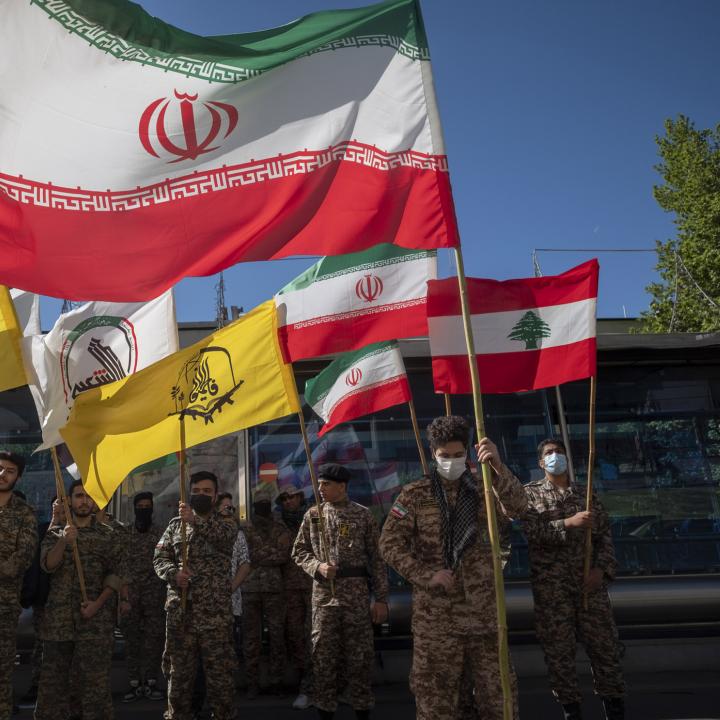
Given the blows Hezbollah has suffered since 2023, Tehran understands that the group can no longer maintain its dominant role in Lebanon without help from others—namely, patronage and protection from Berri, along with deeper, more direct oversight by Iran’s own Islamic Revolutionary Guard Corps. The IRGC’s expanded role in Lebanon has in turn given Tehran even more bargaining chips and leverage over key U.S. interests in the Middle East.
Of course, Hezbollah has always been a de facto arm of the IRGC, in part because Iranian military leaders regard Lebanon as a central component of the regime’s strategic depth in the region. Yet the IRGC dramatically tightened the leash after Israel killed Hassan Nasrallah and many other top Hezbollah figures in 2024. Iranian leaders realized they might soon lose Hezbollah and, by extension, their sway over Lebanon unless they essentially took over the group’s command structure.
According to sources close to Hezbollah, the IRGC began deploying hundreds of commanders to Lebanon in November 2024 to rebuild and restructure the group. This effort resembled the IRGC’s late-1970s collaboration with Amal and Palestine Liberation Organization elements inside Lebanon. Today, the IRGC presence there is extensive. Israel has released the names of dozens of IRGC officers killed in action throughout Lebanon, while social media obituaries reveal various Syrian and Iraqi fighters killed there while operating in Hezbollah units—evidence that the IRGC has employed its usual tactic of blending and deploying fighters from Shia militias across the region whenever the need arises.
Going forward, the IRGC’s Hezbollah strategy appears to be focused on three main goals:
- Survival: Making sure that despite its major losses so far, Hezbollah does not fully surrender its weapons or military infrastructure.
- Regeneration: Using Hezbollah’s levers within the Lebanese state—including its influence over LAF elements, the GSD, the Customs Administration, and various financial institutions—to guarantee that no matter how the U.S.-Iran and Israel-Lebanon conflicts turn out, the group will retain its capacity to rearm.
- Confrontation: Maintaining at least minimal Hezbollah attacks against Israel while escalating the group’s tactics against internal opponents. As noted above, Tehran and Hezbollah are hoping that when the Trump administration reaches a deal to conclude the Iran war, it includes a ceasefire in Lebanon while excluding any provisions on halting Iranian support for regional proxies. Such an outcome would enable them to declare victory and, more important, push back forcefully against further efforts to disarm Hezbollah and advance Israel-Lebanon peace.
Unless Washington and its partners actively counter this strategy, Hezbollah will have ample time and leverage to position itself for Lebanon’s next parliamentary election in 2028. In that scenario, the group could quickly regain much of what it has lost in the past three years.
Policy Recommendations
Although disarming Hezbollah necessarily remains a priority, it is not enough. The Trump administration must look beyond weapons, addressing the group’s broader ability to restore itself after the dust settles from the current crises in Lebanon and Iran. Several steps will be crucial to this effort:
Delink Iran and Lebanon. As the Trump administration works to finalize the terms of an agreement on ending the Iran war, it should not let Tehran introduce any provisions related to the negotiations in Lebanon. Otherwise, the resultant Iran deal could wind up undercutting Israel’s efforts to weaken Hezbollah, defanging Beirut’s efforts to delegitimize the group’s weapons, and spoiling Washington’s own vision of achieving peace between Lebanon and Israel.
Offer carrots to Beirut, not just sticks. So far, the Trump administration has essentially told Lebanon that it needs to make a choice on Hezbollah or lose Washington’s attention. Yet this approach has not been effective at getting Beirut to take action on the ground. Instead, U.S. officials should present the Lebanese government with a basket of carrots and sticks aimed at eroding all of Hezbollah’s pillars of power.
For example, potential carrots could include more assistance to the LAF, more financial and humanitarian aid for citizens displaced by the conflict, help with reforming the financial and security institutions that Hezbollah has infiltrated, and discussions about reconstruction plans. Yet if Beirut fails to fully implement its ceasefire commitments, disarm Hezbollah, and make progress on internal reforms, Washington should make clear that it will levy more sanctions against Lebanon and reconsider security assistance.
At the same time, the United States should assure Lebanese officials that they will not be abandoned if Hezbollah opts for military confrontation with the state. On the contrary, Lebanon should get all the assistance it needs—military or otherwise—if it demonstrates a willingness to deal with the group’s arms. This could take the form of a security agreement with clearer deliverables, timeframes, and benchmarks; for example, Washington could commit to increased military and financial assistance once the LAF resumes disarmament operations north of the Litani River.
Target Hezbollah’s allies, engage its Shia base. Last week’s U.S. Treasury announcement of sanctions against various Hezbollah officials and enablers was a good step that sent clear messages to both Nabih Berri and Hezbollah’s proxies in the LAF and GSD. Yet these sanctions need to be followed up with specific messaging about what is expected of Lebanese institutions going forward—and what will happen to Berri and other enablers if these expectations are not met. For instance, Washington could spell out its red lines regarding the IRGC’s presence in Lebanon, Hezbollah’s cash network, and future appointments within key state institutions.
Berri in particular should be made to understand that the risks of supporting Hezbollah outweigh the benefits. Currently, he benefits from Hezbollah in two ways: politically, he is strengthened by the group’s presence in government and by its support during parliamentary and municipal elections; financially, he has become the protector (and, by extension, a major beneficiary) of Hezbollah’s cash network. The Trump administration’s most effective tool for swaying Berri and his circle is targeted sanctions—progressing from Amal officials to their family members and personal financial assets.
To further erode Hezbollah’s political pillar, Washington and its partners could discuss ways of engaging the group’s Shia base. For example, they could discreetly support domestic Shia opposition to Hezbollah, provide other economic options to the wider Lebanese Shia community, and help independent media shape alternatives to Hezbollah narratives.
Strengthen the CENTCOM mechanism. Another way to help overcome the disarmament impasse is by strengthening the U.S. presence in Lebanon, mainly via U.S. Central Command and the ceasefire monitoring mechanism it helped establish in 2024. If a new ceasefire agreement is reached, monitoring and assessing LAF operations in coordination with the Israel Defense Forces will be crucial. In that case, the LAF should be asked to propose a new disarmament plan through the CENTCOM mechanism—one with a faster timeline than its 2025 plan.
Hanin Ghaddar is the Friedmann Senior Fellow in The Washington Institute’s Rubin Program on Arab Politics and coauthor of its 2025 report “A Roadmap for Israel-Lebanon Peace.”