Hanin Ghaddar is the Friedmann Senior Fellow at The Washington Institute's Rubin Family Arab Politics Program, where she focuses on Shia politics throughout the Levant.
Brief Analysis
The two governments have agreed to direct talks that could (and should) turn into a wider U.S.-brokered peace process, but only if officials are prepared to counter potential spoilers like Hezbollah ally Nabih Berri.
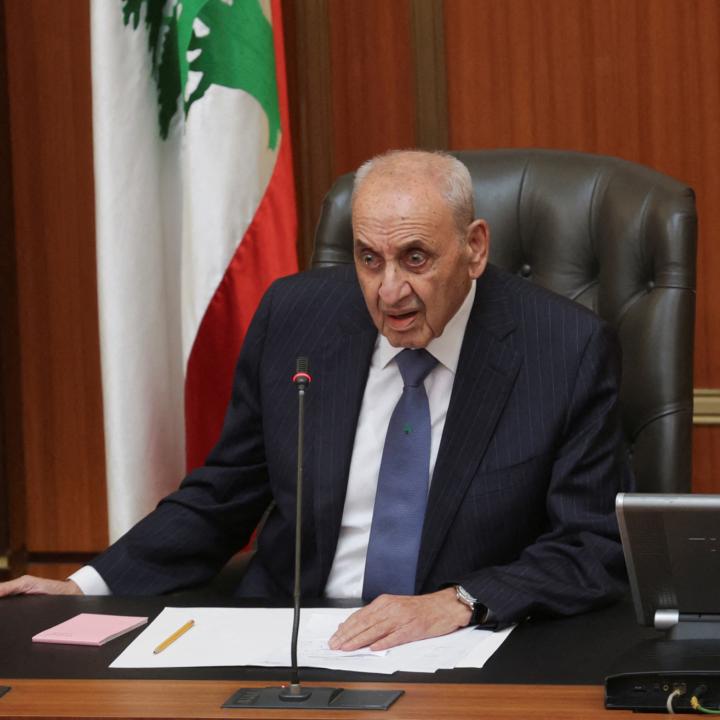
Israeli and U.S. calculations on Lebanon may have taken an important turn this week by shifting focus to the role of parliamentary speaker Nabih Berri, a longtime Hezbollah ally and leader of the Amal Party. Amid expanded strikes in Beirut on April 8, Israel appeared to send him a message by targeting Amal-controlled neighborhoods, killing a number of the party’s members, and hitting Berri’s headquarters. He seemed to hear the message loud and clear—when direct negotiations between Israel and Lebanon were announced the next day, he did not object.
Until now, Berri likely believed he was immune to foreign pressure. His longstanding mastery of the Lebanese political scene enabled him to maintain rhetorical distance from Hezbollah while simultaneously acting as the chief gatekeeper to the group’s political and security interests.
After the Iran war broke out and Hezbollah resumed attacks on Israel, Berri predictably became the main hindrance to diplomacy. On March 9, Lebanese President Joseph Aoun expressed interest in opening direct talks with Israel, but Berri nixed the effort by refusing to name a Shia representative for the negotiating team. Although the Lebanese constitution does not give the speaker of parliament a say in such decisions, Aoun was clearly wary of proceeding without Berri’s approval and Shia participation. Yesterday, however, the government gave the green light to new talks, indicating that Berri was forced to approve.
Berri’s Codependent Relationship with Hezbollah
In recent years, Berri’s influence has grown stronger through Hezbollah’s power system. He knows he cannot win parliamentary elections without the group, and their financial and political interests have become more intertwined. Although he is not ideologically tied to Hezbollah, Berri realized he could indirectly inherit broad control over the group’s networks in Lebanon if he strengthened his ties with Hezbollah leaders. In doing so, he has not only reaped greater political power within state institutions, but also secured more financial power for him and his family business networks.
When Berri decided to support negotiations to end the previous war with Israel in late 2024, Hezbollah leader Naim Qassem expressed “full confidence” in the speaker and called him “the big brother.” Berri quickly grasped the implications of such language—a weakened (but not destroyed) Hezbollah could mean even more power for him and his political entourage. The group needed him, and he gladly seized this leverage. A year later, Berri sent his aide Ali Hassan Khalil to meet with Hezbollah’s patrons in Tehran, marking the first Lebanese official visit to Iran since the 2024 ceasefire. According to various accounts of his discussions with senior regime officials Ali Larijani, Muhammad Baqer Qalibaf, and Abbas Araghchi, Khalil’s message was clear: Berri was now the only Shia leader who could help Hezbollah rebuild.
Since then, Berri has facilitated the terrorist group’s reconstitution by forcing Hezbollah-friendly appointments in the government and security apparatus, ensuring that Iranian officers from the Islamic Revolutionary Guard Corps (IRGC) could move freely throughout Lebanon, and disrupting all efforts to dismantle Hezbollah’s financial network. Taking note of these activities, Israel finally decided to signal Berri that he is no longer immune.
What’s Next?
In announcing the new talks, President Aoun highlighted the need for a ceasefire, while Israeli Prime Minister Binyamin Netanyahu emphasized the need to disarm Hezbollah. So far, the Trump administration has left the two parties to reconcile these priorities, though it will likely need to mediate such differences if Washington winds up sponsoring the talks as expected.
In addition to ironing out the logistics of the negotiations—such as who will represent each country and where the meetings will be held—Washington must make clear to Nabih Berri that he cannot treat the process as just another way to buy time. As Hezbollah’s political gatekeeper, he has repeatedly hampered Lebanese efforts to disarm the group and limit its power. If he tries to obstruct the new talks by imposing conditions or using other stall tactics, the Trump administration should designate him under Executive Order 13441 (which blocks the property of individuals who undermine Lebanese sovereignty) and/or target him with sanctions under the Global Magnitsky Act.
Washington can also counter Berri’s potential maneuvers by taking the following steps:
Whether initially or down the road, the Trump administration should take a direct sponsorship role in the talks. This could embolden Beirut to finally follow through on its 2024 ceasefire commitments by proceeding with Hezbollah’s disarmament. Without U.S. oversight, the talks could stall, enabling Hezbollah to continue rebuilding its military infrastructure.
Washington should make sure Lebanese officials understand that disarmament will be a big part of the talks. Beirut must come prepared with a plan on how to seize and destroy Hezbollah’s military arsenal, including guarantees and a clear timeframe. If Lebanese Armed Forces (LAF) commander Rudolph Haykal refuses to follow these orders, the government should replace him. Confidence-building efforts on this issue will be vital for reaching and sustaining a potential ceasefire.
To help ensure that Lebanon provides concrete deliverables, Washington should condition increased U.S. aid to the LAF on progress toward disarmament. For example, benchmarks could be established for sending specified assistance if certain sectors are cleared of Hezbollah weapons and infrastructure by certain dates. Conversely, if the LAF does not expand its efforts north of the Litani River, Washington should threaten to freeze all U.S. assistance to the force.
To improve the chances for an eventual peace deal between Lebanon and Israel, Washington could demand that Beirut ease or eliminate its longstanding anti-normalization laws. A carrot-and-stick policy may help in this regard—the Trump administration could offer economic benefits for easing these laws while also directing the State and Treasury Departments to sanction Lebanese judicial and law enforcement officials involved in enforcing them.
Hanin Ghaddar is the Friedmann Senior Fellow in The Washington Institute’s Rubin Program on Arab Politics.