- Policy Analysis
- PolicyWatch 4215
Shifting from Diplomatic Urgency to Strategic Patience on Iran
For decades, Tehran has repeatedly exploited Western diplomatic urgency to extract concessions, buy time, and refill its coffers; the answer is to turn time itself against the increasingly vulnerable regime.
The latest round of indirect exchanges between Washington and Tehran appears to reflect a familiar pattern in U.S.-Iran diplomacy: proposals, counterproposals, tactical signaling, and competing interpretations of urgency. Over the past two weeks, Iranian officials have conveyed elements of a more detailed position through intermediary channels, only for President Trump to quickly reject them, followed by another Iranian proposal days later amid White House threats of military action—which were then put “on hold.”
The broader strategic dynamic is becoming increasingly clear—the Islamic Republic appears convinced that time and escalation management are in its favor, while the Trump administration continues searching for mechanisms that could ease the global crisis without drawing the United States back into large-scale military operations. This asymmetry in perceived urgency is warping the negotiating environment, but rethinking the current approach could help turn the tables.
How Iran Interprets Negotiations
Iranian strategy toward the United States did not emerge from engagement with a single administration or diplomatic episode. Rather, it reflects accumulated lessons drawn from multiple periods of interaction, including with the Obama, Biden, and Trump administrations.
The Obama-era negotiations convinced Iranian policymakers that prolonged diplomacy and strategic patience—if not outright entrenchment in their positions—could gradually increase American flexibility over time. Notably, those talks lasted for more than two years and unfolded under the shadow of a military threat; although U.S. officials clearly preferred diplomacy, Tehran understood that military escalation remained on the table. The Islamic Republic was also under severe economic pressure at the time, and its leadership was perceived as relatively pragmatic. Then-President Hassan Rouhani recognized the degree to which deteriorating conditions were affecting the population, and his influence over Supreme Leader Ali Khamenei helped facilitate the regime’s acceptance of the 2015 nuclear deal (both the restrictions it imposed and the gains it reaped for Iran).
In contrast, the Biden years passed without fruitful direct negotiations. His administration held multiple rounds of intensive, indirect talks with Iran, but ultimately walked away when it became clear that the regime was not interested in reaching another deal at that time.
The two Trump administrations have yielded a different but equally important set of lessons. Over the course of President Trump’s split terms, Iran has experienced “maximum pressure” sanctions, a demonstrated willingness to overturn past deals, direct military confrontation alongside negotiations, and renewed American efforts to avoid a broader regional war.
Washington’s shifting approach has seemingly reinforced two conclusions in Tehran: first, that America can exert severe pressure, but the regime can survive it, even after this pressure finally shifted to large-scale military operations; second, that the United States has little appetite for another full-scale war in the Middle East, especially one that involves prolonged ground operations with the potential for greater American casualties. Iranian policymakers are also attentive to U.S. public opinion, which broadly sees little justification for having launched the current war, let alone for expanding it. These long-term perceptions shape Tehran’s position and the overall negotiating climate more than any individual diplomatic proposal.
The Strategic Importance of Time
Iran’s diplomatic approach reflects its longstanding doctrine of “controlled endurance.” From this perspective, negotiations are not primarily pathways to compromise, but mechanisms for managing pressure, extending timelines, and testing the political patience of adversaries. This doctrine has characterized Tehran’s conduct toward not only Washington, but also France, Germany, and the United Kingdom—including the failed 2004 Paris Agreement that Iran brokered with the E3 on nuclear enrichment, as well as later Iranian efforts to prevent U.S.-European alignment on withdrawing from the nuclear deal in 2018 and activating the “snapback” mechanism on UN sanctions last year.
Today, amid the growing influence of the Islamic Revolutionary Guard Corps (IRGC) and the ascension of their long-time associate Mojtaba Khamenei as the new Supreme Leader, Tehran appears even more confident that uncompromising positions can generate long-term strategic gains. The regime’s central assumption is that the United States seeks de-escalation more urgently than Iran does. That assumption should concern U.S. policymakers because it directly shapes Tehran’s incentives to make concessions. As long as the regime believes American urgency will ultimately produce American concessions, there is little incentive for meaningful Iranian flexibility.
Indeed, time has already eroded several of the fifteen points in the Trump administration’s initial peace plan; the remaining objectives largely focus on the nuclear issue. Continuing the high-profile public pursuit of new proposals may simply reinforce Tehran’s strategy of exploiting diplomatic processes to buy time—particularly if U.S. officials keep signaling urgency.
Toward Strategic Patience
The most appropriate response to this decades-long Iranian strategy is neither diplomatic withdrawal nor immediate military escalation. It is strategic patience.
Of course, a global power like the United States should always remain open to negotiations. Yet no superpower should cast itself as seeking an agreement at any cost. Moreover, in order to shift the burden of initiative to Tehran, communication should be moved to discreet channels rather than frequent public statements by the head of state. Diplomatic channels can remain active during this shift, particularly through capable, trustworthy intermediaries. Yet the dialogue itself should become quieter, less public, and less reactive. The strategic objective is not to eliminate diplomacy; it is to alter Tehran’s perception of time.
In 2011, for example, Iranian officials agreed to hold secret, substantive, indirect talks in Oman only after prolonged sanctions pressure significantly reduced their economic flexibility. That experience remains highly relevant today, when Iran’s structural economic vulnerabilities are substantially greater.
At the same time, the current war has presented Washington and its partners with a formidable constraint. Because global financial and maritime systems now operate on far more compressed timelines, prolonged disruption in the Strait of Hormuz entails severe implications worldwide, including energy instability, shipping delays, insurance volatility, and broader economic consequences. Iranian policymakers understand this vulnerability and appear intent on exploiting it; for instance, they may believe that continued pressure on these sectors will eventually convince other countries to push Washington toward compromise. At the same time, similar pressure can be imposed on Iran (see below).
Although the Hormuz constraint poses genuine strategic dilemmas, the task of stabilizing and fully reopening this waterway will likely be difficult in the near term unless Washington is prepared to take other unpalatable actions—namely, offering broader concessions on core issues that may damage other long-term interests, or pursuing a large-scale, highly complex military campaign. A better, more realistic option may be to deemphasize the push for rapid resolution and instead pursue a strategy of long-term, controlled pressure combined with diplomatic openness. Such pressure would need to be exerted on several fronts simultaneously:
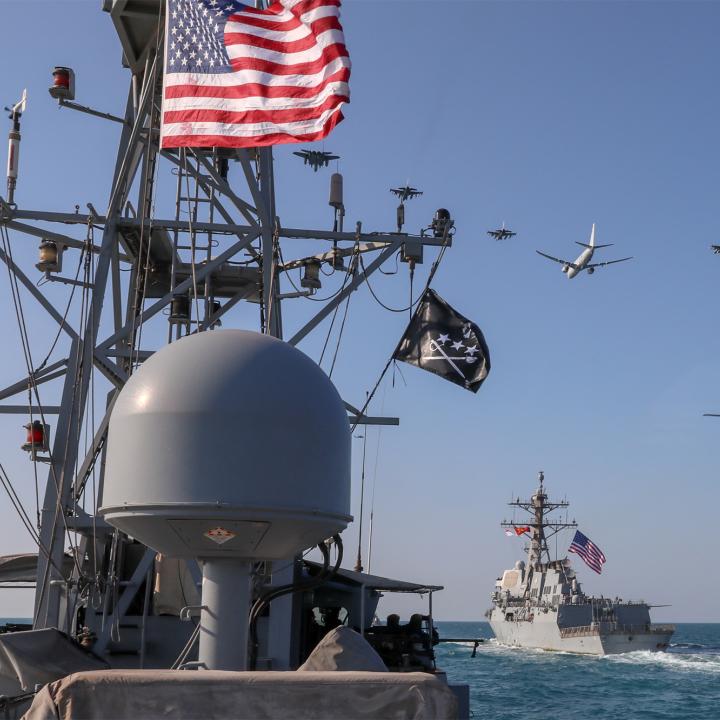
Maritime pressure. Perhaps the most important lever that the United States and the broader international community can wield in this sector is credible naval force, including continued blockade measures against Iranian ports and vessels, maritime enforcement, and a naval presence around the Strait of Hormuz. Sustained maritime pressure would directly undermine Tehran’s ability to generate revenue, particularly from oil exports. It would also incentivize regional and international actors to seek de-escalation, including by pressuring the regime to make the required concessions.
Overland and financial pressure. Maritime measures alone are insufficient—Iran has spent years constructing alternative commercial corridors and sanctions-evasion mechanisms through regional intermediaries. Accordingly, a broader economic pressure framework is needed, including:
- Tighter enforcement against trade and financial networks connected to Iran’s neighbors.
- A land blockade architecture targeting regime-linked commercial entities operating through Turkey, Iraq, Pakistan, Afghanistan, Armenia, and Turkmenistan.
- Greater pressure on commercial and financial entities connected to China in particular, but also to Russia, India, and Dubai. (Oman may eventually become part of a broader enforcement architecture as well.)
The objective is not to spark confrontation with these states, but to raise the cost for the wide spectrum of banks, shipping companies, energy intermediaries, logistical firms, insurance companies, and other entities that operate in their territory and help Iran evade sanctions. At the same time, the humanitarian and medical trade sectors should be left to continue operating without restriction.
Tehran’s Internal Constraints
The need for strategic patience is further reinforced by Iran’s current domestic circumstances. When the Islamic Republic came to power, it promised the Iranian people economic prosperity, geopolitical influence, and strategic strength. Yet the gap between promises and realities has steadily widened over the decades—now more than ever, the regime faces structural economic deterioration, growing isolation, and persistent public frustration.
Recent military confrontations have likewise exposed its vulnerabilities. The fact that Israel and the United States were able to establish rapid operational dominance over large portions of Iran’s airspace demonstrated a level of military exposure that would have been difficult for its leaders or citizens to imagine in the past.
This does not mean the regime is on the verge of immediate collapse. It does, however, suggest that the Islamic Republic’s long-term strategic narrative is under increasing pressure at home. The question is whether a prolonged period of relative calm, sustained economic pressure, and strategic patience would gradually tip the internal balance between endurance and exhaustion.
Conclusion
Washington’s primary advantage in this confrontation is not just military superiority—it also lies in America’s structural economic power, global financial influence, alliance architecture, and capacity to sustain pressure over time without exhausting itself. These are the instruments of a superpower, and employing them in tandem presents a credible path to strategic success without requiring immediate military escalation.
Conversely, a near-term decision to resume major military attacks inside Iran would likely fail to achieve its objectives given the regime’s current strategic conditions and mindset. For instance, some have proposed a limited strike against a significant Iranian energy target, but that is unlikely to change Tehran’s posture; if anything, it may spur further attacks on major Gulf energy targets. And a comprehensive strike against Iran’s broader energy and electrical infrastructure might produce dramatic effects, but it would also inflict severe damage on the population and further complicate the postwar environment.
Hence, the central challenge is not necessarily how to secure an immediate agreement with Tehran, but how to prevent time itself from becoming an Iranian strategic asset—and, by extension, how to steer the regime’s calculations toward longer-term compromise, particularly on the nuclear issue. The most effective posture may therefore be one of disciplined strategic patience based on the following principles:
- Significantly intensifying economic leverage (primarily via the closure of land crossings surrounding Iran).
- Preserving regional deterrence (e.g., via maritime enforcement measures and credible threats of resumed attacks on regime targets)
- Remaining continuously open to quiet diplomacy.
This approach does not guarantee rapid success. But it would change the underlying strategic equation that Tehran has been using for decades to buy time and maintain its hostile regional posture.
Zohar Palti is the Viterbi International Fellow with The Washington Institute. Previously, he served as head of the Mossad Intelligence Directorate and head of the Policy and Political-Military Bureau at Israel’s Ministry of Defense.