- Policy Analysis
- PolicyWatch 4208
Why Iran’s Navigational Order Will Be Difficult to Overturn
by
Noam Raydan
May 1, 2026
Also available in
About the Authors

Brief Analysis
Tehran has upended traditional maritime arrangements in the Strait of Hormuz and remains in the driver’s seat despite U.S. pressure, so authorities cannot expect to reverse this shift quickly even if the war ends soon.
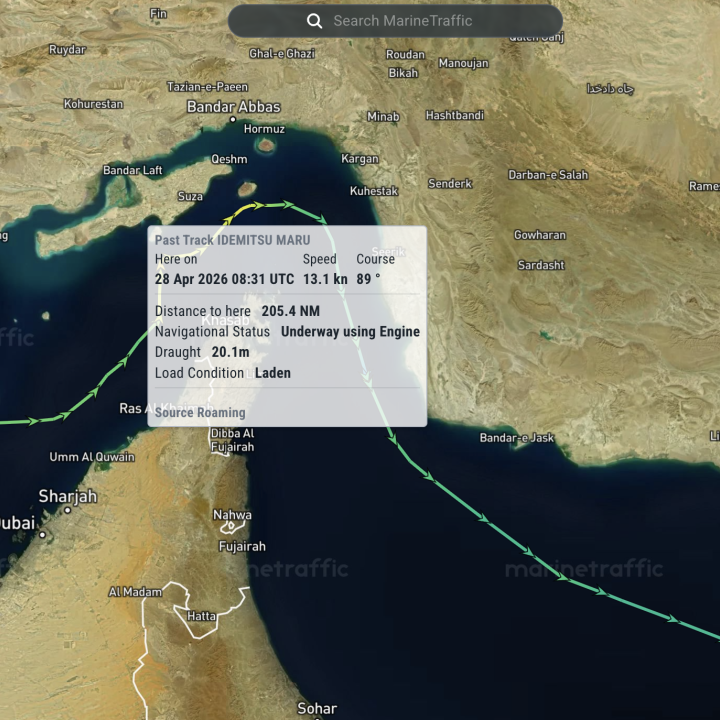
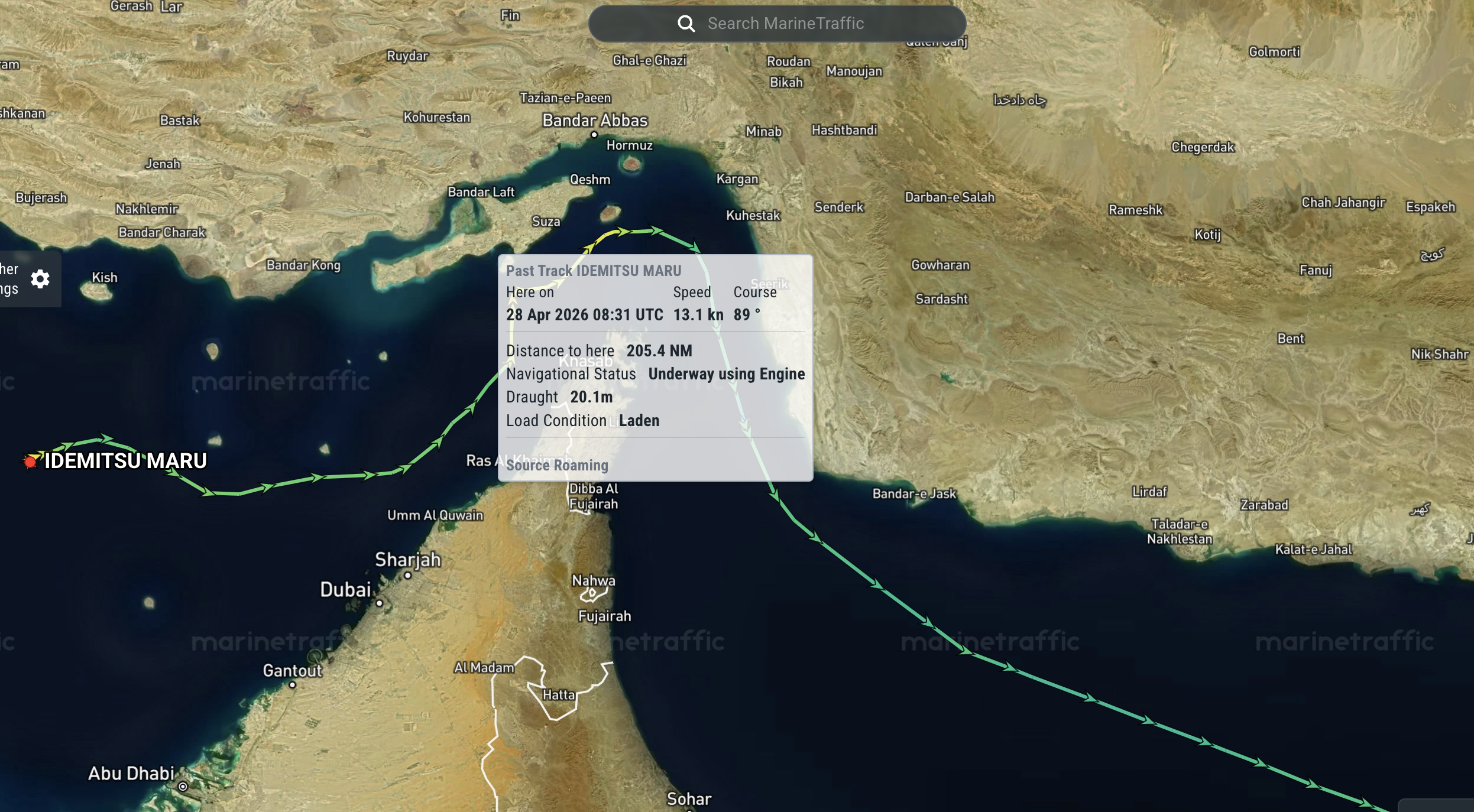
On April 28, a Japanese-owned, Panama-flagged crude oil tanker safely transited the Strait of Hormuz carrying around 2 million barrels of crude oil loaded at Saudi Arabia’s Juaymah terminal on March 3. While the Idemitsu Maru (IMO identification number 9334210) was finally permitted to leave the Persian Gulf after being stranded for nearly two months, over 150 other tankers remain stuck there as Iran maintains tight control over traffic through the strait. Indeed, the passage of this tanker and a few other non-Iranian vessels over the past week does not signal a shift in the regime’s behavior—transits are still strictly tied to the new navigational order that Tehran has been adjusting in response to developments throughout the war, including the current U.S. blockade of its ports. Controlling this traffic, particularly oil tankers, is the regime’s strongest card in this crisis, so Iranian officials will continue playing it to exert leverage and project influence.

Status of Navigation in Hormuz
Commercial vessels still lack guarantees that they can safely sail through Hormuz, particularly without adhering to the new routes Iran has ordered them to take, which lead through its territorial waters rather than international waters. Some ships that managed to exit and enter did so after the countries they are affiliated with reached out to Tehran, including India, Japan, and Pakistan, among others. Yet even these apparent arrangements have not been foolproof. Since April 18, when Iran reintroduced strict control of transit, ships linked to Pakistan and India have struggled to exit the strait. These countries—among other importers and exporters (like Iraq)—rely heavily on the Hormuz route for their energy security, so any such impediments are significant.
The last Pakistan-flagged tanker seen exiting the strait before the April 18 clampdown was the crude oil vessel Shalamar (IMO 9336842), which entered the area on April 12—the day that initial U.S.-Iran talks in Islamabad failed—and was able to load at Das Island, United Arab Emirates, and leave on April 16. Yet the Pakistan-flagged oil products tanker Khairpur (IMO 9594872), which entered the Gulf on April 12 and loaded at Kuwait’s Mina al-Ahmadi terminal, was among several vessels that failed to exit Hormuz on April 18. It was forced to reverse course and was not permitted to leave until April 30.
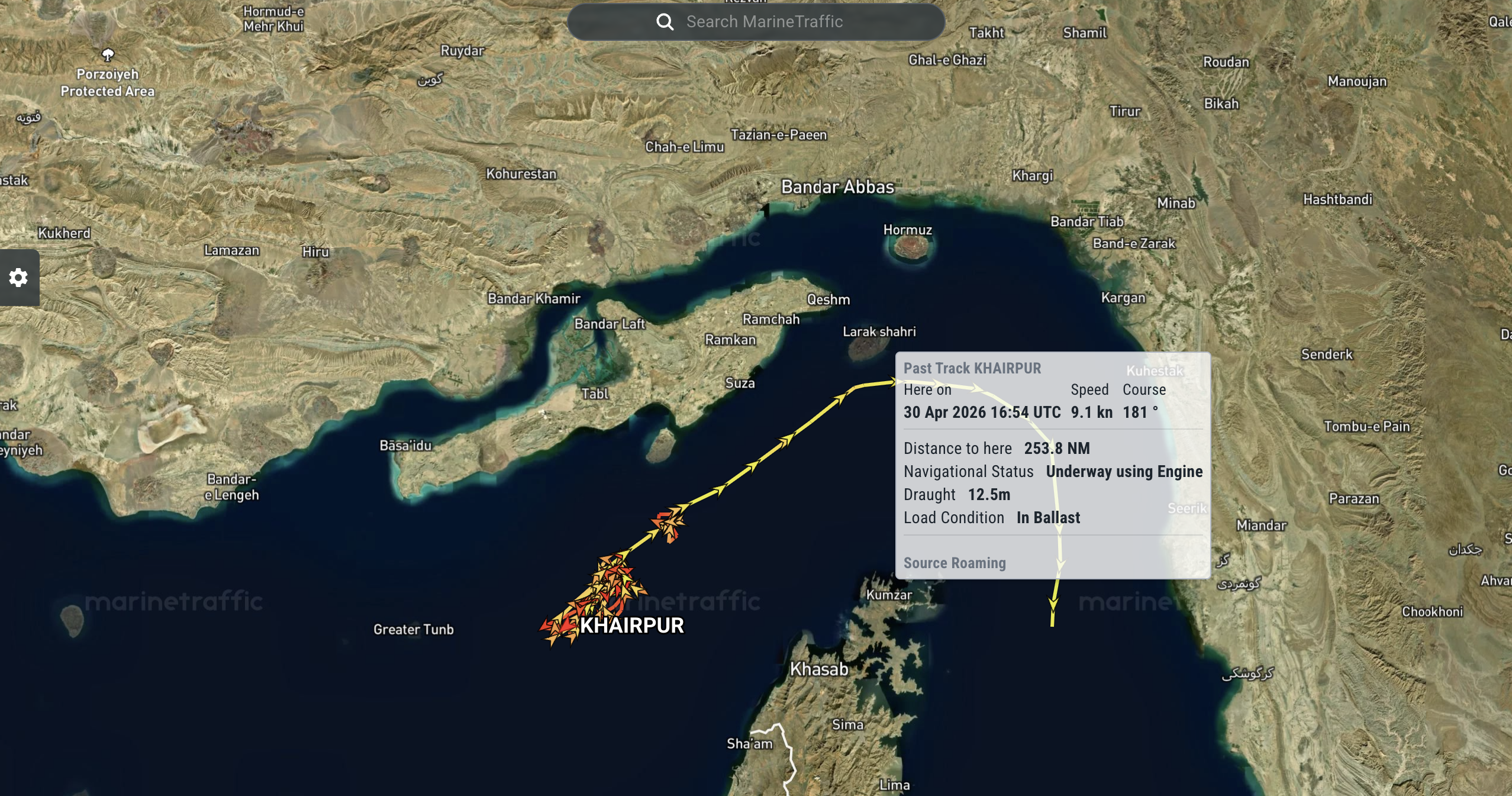

Even as the Khairpur exited, the Malta-flagged oil tanker Agios Fanourios I (IMO 9759824) was still in limbo after entering on April 15 and loading around 2 million barrels of Basra-grade crude in Iraq. Vessels doing business with Baghdad were supposed to be exempted from such restrictions, but shipping data does not show this to be the case so far. Prior to the war, Iraq’s southern crude exports via Hormuz totaled more than 3 million barrels per day (mb/d), but they have since been paralyzed.
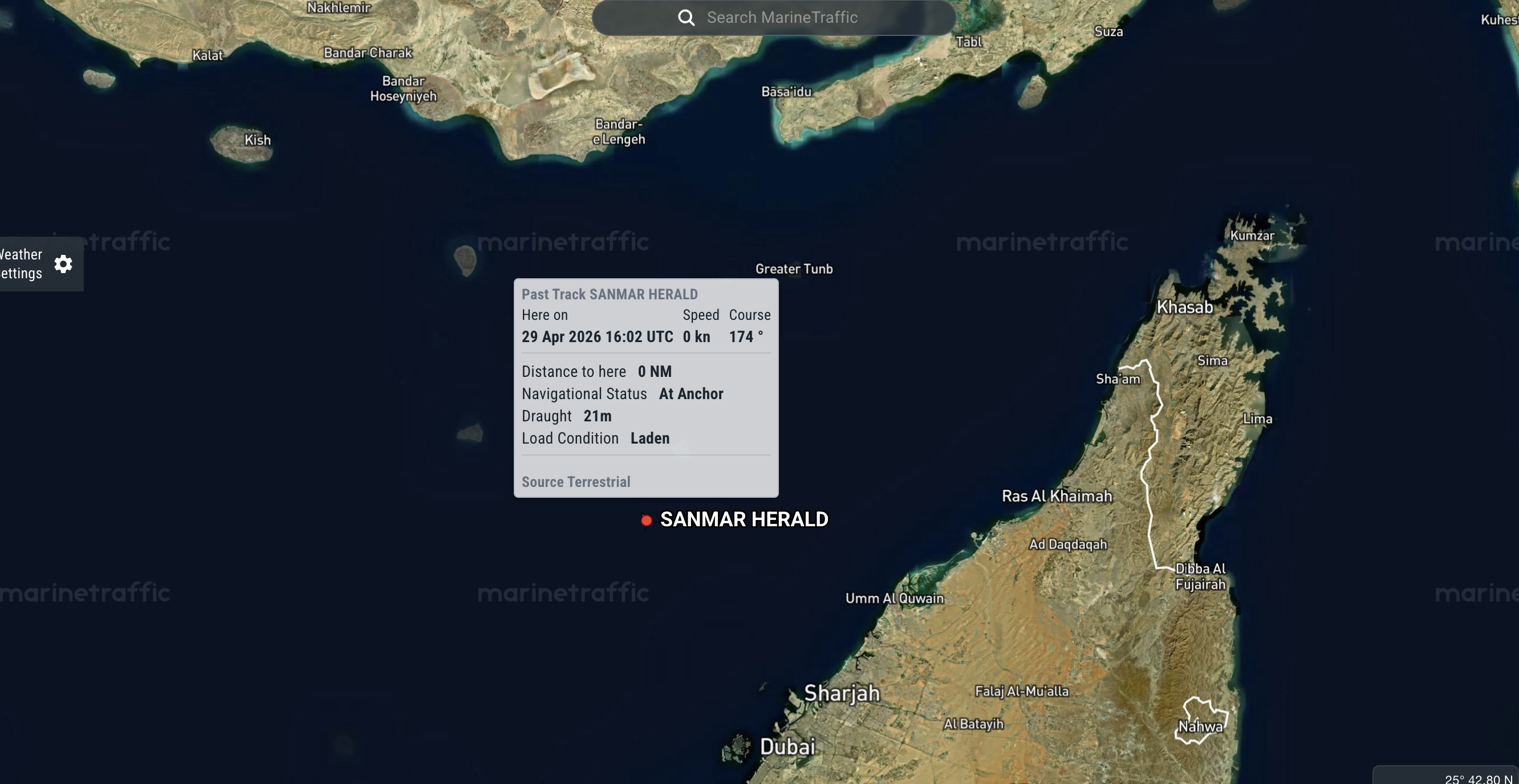
Meanwhile, at least two India-flagged vessels that attempted to transit the strait on April 18 came under attack. The very large crude carrier Sanmar Herald (IMO 9330563), which is carrying around 2 million barrels of Basra crude, was fired on by gunboats from the Islamic Revolutionary Guard Corps (IRGC), forcing it to turn back. In response, officials in New Delhi expressed “deep concern” and urged Tehran to facilitate the passage of India-bound ships. As of April 30, there was no concrete evidence that the Sanmar Herald had left the Gulf, where it has been stranded along with other India-flagged vessels. (For more on these attacks and other incidents, see The Washington Institute’s interactive map and attack tracker.)

Interestingly, at least one non-Indian tanker was able to load a Gulf cargo and deliver it to an Indian refinery despite Iran’s recent clampdown. The Liberia-flagged Jiaolong (IMO 9379208), operated by Greece-based Dynacom Tankers Management, sailed into the strait on April 19 with its Automatic Identification System (AIS) switched off, loaded at Zirku, UAE, and exited on April 24 with its AIS still shut off. The cargo reached India’s Jamnagar refinery on April 26, according to data from Kpler and MarineTraffic. In fact, at least six Dynacom tankers have managed to enter and exit the region since the war began, but it is unclear how they have been successfully navigating the strait amid the high security risks, and whether the act of switching off their AIS has helped them sail unhindered (generally, transiting the strait “in the dark” like this is very risky).
Supply Shock
According to the International Energy Agency, the overall loss in oil exports due to the war has topped 13 mb/d, putting undeniable pressure on global markets, prices, and demand. These barrels from the Gulf cannot be easily replaced—the pool of alternative supplies is limited, and competition over these volumes is sharp. U.S. crude exports have surged from around 3.8 mb/d in February (before the war) to around 5.2 mb/d in April, but this is not nearly a sufficient substitute. Shortly before the war broke out, Gulf exports of crude and condensate through the Strait of Hormuz stood at around 15 mb/d, according to Kpler.
Saudi Arabia and the UAE have been using two pipelines to bypass Hormuz, but the amount of crude they can send by that route is much less than the volumes previously sent through the strait. Moreover, these pipes cannot transport the many other oil products that need to be exported, nor the region’s flow of liquefied natural gas, which constitutes around 20 percent of global LNG supply. Tapping into various emergency oil inventories around the world is only a stopgap solution with clear limitations, not a replacement for flows via Hormuz.
The impact of all this disruption is global, albeit uneven. It is already affecting a wide array of sectors, from transportation and aviation (which have seen fuel prices soar) to agriculture, manufacturing, petrochemicals, and more. As the International Energy Agency has noted, “Resuming flows through the Strait of Hormuz remains the single most important variable in easing the pressure on energy supplies, prices, and the global economy.” Yet Tehran is unlikely to make that easy, particularly now that the U.S. blockade is disrupting tankers that carry Iranian oil to Asian countries, mainly the regime’s top client, China.
Tug of War
The movement of oil and gas tankers through Hormuz remains abysmal compared to prewar figures. For oil tankers specifically, around fifty entered and exited on February 28 alone, according to data from Kpler. Yet the number plummeted to as low as three tankers on April 28, including the aforementioned Idemitsu Maru.
Tehran will likely maintain this pressure on tankers stranded in the Gulf, partly in response to the fact that the U.S. Navy is now directing Iranian oil tankers and other vessels to return to port while seizing some falsely flagged vessels carrying Iranian oil. If Tehran bends beneath U.S. pressure and allows oil tankers to freely transit the strait, it would send a positive signal that the regime is willing to ease control over the crucial chokepoint. So far, however, there are no signs this will happen.
When the war erupted, Iran took steps early on to dominate the maritime theater. Instead of relying solely on its past tactic of attacking ships, it has focused more on establishing and maintaining tight control over Hormuz transits. Authorities should not expect this grip to loosen easily. Amid the U.S. blockade, Tehran will presumably continue portraying its restrictions over other countries using the strait as a “necessary and proportionate measure” against what it deems “security threats” in nearby waterways.
Even if a political agreement is reached to reopen the strait, a quick return to normal navigation is unlikely. Iran should be expected to exploit the new geopolitical circumstances that the war has ushered in by continuing to project influence across the maritime domain. It has already upended the principle of freedom of navigation and gravely eroded maritime security, and the path to restoring these two pillars of maritime trade remains unclear. This is the new navigational order in the region, and it is currently run by Iran.
Noam Raydan is the William Sudhaus Fellow at The Washington Institute and co-creator of its interactive map project Maritime Attacks in the MENA Region.
Share