- Policy Analysis
- PolicyWatch 4189
Iran’s Force Multiplier: Tracking the War’s Maritime and Energy Effects
by
Noam Raydan
Mar 23, 2026
Also available in
About the Authors

Brief Analysis
If Washington wants to calm the markets and reach its other energy objectives more quickly, it will have to find a way of de-escalating a shipping crisis that Tehran is clearly taking advantage of in the Strait of Hormuz and beyond.
Since the war began, Iran has quickly established itself as the principal traffic controller in the Strait of Hormuz chokepoint, forcing many vessels to remain stranded in the Persian Gulf, leaving others reluctant to enter the area, and attacking commercial ships and onshore energy infrastructure to drive home the message that it is in charge. Maintaining this state of affairs is Tehran’s strongest leverage, and the fast-moving global ripple effects of this development were both predictable and quantifiable.
Between January and the start of the war, the oil loading average in the Gulf region stood at around 20 million barrels per day (b/d) of non-Iranian crude oil, condensate, and oil products, based on data from Kpler. Some of the crude volumes have been rerouted (see below), but most are now subject to Tehran’s control. The same goes for the region’s exports of liquefied natural gas (LNG), which account for around 20 percent of global supplies.
The Trump administration has sought to ease the situation by issuing a temporary license allowing purchases of Iranian oil aboard tankers already at sea. Yet stopgap solutions like this cannot replace the massive energy flows from Gulf suppliers. Washington has also pushed for multinational naval escorts in the strait to reassure shipping firms and calm the markets. Yet while some countries have tentatively agreed to help, others have reached out to Tehran instead to ensure safe passage for their vessels, including India and Japan—a U.S. ally that relies on the Gulf for around 90 percent of its oil imports. By compelling such governments to negotiate, Tehran is positioning itself as a force to be reckoned with even after the war.
What Is Iran Allowing Through the Strait?
As of March 20, Iran-linked tankers were the main vessels carrying crude oil through the strait, with other traffic slowed to a trickle. Data from Kpler shows that between March 5 (as risks to shipping began to increase) and March 20, at least twenty-eight oil tankers linked to Iran transited Hormuz in both directions (empty and laden), at least eight of them in the past week. These include tankers with a history of sailing to the East Outer Port Limits (EOPL) off Malaysia near the Singapore Strait, a ship-to-ship hub where vessels transfer their oil cargoes for transport to China.
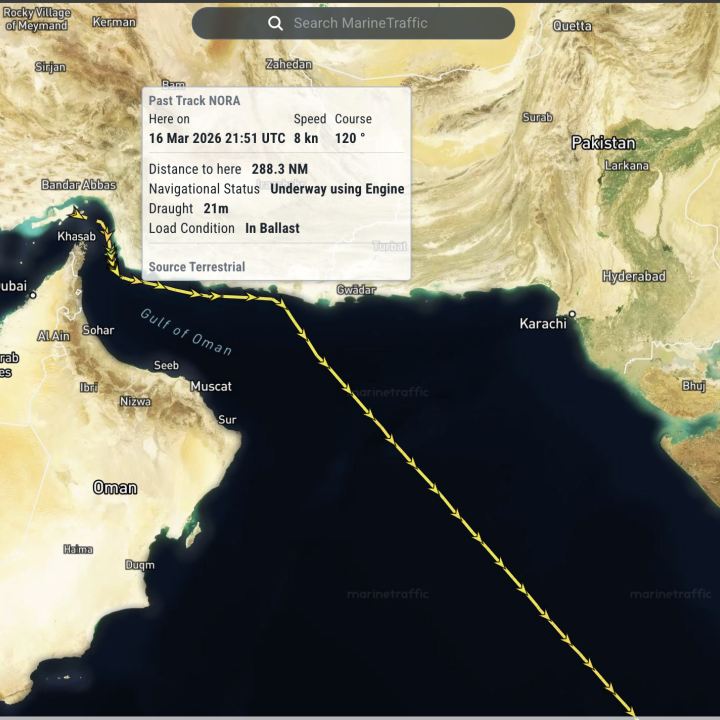
Among them is the Nora (IMO identification number 9237539), which is believed to have loaded around 2 million barrels at Kharg Island on March 7, keeping its Automatic Identification System switched off like oil tankers often do when loading in Iran. The Nora then transited the strait on March 15 with its AIS on and was observed sailing very close to the Iranian coastline until it reached Chabahar before sailing out into the Arabian Sea.

It is unclear whether the ship’s unusual navigational behavior was related to concerns about being targeted or seized. Some reports suggest that Iran has mined certain parts of the strait, but there is no concrete evidence of this so far, and U.S. defense officials have denied it. In any case, data from MarineTraffic shows the Nora signaling China as its destination, indicating that Tehran’s oil sales to its top customer have not been disrupted by the war.
In addition, at least eight oil tankers not linked to Iran (six laden, two empty) passed through the strait between March 5 and March 20. These include the Pakistani-flagged Karachi (IMO 9903413), which crossed on March 15 with crude loaded at Das Island, United Arab Emirates, and bound for Pakistan.
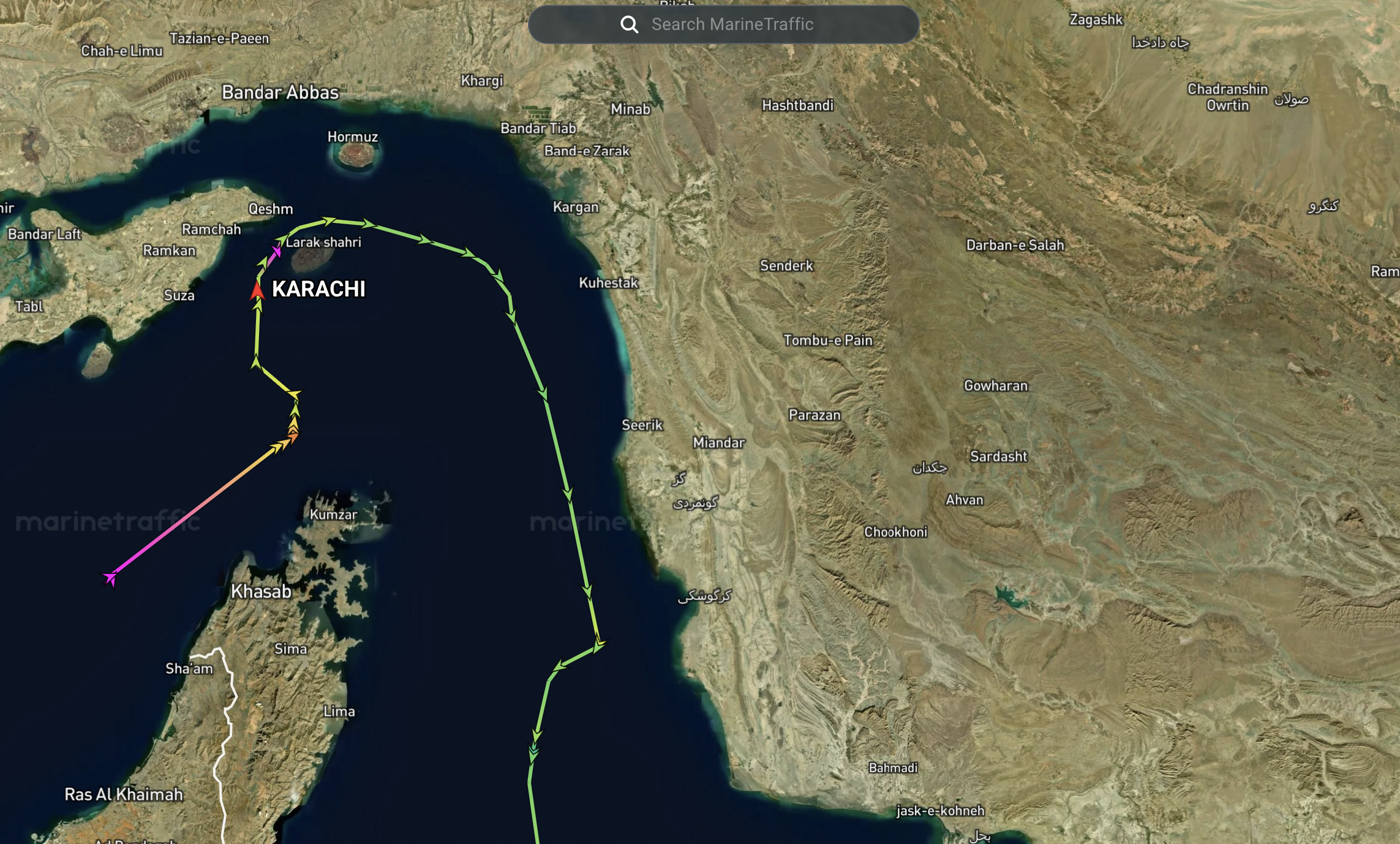

Notably, the Karachi and a few other vessels have been observed sailing around Iran’s Larak Island before exiting the strait—an unusual path for a commercial vessel leaving the Persian Gulf. It remains unclear why Iran may be mandating this route. Meanwhile, Iranian authorities have reportedly demanded transit fees from some ships. What is certain is Tehran’s effort to emphasize that it is the one deciding when and how traffic resumes via the strait.
Regarding another key energy cargo—liquefied petroleum gas—at least four India-linked LPG carriers have transited the strait since mid-March (two of them earlier today, and more should be expected). India is extremely vulnerable to disruptions of LPG transported via Hormuz. About 80 percent of its LPG needs are imported, and the majority of these supplies are sourced from Gulf countries (mainly the UAE, Qatar, Kuwait, and Saudi Arabia). India and Pakistan have reportedly been offering naval escorts to vessels flying their flags once they exit the strait, and more countries should be expected to follow suit.
Iran is also likely to continue using the strait as leverage over Gulf energy exporters, not just their customers. For instance, Iraq is the second biggest oil producer in the OPEC cartel, and around 90 percent of its national budget relies on revenues from crude exported from its southern oil terminals in the Gulf. As such, Baghdad has already asked Iran for an exemption to let its oil through Hormuz; it remains unclear if Tehran approved. In the meantime, Iraq declared force majeure on all foreign-operated oil fields due to the disruption.
Elsewhere, data from Kpler indicates that LNG tankers have been nonexistent in the strait since February 28, including from major exporter Qatar. Iran also inflicted substantial damage on Doha’s giant Ras Laffan LNG hub, targeting the site with a ballistic missile strike on March 18 in retaliation for an Israeli strike against Iranian gas facilities.
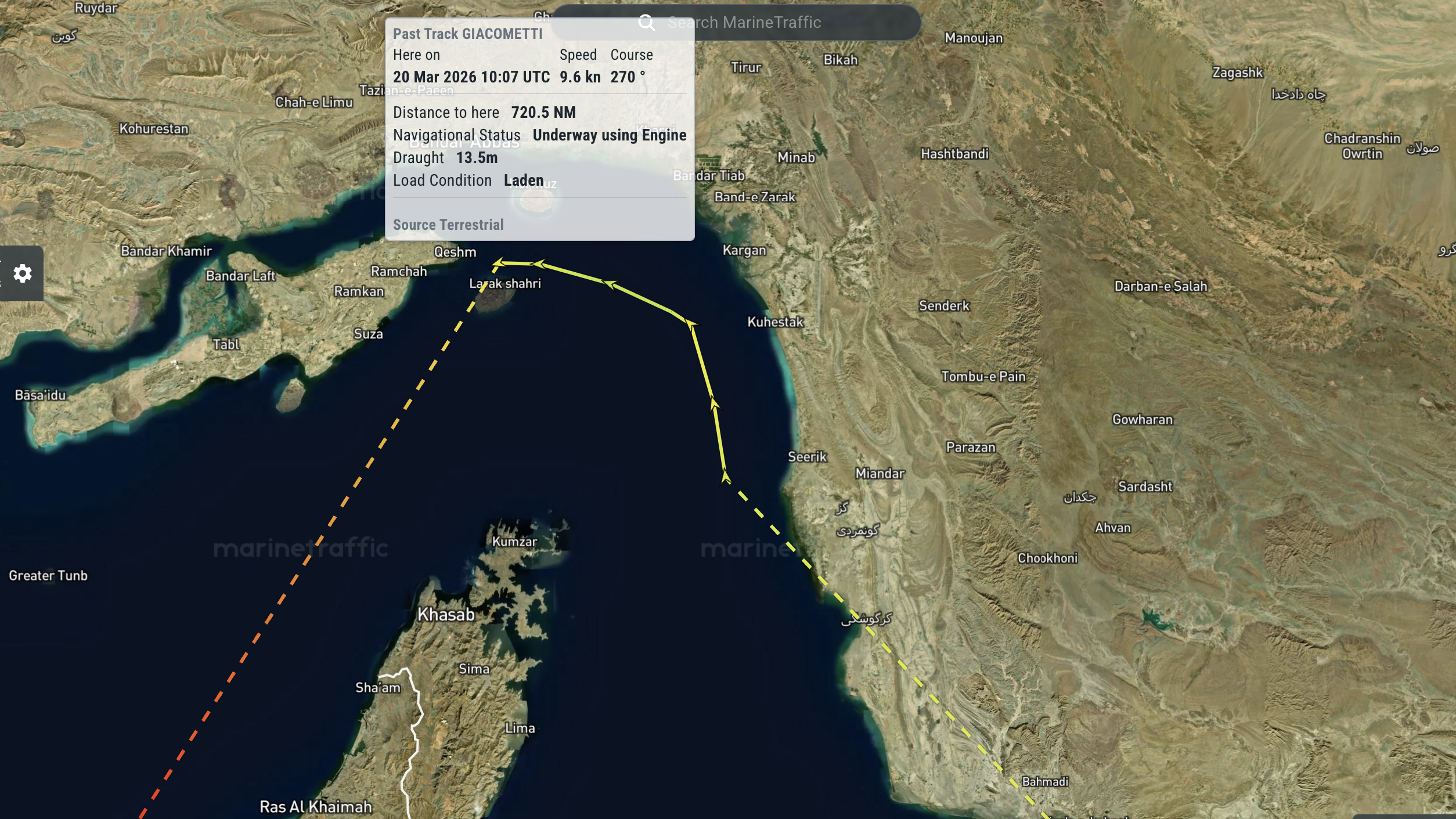
In addition to oil and gas tankers, at least nine vessels carrying dry cargo have been seen leaving and entering the Persian Gulf since March 15. These include Giacometti (IMO 9615377), owned by Greece-based company Oceanbulk Shipping, which transited the Strait of Hormuz on March 20 via the unusual Larak detour mentioned above. Other dry cargo ships making the transit included vessels (some Iran-linked) that had been at Bandar Imam Khomeini port when the war broke out.

Hormuz Is a Force Multiplier for Tehran
By disrupting all of this Gulf shipping activity, Iran is simultaneously exerting pressure on multiple regional and global systems. When tankers are unable to enter the Gulf and load, producers are forced to curb production and refining activities amid storage constraints (see: Iraq). The rest of the global oil and gas value chain is shaken as well, from upstream (exploration, production) to midstream (transportation, storage) to downstream (petrochemicals, refining).
Tehran no doubt hopes to keep these repercussions rolling through any potential diplomatic breakthrough in the war. This is best exemplified by its missile strike on Ras Laffan, where U.S. oil major Exxon Mobil is a partner. According to Saad al-Kaabi—who serves as Doha’s state minister for energy affairs and CEO of QatarEnergy—the attack took out 17 percent of the country’s LNG export capacity, risking gas supplies to Asian and European markets, possibly for as long as five years.
Further strikes on Iran’s energy infrastructure would likely exacerbate this threat. If the United States targets the regime’s main oil installations on Kharg Island, Tehran could be expected to retaliate by hitting additional energy export systems in the region, potentially including:
- Saudi Arabia’s East-West Pipeline to the Red Sea port of Yanbu. This line has a capacity of 7 million b/d, and the kingdom has been using it to divert some crude exports away from the Strait of Hormuz route during the war (though current exports through this route remain below 5 million b/d, and some of the rerouted volumes will be needed for the domestic market).
- The Abu Dhabi Crude Oil Pipeline, which has a capacity of 1.5 million b/d and carries crude from the Habshan oil fields directly to Fujairah along the Gulf of Oman
- Iraq’s northern energy infrastructure, which is already under severe constraints due to attacks by Iran-aligned militias.
If threatened further, Tehran might also ask Yemen’s Houthis to disrupt energy flows via the Bab al-Mandab Strait in the Red Sea. This could affect the diverted crude volumes that Saudi Arabia is exporting to Asian markets via Yanbu. Yet it is unclear if the Houthis would be willing to take such action given their own interests in the region and with Riyadh.
Conclusion
If the Trump administration wants to reach its stated energy objectives quickly—in the words of Treasury Secretary Scott Bessent, to “maximize the flow of energy to the world, strengthen global supply, and seek to ensure market stability”—it will have to find a way of de-escalating a maritime crisis that Tehran is clearly taking advantage of, then pave the way toward a diplomatic solution. This will require concerted help from America’s Gulf partners on addressing a clear set of maritime security challenges in the Strait of Hormuz and beyond. Four weeks of war have ensured that this will be a central subject in the region for years to come, especially coming after the previous Red Sea crisis with the Houthis.
Moreover, many countries—especially in Asia—rely heavily on the Gulf region for their energy security. Now that Iran has starkly demonstrated its ability to control ship traffic through Hormuz, some of these countries are showing a preference for negotiating safe passage with Tehran instead of sending warships to the region. The risk is that the longer the war continues, the more Iran will seek to exert this leverage over the maritime and energy domains, forcing more countries to cut side deals with it.
Noam Raydan is a senior fellow at The Washington Institute and co-creator of its new interactive map project Maritime Attacks in the MENA Region.
Share