Aaron Y. Zelin is the Gloria and Ken Levy Senior Fellow at the Washington Institute for Near East Policy, where his research focuses on Sunni Arab jihadist groups in North Africa and Syria, foreign fighting, and online jihadism.
Brief Analysis
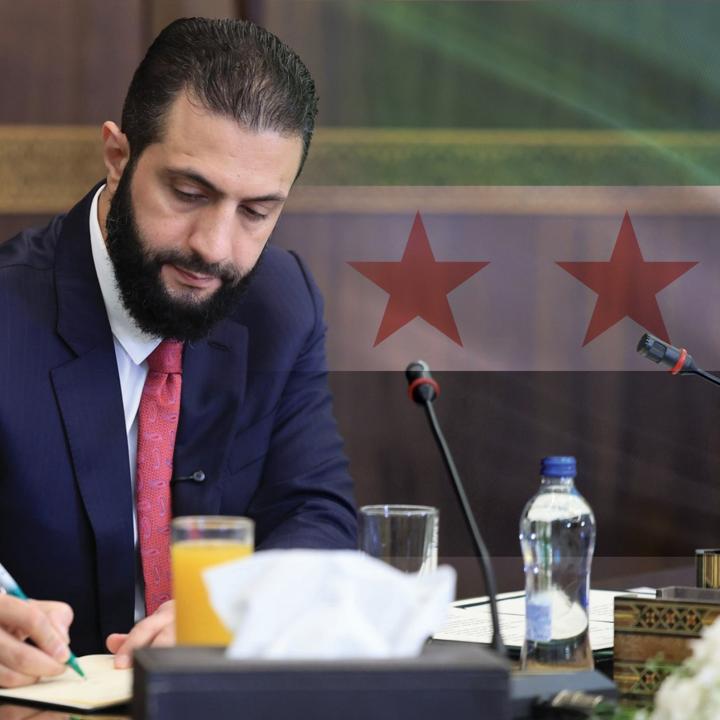
The years that President Sharaa’s circle spent managing Idlib province now look less like improvised wartime governance and more like a deliberate long-term project to build the cadres of a future state.
In recent weeks, Syria’s transitional authorities began a process of shuffling senior-level positions across the new government. This was an annual tradition when Ahmed al-Sharaa and Hayat Tahrir al-Sham (HTS) ran the Syrian Salvation Government (SSG) in Idlib province for years before ousting Bashar al-Assad’s regime, so the new changes should be contextualized within this historical continuity.
Further changes are expected in the near term, so the current picture is only a partial snapshot. So far, however, most of the new appointees hail from the Idlib/SSG cohort. What looked like improvised local governance during the civil war was, in retrospect, something more deliberate: a decade-long project to build the cadres of a future Syrian state. This means the experience now being rewarded is very specific to one governing network and one wartime political trajectory.
Who Are the New Appointees?
Secretary-General of the Presidency,Abdulrahman Badr al-Din al-Ama: During the civil war, he was the SSG’s deputy minister of social affairs and labor (2017-18), minister of development and humanitarian affairs (2018-21), director of the Humanitarian Coordination Office (2022-23), and director of the Central Planning Authority (2023-24). Prior to his new appointment, he had served as governor of Homs province since December 2024.
Governor of the Central Bank, Mohammed Safwat Raslan: During the Assad years, he was a branch manager at Byblos Bank-Syria, a consultant with EY and Capco, an expert at Targobank and Deutsche Bank, and a credit business manager at another German bank. Since the fall of the regime, he has served as general manager of the Syrian Development Fund.
Minister of Agriculture, Basel Hafez al-Suwaidan: He has taken on many positions since Assad’s ouster: deputy minister of agriculture and assistant minister for administrative and financial affairs; director of the agriculture and animal wealth sector for the Syrian Sovereign Fund; general manager of various agricultural investment companies; general manager of the Currency Protection and Consumer Protection Institution in Idlib; chair of the National Committee for Combating Illicit Gains; and a member of the National Import and Export Committee.
Minister of Information, Khaled Fawaz Zaarour: Prior to the fall of the regime, he was a lecturer at Syrian and Lebanese universities (2015-24) and received his doctorate in digital media from Lebanese University in 2019. After Assad’s ouster, he became dean of the College of Media, University of Damascus.
Governor of Deir al-Zour province, Ziad al-Ayesh: Prior to the fall of the regime, he was the SSG’s general supervisor of checkpoints management in Idlib, director-general of its Personal ID Card Project (2022-23), and head of civil affairs in the SSG’s Ministry of Interior (2023). After Assad’s ouster, he became deputy minister of interior for civil affairs. Since February, he has also served as the presidential envoy tasked with following up on the government’s agreement with the Kurdish-led Syrian Democratic Forces (SDF).
Governor of Homs province, Murhaf al-Naasan: Prior to the fall of the regime, he was an opposition field commander in Homs during the 2012-13 siege, served as chief of police in Idlib (2016-18), and worked within the HTS/SSG general security apparatus. Since December 2024, he has served as head of internal security in Homs.
Governor of Latakia province, Ahmad Ali Mustafa: Prior to the fall of the regime, he was a member of the consultative council for the opposition group Ahrar al-Sham (2011-16) and director of the Bab al-Hawa border crossing with Turkey (2016-24). Under the new government, he has served as director of Latakia port (2024), deputy president of the General Authority for Borders and Customs (2025), and director-general of Syrian ports (2025).
Governor of Quneitra province, Ghassan Elias al-Sayyed Ahmad: Prior to the fall of the regime, he was president of both the Free Local Council in Deir al-Zour (2011-12) and the SSG’s Civil Council for Displaced Persons of the Eastern Region. After Assad’s ouster, he was named deputy governor of Deir al-Zour province, later ascending to governor in March 2025.
Apart from Raslan and Zaarour, all of these individuals are from SSG circles. On one hand, this could raise concerns that the new shuffle represents consolidation rather than transition, essentially formalizing HTS/SSG dominance over state institutions. On the other hand, the changes reflect a government trying to balance several imperatives simultaneously: rewarding loyalty and field experience from the Idlib period, projecting technocratic competence to the outside world, relying on trusted figures to carefully manage sensitive regions, and presenting a young, forward-looking image. The intended outcome of these efforts seems clear: trusted revolutionary-era cadres will run the state, while select ministries and financial/media portfolios will be given to figures who can project administrative competence, international connectivity, and institutional modernization.
Yet running a wartime statelet is fundamentally different from governing a large country that remains traumatized, impoverished, and riven by multiple divides (urban/rural, socioeconomic, regional, and sectarian). Whatever the individual merits of the new appointees, the announcements suggest that the leadership’s transition from one governance challenge to the other is still very much a work in progress. The Idlib model was developed for a specific population in a specific territory; scaling it nationally without meaningful adaptation is a significant political gamble, especially considering Syria’s deep economic insecurity.
U.S. Policy Implications
In determining how best to approach this sensitive moment in Syria, the United States brings a complicated hand to the table. The Trump administration has fully withdrawn all American troops; sanctions relief, full diplomatic recognition, and deeper engagement with Damascus all remain up for debate in Washington; and the composition of the latest government shuffle has given some U.S. officials pause, since it did not expand the circle any further than the previous shuffle a year ago.
Going forward, however, the question of how these individuals actually govern seems more relevant than their biographical details and past affiliations. America’s policy priorities remain the same: preventing Syria from becoming a platform for transnational terrorism (whether global jihadist or Iran-backed), eliminating any residual chemical weapons from the Assad era, and avoiding a government collapse scenario, since that would likely produce another wave of refugee displacements and regional destabilization. On all these fronts, Damascus has done better than most expected over the past eighteen months.
To be sure, the new government still has important questions to answer about excising extremists who have infiltrated its ranks, particularly given Washington’s lingering anger over the December 2025 attack that killed American soldiers in Palmyra. And U.S. officials should of course continue conditioning and sequencing sanctions relief based on Syria’s demonstrated ability to fulfill verifiable benchmarks, namely:
Visible inclusion of minority representatives in governance structures (the imminent seating of the new parliament should help with this issue).
Measurable steps toward press freedom and civil society space (the government is heading in the right direction on the former issue, but the latter will require a new NGO law to protect civil society groups).
Reforms and demonstrated accountability mechanisms in the security services (who continue to fall short on issues of transparency and actual adherence to the 2025 Constitutional Declaration).
At the same time, Washington should be honest about the limits of its ability to sustain political attention on Syria and micromanage the country’s transition, especially amid major crises elsewhere in the Middle East and growing geopolitical challenges further abroad. U.S. officials should therefore embrace close cooperation with partners in Europe, the Gulf states (who have real financial leverage in Syria), and Jordan and Turkey (who have immediate geographical stakes). Together, they can construct a genuinely multilateral engagement framework that distributes both the incentives and the monitoring burdens of engaging the new Syria more broadly. Calibrated, conditional, and patient engagement with clear red lines around sectarian violence is the only realistic policy posture available.
At the end of the day, however, Syria will be shaped primarily by Syrians. If Damascus makes other changes at the ministerial and governor level in the coming days and weeks, it may be worth reexamining how all this shuffling fits together. But the pattern so far is more continuity than change—the question is whether propagating the Idlib model at the national level will work in the long term.