- Policy Analysis
- PolicyWatch 4216
Iran’s Drone Strategy (Part 1): Wartime Performance and Adaptations
The war has shown that Iran’s one-way attack drones are highly adaptable tools of coercion and military effect, able to continue imposing costs across the Gulf region and beyond even after heavy losses.
According to recent U.S. military estimates, as much as 85 percent of Iran’s drone arsenal and associated industrial base was damaged or destroyed during Operation Epic Fury. Yet the conflict has also clarified what makes the regime’s drone program so dangerous: an operational approach built around mass dispersal, repetitive attack pace over a long period, and the ability to produce strategic effects even with limited success in penetrating enemy air defenses. As the crisis continues, the most pressing questions are clear: What elements of the drone program has Iran lost? What has it preserved? And how will the remaining elements most likely be used if fighting resumes in the near future?
U.S. and Israeli strikes appear to have sharply reduced Tehran’s ability to sustain large, long-range salvos at the tempo seen early in the war. In response, however, Iranian forces changed their operational rhythm and transformed the conflict into a war of attrition, with smaller but repeating waves that are more difficult and costly to defend against. If hostilities break out again soon, allied countries will likely face a more streamlined, improvised, but still dangerous drone campaign built around surviving stocks, dispersed launches, and selective attacks on vulnerable targets, to include Gulf shipping.
Arsenal, Doctrine, and Wartime Adaptations
Before the war, Iran had a large arsenal of one-way attack drones (OWADs) distributed across the Islamic Revolutionary Guard Corps and regular army (Artesh), operated from small, simple airstrips around the country and a few underground bases at undisclosed locations in central and southern Iran. The exact inventory remains unknown, but it included multiple midsize OWAD types; the IRGC and Artesh were estimated to have hundreds of each type, for a total force numbering in the thousands.
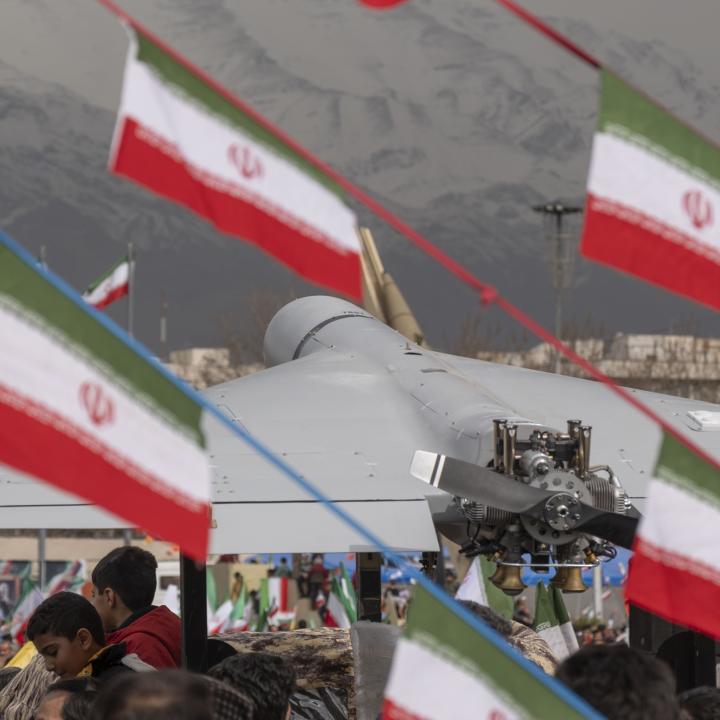
Both last summer’s twelve-day war and the current conflict confirmed that these drones have joined ballistic missiles as central components in Iran’s precision strike capability. The regime entered this year’s war with a lethal ecosystem built around large stocks of Shahed-136, Arash-2, and other long-range OWADs, along with dispersed mobile launch capabilities, seasoned supply networks, and a research and production base easier to regenerate than its missile force.
The program’s survivability against massive U.S. and Israeli operations is less surprising when one considers Iran’s physical size and the breadth of its drone ecosystem. Military production lines, front companies, dual-use suppliers, and nominally civilian firms all feed into the enterprise, while numerous Iranian universities and technical institutes run defense-oriented research projects related to drone engines, actuators, sensors, guidance software, and communications. These institutions have supplied both engineering talent and applied research, while startups and workshops have filled gaps in components, composite materials, and assembly. (Part 2 of this PolicyWatch will discuss this ecosystem in greater detail, including why Tehran may be able to reconstitute and enhance it quickly after the war.)
From the conflict’s outset, Iran used OWADs as standalone strike systems and as part of a broader coercive method. Besides hitting targets, the point was to make the air picture crowded and costly enough that even high interception rates would still leave defenders under constant strain.
The opening phase reflected that doctrine clearly. According to various sources, Iran and its proxies launched a total of about 4,400 OWADs at various countries prior to the April 7 ceasefire, for an average of around 120 per day. Most of them (about 85-90 percent) were fired in the first two to three weeks of the war. By launching so many drones and combining them in mixed packages alongside ballistic and cruise missiles, Tehran was able to keep the Gulf states and Israel on constant alert.
Among the Gulf states, the United Arab Emirates bore the brunt of this campaign (2,210 drone strikes and hundreds of ballistic and cruise missile strikes as of April 7), followed by Saudi Arabia, Kuwait, Bahrain, and Qatar. Although their air defenses were highly effective at the tactical level, they were not impermeable. The volume of near-daily interceptions imposed operational strain, while the relatively small number of drones that got through caused both casualties and major economic disruption, showing that Iran’s arsenal could serve as an instrument of both pressure and attrition.
Perhaps most important, Iran adapted quickly once U.S. and Israeli forces gained broad freedom of action over its airspace, shifting from larger, more visible launch architecture to more concealed and protected methods. This included dispersing launches more widely, hiding drones more deeply in tunnel complexes and civilian, industrial, and natural terrain, and preserving just enough sortie generation to keep the pressure on. In doing so, the regime proved that the operational logic behind its drone program could endure despite the damage that allied airstrikes wrought on production and storage sites.
What the Allied Campaign Achieved
One key objective of the U.S. military’s Operation Epic Fury was to “obliterate” Iran’s drone capability and production capacity. Combined with Israeli airpower, it aimed to reduce daily launch counts and suppress the regime’s ability to generate sustained salvos by striking production lines, regeneration nodes, launch infrastructure, and storage sites. Simultaneously, it sought to protect U.S., Israeli, and partner forces through active air defense, fighter patrols, intelligence fusion, and layered counter-drone efforts, including electronic warfare.
Determining precisely how much of Iran’s drone arsenal has been destroyed is difficult via open-source information alone, but the allied air campaign inflicted real damage. During the operation, U.S. Central Command released various strike videos showing nineteen Shahed-136 and Arash-2 drones destroyed on launchers or in open storage. It also struck many targets related to the production of drone engines, optical sensors, and warheads, along with subassembly and final assembly sites. At the end of March, shortly before the ceasefire was announced, CENTCOM indicated that roughly two-thirds of Iran’s drone production facilities and industrial machinery had been damaged or destroyed, along with about half of the stockpiles, launch equipment, and trained crews that had supported large-scale OWAD warfare. It also stated that launch rates had fallen by more than 90 percent. At the time, some news reports indicated that U.S. intelligence could only confirm destruction of about one-third of the regime’s drone capability, implying a substantial surviving force. Yet the final week of major combat involved even heavier allied strikes on drone-related targets, which could account for the significant differences in U.S. damage assessments between late March and after the ceasefire.
Whatever the actual numbers, the allied campaign clearly did not eliminate the threat—which in any case evolved after the first few days of the war. Iran shifted from mass drone salvos aimed primarily at well-known landmarks (e.g., high-rise buildings) to more selective and accurate strikes against high-impact targets such as airports, fuel storage sites, radar facilities, ports, telecom nodes, and exposed military aircraft. Under the latter strategy, even a handful of successful penetrations can generate outsize operational, psychological, and strategic effects.
Moreover, the regime and its militia proxies in Iraq were able to sustain high daily attack activity against multiple states even amid heavy allied bombardment. By early April, they were still managing roughly 20 to 50 daily drone launches; around 137 such strikes were reported on ceasefire day alone.
The strategic potency of Tehran’s drone campaign stands out even more when compared to concurrent Russian hostilities in Ukraine. As noted above, Iran launched an estimated 4,400 OWADs before the ceasefire, about 90 percent of which were intercepted. In Ukraine, Russia launched over 10,000 Shahed/Geran-type OWADs over nearly the same period, facing a similar average interception rate. Yet thanks to the Persian Gulf’s compressed geography—where critical targets lie just 100-300 kilometers from enemy launch sites—the much smaller volume of Iranian attacks generated disproportionately severe strategic effects, and in a matter of weeks rather than years. In addition to disrupting all sectors of the global oil industry, Tehran’s combined drone and missile campaign slashed Qatar’s exports of liquefied natural gas by 17 percent, triggered commodity price spikes worldwide, and paralyzed commercial shipping through the Strait of Hormuz.
What a Near-Term Return to War Would Look Like
If hostilities resume soon, Iran could likely restore a significant amount of its lost OWAD capacity without waiting for full industrial recovery, drawing on surviving components, hidden stockpiles, dispersed workshops, and partial assembly lines. It could also further refine the adaptations it has already made, potentially including immediate use of tactics like the following:
- Quicker, more improvised use of its remaining arsenal.
- Smaller salvos that make greater use of concealed launch methods, including civilian cover.
- Greater reliance on proxy strikes, especially from Iraq.
- More selective attacks against target sets where even a few successful penetrations could have outsize effects.
- More focus on vulnerabilities exposed during the war, including Gulf air defense and air traffic radars, parked military aircraft, maintenance hangars, and logistics nodes. The regime’s use of long-range OWADs against Gulf infrastructure, shipping, and rear-area targets would continue, but the emphasis may shift to critical infrastructure targets against which the accuracy of a strike matters more than its explosive weight.
- Greater use of smaller, shorter-range drone systems, particularly against any U.S. naval vessels and other forces operating close to Iranian territory.
In short, Iran would likely pose a substantial drone threat even before a full postwar rebuild, in part by improvising with its surviving stocks, hybrid launch methods, and more opportunistic operations focused on rapid exploitation of exposed, time-sensitive targets.
Conclusion
The war has shown the level of damage Iran can inflict with OWADs while under heavy enemy pressure. To be sure, any near-term resumption of allied military operations would presumably concentrate even more intensively on destroying drone capabilities, perhaps even through the use of ground forces. Yet many of the top threats posed by this arsenal could persist indefinitely under fire. Most notably, Iran’s degraded but highly adaptable drone forces may use these weapons even more selectively and more covertly, focusing on vulnerable, high-value regional targets such as power substations, desalination plants, port control nodes, communications hubs, fuel tank farms, air traffic control centers, and airport aprons and hangars.
For the United States, the immediate priority should be force protection. The war has shown that relying too heavily on expensive missile defenses against relatively low-cost OWADs is financially and operationally unsustainable. U.S. and partner forces need to make urgent improvements on several fronts: passive detection capabilities, optical and acoustic cueing, cheaper interceptors and short-range counter-drone systems (e.g., rapid-firing guns, directed energy weapons), hardening against drone strikes, camouflage, concealment, deception, and local battle management. The Gulf states already appear to be moving toward cheaper, more layered counter-drone defenses, better local integration, and better training, relying in part on Ukraine’s deep operational experience in defeating Shahed-type OWAD systems. U.S. officials should do all they can to accelerate that trend.
Farzin Nadimi is a senior fellow at The Washington Institute, specializing in the security and defense affairs of Iran and the Gulf region.