- Policy Analysis
- PolicyWatch 4184
Washington Should Jump on Ukraine’s Outreach to the Middle East
By offering military expertise and technology to the Gulf states, Kyiv has given the U.S. government a unique opportunity to counter Iran and Russia while boosting the security of American partners and forces in the region.
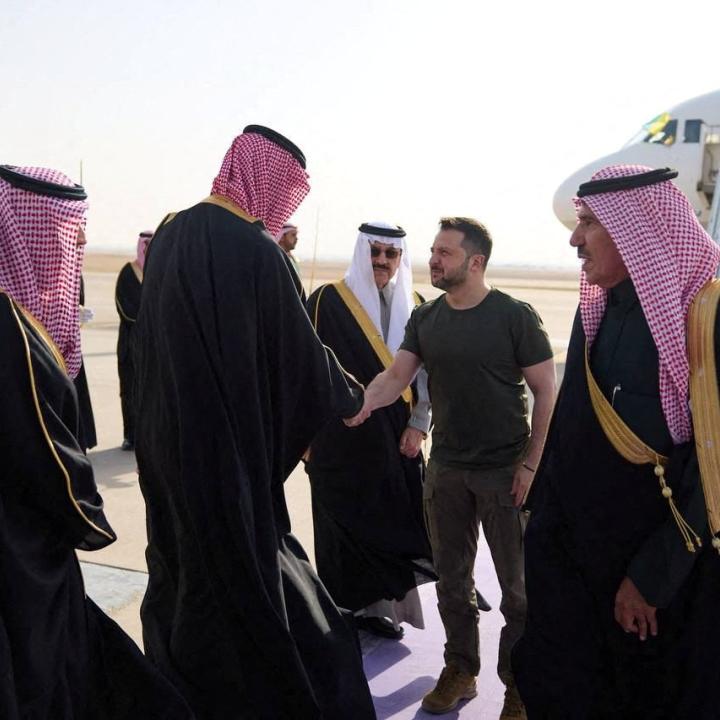
This week, the Ukrainian government reportedly dispatched military experts to Qatar, Saudi Arabia, and the United Arab Emirates to exchange expertise and discuss defense cooperation amid the Iran war and beyond. Indeed, the past four years of Russian warfare in Ukraine have produced a perhaps unexpected outcome: the country is now a world-leading expert in drone and counter-drone operations. Kyiv is smartly marketing this expertise across the Middle East—a significant development for U.S. interests that could bring a key European partner into a network of American relationships apart from European security concerns. And if Ukraine hopes to meaningfully improve its relationship with the Trump administration, seizing these kinds of military, business, and diplomatic opportunities is crucial.
An Unparalleled Asset Against Iranian and Russian Drones
President Volodymyr Zelensky has wasted no time so far—when the Iran war erupted, he quickly proposed that Gulf states exchange some of their air defense missiles for Ukrainian drone interceptors. Within days, Ukrainian drone manufacturers reportedly received orders from the Gulf states and are now prepared to export interceptors pending government approval. Saudi Arabia is also set to buy a large order of Ukrainian air defense equipment.
Indeed, Kyiv is showing itself to be an unrivaled asset in the current security environment. As the only government in the world with a mass-produced, combat-proven system specifically designed to counter Iranian and Russian mass-drone attacks, Ukraine is in a unique position to support urgent U.S. military, economic, and political interests in the Middle East. As Zelensky noted in a March 4 statement, “Our military has the necessary capabilities. Ukrainian experts will work on-site, and teams are already negotiating this. We are ready to help protect lives, protect civilians.”
Soon after the war began, Iran launched large waves of Shahed drones and other munitions against the Gulf states. Russia has used tens of thousands of these same Iranian-designed drones against Ukraine since 2022, so Kyiv’s long experience defending against them could be of immense help to Gulf governments. Significantly, Ukraine’s drone-based interceptors also provide a cheaper alternative to U.S. Patriot missiles.
Despite the overall reduction in Iranian drone strikes in recent days, these defensive needs will persist during and beyond the current war. Unless the regime in Tehran completely collapses, Gulf states will need the proper equipment to effectively (and cost-effectively) defeat one-way attack drones like the Shahed, as well as trained personnel who know how to use these systems. Proven counter-drone tactics must be paired with the technological ability to shoot these weapons down, and Ukraine has both.
When Russia launched its full-scale invasion of Ukraine in 2022, it quickly ran into several major problems: quick depletion of precision munitions, inability to establish air superiority, and high-attrition warfare. It therefore sought a low-cost way to strike at Ukrainian infrastructure at a high rate. Iran helped solve this problem by emerging as a key supplier of Shaheds, and Russia then improved on this technology by transforming the Shahed into the Geran. The two countries eventually expanded this drone cooperation into the realms of wider technology transfers and licensed manufacturing.
As a result, Ukraine had to find ways of intercepting, jamming, shooting down, and reverse-engineering thousands of Russian/Iranian drones for years, on a daily basis, and at low cost. One outcome of this effort was an entire generation of operators, engineers, and tacticians with practical expertise in using and defending against drones. No country has the relevant combat data and human expertise that Ukraine now possesses. The irony is hard to miss—Iran designed effective drones and transferred them to Russia; Moscow improved on this technology; Ukraine was forced to develop top-notch counter-drone capabilities in response; and Kyiv is now selling these defensive systems to Iran’s regional adversaries.
Policy Recommendations
Zelensky’s offer highlights the deep interconnections between the European and Middle Eastern theaters, especially given that Russia remains Iran’s partner and is reportedly providing it with indirect support during the war by sharing intelligence. Some observers have also suggested that Moscow is providing Tehran with additional drones, but regardless of whether such speculation proves true, their military cooperation will likely continue and perhaps even grow, especially if the Ukraine war pauses.
The current crisis has created a unique moment in which Ukraine and the Gulf states need each other: Kyiv can offer them defensive options that no one else can, while Gulf leaders can help ease Ukraine’s immediate need for cash, among other potential assistance to the war-torn country. Yet U.S. officials should understand that this situation provides a basis for much more than short-term transactional benefits. If the Trump administration seizes this moment, it could not only facilitate a durable partnership between Ukraine and the Gulf states, but also begin the long-term process of eroding Russia’s often-destabilizing influence over these governments. Specifically, Washington should prioritize the following steps:
Act as the convener by bringing Ukrainians to regional military headquarters. Given its leading role in important regional military exercises involving numerous Gulf states, the United States could create another exercise series focused on countering air threats, then invite Ukraine to send technical experts or offer training in the field. This would naturally serve as an opportunity to demonstrate U.S. and Ukrainian counter-drone capabilities while workshopping important tactics, techniques, and training challenges with Gulf partners.
Based in Qatar, U.S. Central Command’s Combined Air Operations Center (CAOC) is designed to host diverse partners at multiple classification levels and in support of unique missions. This framework for cooperation and mission planning could easily incorporate Ukrainians if Washington agrees to bring them in. Similarly, Ukrainian experts could join U.S. air defense command headquarters to provide technical expertise or conduct working-group exchanges to review ongoing planning for counter-drone defense in the Gulf.
U.S. officials should also encourage the Gulf Cooperation Council to consider admitting Ukrainians to relevant events and forums; for instance, they could fulfill technical expert roles at the GCC’s Unified Military Command in Riyadh. Such arrangements would enable both the United States and Gulf partners to learn from Kyiv’s hard-won expertise in building a network of systems to reliably counter air threats.
Encourage greater GCC diplomatic and economic engagement with Ukraine. Given its extensive partnerships with the Gulf states, the Trump administration is well-positioned to request that Ukraine be featured more prominently in regional economic and energy forums like the GCC Strategic Dialogue. This could include giving Kyiv observer status or other increased participation in GCC regional expo events. Washington could also facilitate regional trade discussions with Ukraine, especially on food and energy. Although Moscow has established a de facto leadership role in the OPEC+ cartel, U.S. officials can chip away at Russia’s prominence in the Middle East’s overall energy sector by including Ukraine in discussions of alternatives such as nuclear energy (where Kyiv has extensive expertise), green hydrogen, wind, solar, and innovative energy storage technologies. Increased ties with Kyiv could in turn give the Gulf states practical reasons to invest in Ukraine’s future, potentially tipping the scales and eroding their interest in remaining neutral on Russia’s war against Ukraine.
Launch a pro-Ukraine information campaign in the region. Over the past few years, Kyiv has learned the importance of engaging with the so-called “Global South,” including the Middle East. The region was ambivalent (at best) in its response to Russia’s 2022 invasion of Ukraine—it did not join Western sanctions or otherwise help isolate Moscow in a meaningful way. As Ukrainians continue to demonstrate their creativity in solving important problems using effective technology and proven expertise, the United States should help highlight these successes throughout the region, emphasizing that Kyiv can be a viable alternative to Moscow in the military realm and other sectors. Besides decreasing Russia’s market for arms exports, such efforts could lay the foundation for creating viable alternatives to Moscow’s influence in the region and reducing Gulf worries about antagonizing the Kremlin.
Anna Borshchevskaya is the Harold Grinspoon Senior Fellow in The Washington Institute’s Diane and Guilford Glazer Foundation Program on Great Power Competition and the Middle East. Matt Tavares is a former analyst for the Pentagon, focusing on Russian military strategy and U.S. foreign policy. They coauthored the recent Institute report “After Ukraine: Prospects for a Russian Resurgence in the Middle East.”