- Policy Analysis
- PolicyWatch 4188
Military Options for Reopening the Strait of Hormuz: Limitations and Imperatives
Loosening Tehran’s grip on the strait and its disruption of the global economy would entail not only reducing threats to navigation, but also increasing pressure on the Iranian economy in order to deter further attacks and create leverage for diplomacy.
After attacking more than twenty ships in or near the Strait of Hormuz since the war began, Iran has established a selective passage regime through the Persian Gulf chokepoint, exporting its own oil and natural gas while permitting safe passage to countries that “pay a toll” and denying transit to all others. Tehran’s terms to end the war include a “new legal regime for the Strait of Hormuz,” which is a clear challenge to U.S., global, and regional interests. On March 21, President Trump issued an ultimatum that Iran’s power plants would be obliterated unless it fully opens the strait. The Iranian military countered by threatening to target all U.S. and Israeli-related energy, information technology, and water desalination infrastructure in the region. Earlier today, the president postponed any strikes against power plants for five days to allow ongoing discussions with Iran.
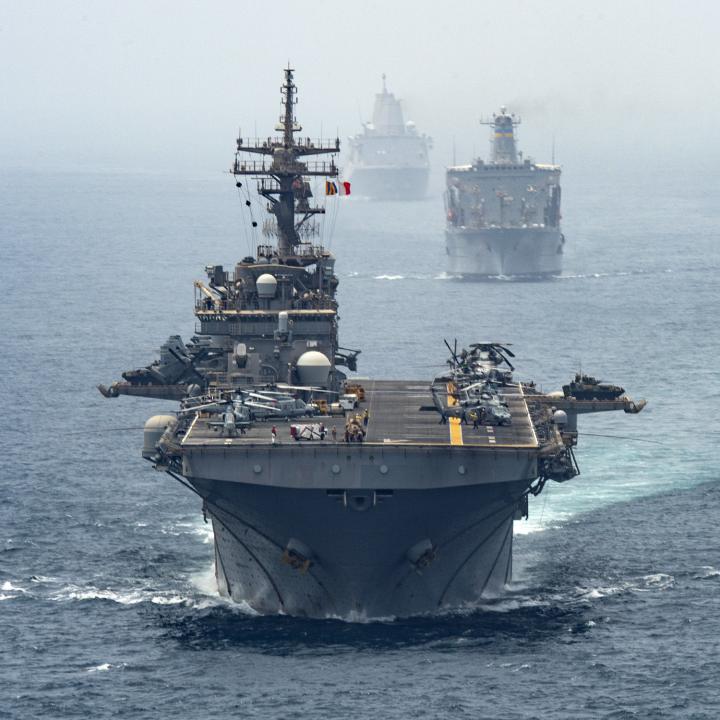
Given the resultant jeopardy to the global economy, Trump has stated that the U.S. Navy will reopen the strait and has called on other countries to help. On March 19, the leaders of Canada, France, Germany, Italy, Japan, the Netherlands, and the United Kingdom issued a joint statement expressing “readiness to contribute to appropriate efforts to ensure safe passage” through Hormuz. Twenty-two nations have now signed the statement. Meanwhile, U.S. forces have destroyed over 130 Iranian naval vessels and 44 minelayers and attacked dozens of military targets along Iran’s coast and inside the Gulf, including storage sites for mines and missiles. The United States has also dispatched the 31st and 11th Marine Expeditionary Units and the USS Tripoli and Boxer Amphibious Ready Groups to the Middle East to provide additional options.
As the war enters its fourth week, what are Washington’s military options for breaking Iran’s hold over the strait and the global economy? Moreover, what risks do these options carry, and what are their prospects for success?
Countering Threats: Convoy Operations and Degrading Enemy Capabilities Ashore
In 1987-88, toward the end of the Iran-Iraq War, the United States organized Operation Earnest Will, a convoy operation intended to defend Kuwaiti tankers. Contrary to U.S. expectations, Iran was not deterred by the American naval presence. Instead, it designed workarounds, ceasing small boat attacks on tankers but challenging the United States by covertly sowing minefields, attacking tankers in port once they were no longer under escort, and ramping up attacks on vessels not protected by the convoys. Indeed, an oil tanker struck a mine in the very first convoy. Tehran did not pull back until after April 1988, following a series of U.S. Navy surface actions (Operation Praying Mantis) that inflicted heavy losses on Iran’s navy. That said, the convoys did deter direct attacks on escorted tankers, force Iran to rely on less effective means, and help contain the war at sea until other developments led Iran’s leaders to accept a ceasefire (e.g., Iraqi victories on land, the collapse of morale in Iran, and the accidental U.S. downing of an Iranian airliner which killed all 290 aboard).
Yet several factors distinguish the current situation. The Gulf is a much more complex operational environment today. Although Iran’s military has been greatly weakened, it appears to retain significant residual capabilities, including large numbers of small boats, antiship cruise and ballistic missiles, coastal artillery and rocket units, and numerous attack drones. Many of these drones could be launched from over 1,000 miles inland, and depleted inventories might be replenished by Russia as the crisis continues.
Another notable difference is that nearly thirty warships were involved in Earnest Will in an era when the U.S. Navy had nearly 250 major surface combatants in total. Today, a task force of this size would comprise nearly a third of the U.S. fleet, which has shrunk to around 100 major surface combatants. This is probably not a sustainable commitment. The U.S. Navy also lacks critical equipment; U.S. Central Command currently has only one littoral combat ship with a mine countermeasures mission package deployed to the region.
In addition, the United States was not a belligerent during the Iran-Iraq War, and Iran sought to avoid military confrontation with America at a time when it was barely holding off Iraqi forces. Today, the United States is a belligerent, and its ships would almost certainly be targeted if they commence convoy operations. While this threat might be mitigated by attacks on Iran’s small-boat pens and missile and drone bunkers, it is unlikely to be eliminated entirely. And as noted above, Tehran has numerous ways of harassing commercial traffic in the Gulf even if it does not attack naval vessels.
Degrading Iranian capabilities in the vicinity of the Gulf must therefore be part of the mix. And under the current circumstances, playing offense is more cost-effective than playing defense, in part because offensive munitions are cheaper than defensive interceptors. The United States and its Gulf partners must also do more to protect onshore energy infrastructure. Iran has already shown a willingness to strike such targets and may step up these attacks as a parallel means to disrupt the global economy, or in response to attacks on its own infrastructure.
In short, while convoy operations and intensified attacks on Iran’s military capabilities might temporarily relieve some pressure on world oil markets, they could come at a significant cost and take significant time, and they are not guaranteed to safeguard navigation given that residual attacks may still deter shipowners, traders, and insurers. Achieving more durable success will require a complementary approach that involves applying further pressure on Iran’s economy.
Turning the Enemy’s Strategy Against It
In addition to defeating Iran tactically through defensive and offensive action, the United States and Israel need to turn the regime’s strategy against it. To deter Tehran from using its residual military capabilities to threaten U.S. convoy operations, wider Gulf shipping, or onshore energy infrastructure, U.S., Israeli, and other coalition forces should apply countervailing pressure on Iran’s ability to use the Strait of Hormuz, making clear that if other states cannot use the strait, neither can Iran. The following measures could advance that goal:
Kharg Island blockade? Tehran exports 90 percent of its oil through the loading terminals on Kharg, making it the Achilles’ heel of the Iranian economy. Some have hinted that Marine forces might be tasked with seizing the island, but any U.S. ground elements involved would be vulnerable to prolonged bombardment from the mainland. Alternatively, some might argue that a sounder (and less politically fraught) plan would be to mine Iranian territorial waters in the approaches to Kharg and threaten any Iranian vessels attempting to clear them, so that Iranian tankers cannot take on petroleum products there. This option requires careful study, since Tehran could use it to justify further mining of international waterways. Washington could offer to clear the mines when Tehran permits freedom of navigation through Hormuz and clears its own mines, thereby creating an opening for end-of-war diplomacy.
Distant blockade of oil exports. Iran has continued shipping oil to China throughout the war, so the U.S. Navy should respond by diverting Iranian “shadow tankers” between the Strait of Hormuz and the Strait of Malacca, then impounding and selling their cargo as done in the past with tankers from Venezuela’s “shadow fleet.” These diversions should continue until Iran lifts its restrictions on traffic through Hormuz. Washington should also consider impounding Iranian “shadow fleet” tankers located largely in Asia that serve as floating storage, holding nearly 140 million barrels of oil—though legal, logistical, and financial obstacles might complicate such efforts. Instead, the Trump administration recently approved a Treasury Department short-term general license permitting the temporary sale of Iranian oil currently at sea to keep the prices down, reflecting greater administration concerns about prices than about choking Iran’s revenues.
Close blockade of non-oil imports. About 80 percent of Iran’s imports pass through Hormuz, giving the United States significant economic leverage. One option is a selective blockade, allowing ships largely carrying foodstuffs to Iran to pass while diverting those carrying raw materials, equipment, and industrial goods.
Threats, punishment, and operational learning. President Trump has repeatedly threatened to destroy Kharg Island’s energy infrastructure if Tehran continues obstructing Hormuz. And on March 18, Israel struck Iran’s South Pars gas field, signaling its willingness to target Iran’s energy infrastructure. Tehran quickly responded by attacking gas facilities in Israel, Kuwait, Qatar, and Saudi Arabia. Among these targets was the world’s largest liquified natural gas export installation near Doha, prompting President Trump to warn that U.S. forces will destroy South Pars entirely if Qatari LNG facilities are struck again. So far, however, ominous warnings and highly visible military strikes have not managed to alter Iran’s conduct. In tandem with such coercive threats, the United States and its partners should also selectively employ non-destructive, indirect approaches like those outlined above to pressure Tehran, since the regime has much to lose if its own energy sector is targeted by military strikes.
The Enemy Has a Vote—and Time
The Iranian regime tends to play the long game, and in response to the existential threat it now faces, it has doubled down on “resistance” in an effort to outlast its enemies. Targeting its energy facilities has already led to reciprocal attacks on Gulf energy sites; seizing “shadow” tankers may likewise spur Iran to seize other nations’ vessels, which it remains capable of doing despite major allied degradation of its naval forces. Whatever its specific tactics, Tehran will likely play for time while seeking retribution against its neighbors. Already under heavy bombardment, it may be less impressed by further allied attacks and more willing to inflict heavy damage on the Gulf states. Moreover, Iran has various means to keep limiting passage through the Strait of Hormuz even after the United States decides to conclude its campaign, confronting Washington with a dilemma: yield to Tehran’s demands and hand it a victory, or wage a protracted effort to keep the strait open at the expense of other global priorities.
There is no silver bullet to solving this dilemma, and all military options to reopen the strait (and keep it open) will entail substantial risk and require significant resources and time—with potentially far-reaching political and economic implications. Yet Tehran has threatened global energy security and taken the global economy hostage, making this the war’s make-or-break issue. Allowing Iranian threats to persist indefinitely is unacceptable—whether against ships transiting the strait, Gulf sites exporting oil and gas, or both. Accordingly, Washington and its partners will need to combine direct and indirect approaches, countering Iran’s attacks while checkmating its strategy, in order to deter perpetual threats and, by relying in part on non-destructive, indirect measures, create an opening for diplomacy. At the same time, they must prepare for the possibility of continued disruptions to global shipping, energy flows, and markets, designing a potential follow-on campaign to ensure freedom of navigation through the strait against a wounded but still dangerous and aggrieved regime.
Michael Eisenstadt is the Kahn Senior Fellow at The Washington Institute and director of its Military and Security Studies Program. Brig. Gen. Assaf Orion, IDF (Res.), is the Institute’s Rueven International Fellow, a senior research fellow at the INSS, and former head of the Israel Defense Forces Strategic Planning Division.