- Policy Analysis
- PolicyWatch 4178
What Kind of Supreme Leader Would Mojtaba Khamenei Be?
Mar 5, 2026
Also available in
Brief Analysis
Given his strong ties to the IRGC, Khamenei’s son might pursue extreme strategic options.
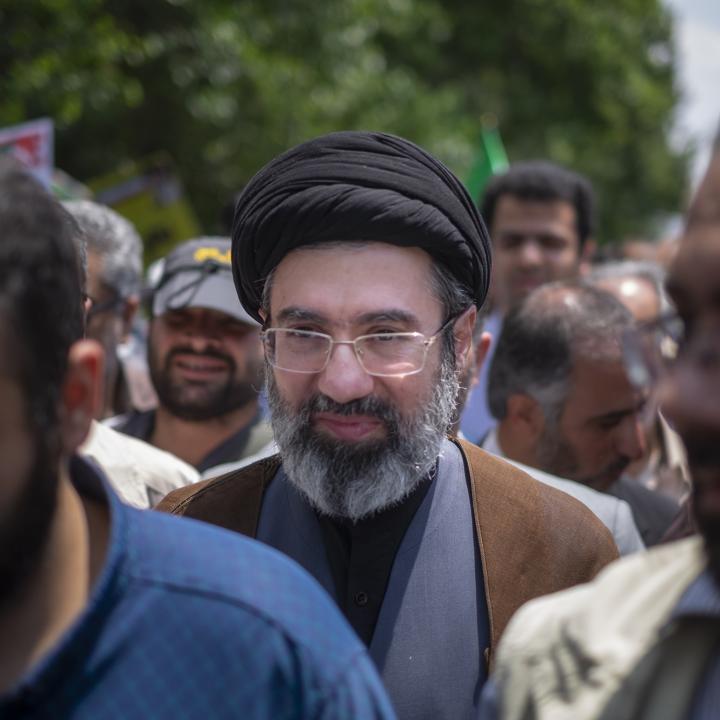
This week, the New York Times and other media reported that Iranian authorities are leaning toward naming Mojtaba Khamenei to succeed his late father as Supreme Leader, with the Assembly of Experts potentially confirming that choice during ongoing online meetings. Any such decision would be fraught with uncertainty under the present circumstances—the assembly has been forced to meet remotely because its offices in Tehran and Qom were bombed, while Israel’s defense minister has declared that any new Supreme Leader “will be an unequivocal target for elimination,” warning that the military has been instructed “to prepare and act by all means to carry out the mission.” Israel has shown its willingness to take out enemy leaders and their replacements in quick succession (see Hezbollah circa September 2024). Nevertheless, the Islamic Republic may set prudence aside, expediting the process rather than waiting for the end of the conflict before announcing a new leader. Whatever the case, it is well worth assessing just what kind of Supreme Leader the younger Khamenei might be if he manages to secure that position and stay alive.
Mojtaba as the Regime’s Political Leader?
Given his family ties and relatively young age (56), Mojtaba would start off well positioned to take over and make energetic use of the more than 5,000 functionaries in his father’s personal and office staff. In addition to a wide range of advisors and experts, Ali Khamenei had representatives in every province and government ministry, and in many cities and Islamic Revolutionary Guard Corps (IRGC) units as well. Mojtaba has long been an important figure in the Supreme Leader’s Office, with some observers alleging that he often influenced and even controlled access to his father. He seemed to operate largely in the shadows even when seeking to shape momentous decisions—including some that went badly, such as the push to get Mahmoud Ahmadinejad elected as president in 2005.
In contrast, other potential candidates would have to start out by getting a feel for how the Supreme Leader operated. Ali Khamenei himself needed several years in office before he was able to assert himself as an important voice in regime decisionmaking, and longer than that to establish full control over the government and the revolutionary institutions. Yet these levers of control have been solidified for decades, so Mojtaba would be well placed to quickly exercise much of his father’s authority.
Mojtaba as Commander-in-Chief?
This succession is occurring at an extraordinary moment of regime crisis: a war with the United States and Israel, the sudden elimination of the previous leader, and, if Mojtaba is chosen, the unprecedented transfer of power within the same family—a first for the Islamic Republic, and highly contentious given the regime’s ideology and traditions, not to mention the country’s history before the 1979 revolution. Given Mojtaba’s background, the repercussions will also ripple through the military establishment.
As part of his long record as a behind-the-scenes power broker in the Office of the Supreme Leader, Mojtaba has cultivated influence across Iran’s security, intelligence, military, and religious institutions, including deep ties with IRGC networks. He indirectly ran a substantial money-laundering and overseas investment network in part to finance IRGC operations. In a leaked memo published several years ago, Amir Ali Hajizadeh—the late commander of the IRGC Aerospace Force—praised Mojtaba for his military knowledge and his far-ranging support for the organization, including extra funds for its missile and drone projects.
Mojtaba’s formative military experiences came during the Iran-Iraq War. As a teenager, he served with the IRGC’s 27th Division, mainly in non-combat roles but sufficient to cultivate close camaraderie with other members of his small “Habib Battalion,” many of whom later filled senior positions in the IRGC, intelligence services, and government. Those wartime relationships remain central to his power base today. Hence, if he becomes Supreme Leader, his authority would likely depend more on maintaining cohesion within the IRGC and behind-the-scenes networking than broad clerical legitimacy.
Another personal dimension that must be factored into any forecast of Mojtaba’s future decisionmaking is the traumatic nature of his succession. According to various reports, the military strike that killed his father also killed his mother, wife, sister, and brother-in-law. He may therefore take a deep existential view of foreign security threats, place even stronger emphasis on state power and resilience, and show even less inclination than his father to compromise with the United States. Particularly in the immediate term, he may be driven by raw, vengeful feelings that reinforce the Islamic Republic’s ideology of existential confrontation with America and Israel.
At the same time, his tenure may prove fragile, since a dynastic succession imposed under wartime conditions could easily provoke internal regime rivalries and bring public resentment against the clerical establishment to a head. Mojtaba has modest theological credentials, but this impediment did not prevent his father from becoming Supreme Leader after the constitution was changed in 1989 to ease conditions for assuming the post. In response to this and other potential challenges, Mojtaba will likely try to consolidate power quickly by tightening control over the entire armed forces, conducting loyalty purges inside the security and military services, and strengthening the IRGC’s central role in governance and the economy.
Policy Implications
President Trump has not minced words about Iran’s succession deliberations and the prospect of Mojtaba’s ascent. In an interview earlier today with Axios, he declared, “They are wasting their time. Khamenei’s son is a lightweight. I have to be involved in the appointment, like with Delcy [Rodriguez] in Venezuela...Khamenei’s son is unacceptable to me. We want someone that will bring harmony and peace to Iran.”
Whether or not the president’s remarks wind up affecting U.S. policy on the matter, the strategic risks of Mojtaba rising to power are clear: facing intense personal and political pressures and under strong influence from the IRGC, he may pursue extreme options to restore deterrence abroad and legitimacy at home. Depending on the status of Iran’s steadily degrading capabilities, these options could include expanding ballistic missile strikes (including against the Gulf states), escalating proxy involvement in the war, increasing widespread domestic repression to prevent uprisings, accelerating clandestine nuclear activities, and exploring unconventional procurement channels for missile and nuclear capabilities in the longer term.
As the new commander-in-chief, Mojtaba would likely embrace a strategy of “defiant consolidation”—that is, relying on the IRGC, emphasizing strategic depth through coercive power, and using missile and asymmetric tools to demonstrate resilience. Over the medium term, he and the IRGC may decide that Iran must move quickly to obtain nuclear weapons in order to forestall future U.S. and Israeli attacks. Whether this approach stabilizes the regime or accelerates fragmentation, it will shape the next phase of the conflict. If the regime collapses, Mojtaba would likely try to work with remaining loyalist IRGC and Basij elements to wage an insurgency and foil the Iranian people’s efforts to rebuild their country.
Patrick Clawson is the Morningstar Senior Fellow at The Washington Institute and director of its Viterbi Program on Iran and U.S. Policy. Farzin Nadimi is a senior fellow at the Institute, specializing in the security and defense affairs of Iran and the Persian Gulf region.
About the Authors


Share