Brief Analysis
With Iran seemingly intent on continuing its strikes against Gulf targets and regional leaders mulling whether and how to respond, what can policymakers and military planners expect to see next in terms of likely target sets, risks to civilian areas, concerns over air defense munition supplies, and potential repercussions for energy and commercial shipping interests?
Integrated Air and Missile Defense: Successful, But How Sustainable?
By Elizabeth Dent
Just three days of war have offered the clearest test yet of a years-long effort to boost and integrate Gulf air defenses. Thus far, they are demonstrating great effectiveness under sustained Iranian attack, highlighting the depth of capabilities built via close U.S.-Gulf security cooperation. The United Arab Emirates has reported a 94 percent interception rate for drones and 92 percent for ballistic and cruise missiles, despite receiving the majority of Iran’s fire so far. Bahrain, Jordan, Kuwait, Qatar, and Saudi Arabia report intercepting hundreds of missiles and drones as well, and Doha also claimed to shoot down two Iranian Su-24 fighter jets over its airspace.
The American investment is paying off in terms of integration and interoperability for layered missile defense networks, joint training, and real-time intelligence sharing. Forces have been able to detect threats early and prevent them from reaching their targets. Although some projectiles have evaded defenses, much of the damage seen so far—particularly in Gulf countries—appears to be from debris created by interceptions.
More uncertain is how well countries can sustain these defenses given that interceptors are expensive and access to additional stockpiles was limited even before the war. According to author conversations with officials, the UAE and Qatar have already asked the United States to help replenish their supplies. Meanwhile, Iran relies on comparatively cheap drones and missiles, creating a long-term imbalance in each side’s costs.
Arab governments must also contend with the effects that continued Iranian attacks will have on their populations. Combined with munition supply issues, this concern may lead them to conclude that the best defense is a good offense, driving them to consider deeper participation in the war and/or expanded support for U.S. operations. Whatever these Gulf partners may decide, U.S. and Israeli forces are currently racing to degrade Iran’s missile and drone capabilities faster than they can be replenished, with the hope of staying ahead of the unfavorable cost and attrition curve.
Attacks on Oil: Sending Signals, Raising the Temperature
By Michael Eisenstadt
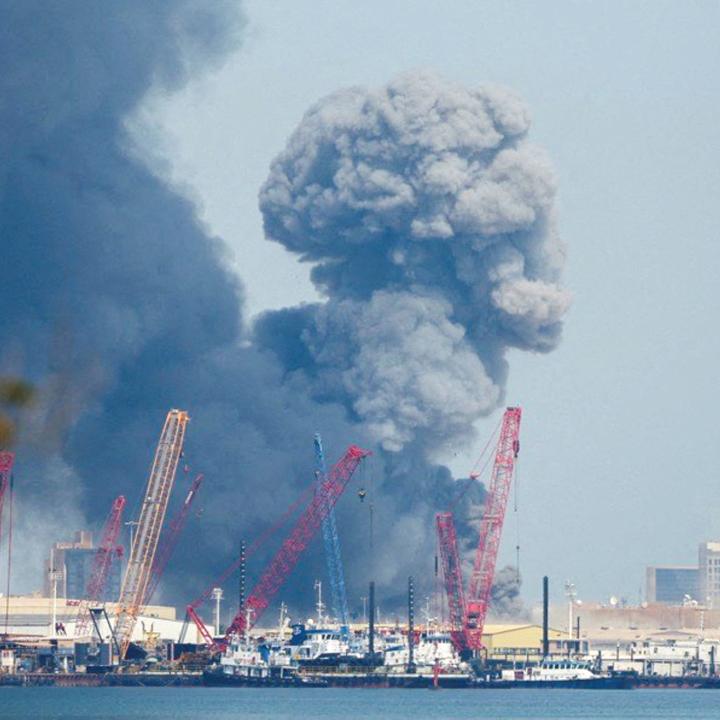
So far, Iran’s relatively small-scale attacks on oil targets in the Gulf have included strikes on tankers at sea (near Oman), in port (in Bahrain), and transiting the Strait of Hormuz; strikes by drones (singly or in pairs) on Saudi Arabia’s Ras Tanura refinery and Qatar’s Mesaieed and Ras Laffan industrial cities; and an attempted attack on the Mina al-Ahmadi refinery in Kuwait. These incidents are part of Iran’s broader war strategy of applying graduated pressure, husbanding resources for a long conflict, roiling oil markets, and catalyzing opposition to the war in the United States and other countries. The regime is also signaling its ability to impose greater costs if its own oil infrastructure is hit.
These small operations have had outsize effects while remaining limited enough to decrease the potential for escalation. They have scared off many commercial vessels en route to the Strait of Hormuz, achieving a de facto shutdown of the waterway. They have also caused some oil and gas producers (including QatarEnergy) to halt production and export operations as a precautionary measure.
To counter this strategy and deter further escalation, Washington and its partners should warn Tehran that if attacks on regional oil targets continue:
- Gulf states that have denied basing or overflight privileges for U.S. military aircraft will lift those restrictions, and some might even join the air campaign against Iran.
- The United States and its allies will enforce a distant blockade of Iranian oil exports at chokepoints located anywhere from the Gulf of Oman (using U.S. Central Command assets) to the Strait of Malacca (using Indo-Pacific Command assets) and beyond.
- The United States and its Gulf partners will respond in kind by attacking Iran’s oil sector, which would further damage the country’s economy and potentially destabilize the regime.
Failing these measures, the United States and its partners would essentially be making Iran’s limited oil attacks a cost-free strategy, with significant benefits for the regime’s war goals.
Potential Effects of Longer-Term Shipping Disruptions
By Noam Raydan
The shipping and energy sectors are at the heart of the current escalation in the Middle East. Most notably, shipping has been severely disrupted in the Strait of Hormuz, through which around 30 percent of the world’s seaborne crude oil trade and nearly 20 percent of its liquefied natural gas (LNG) transit. Many commercial vessels have been left idling outside the strait as operators and trading houses opt to avoid crossing—an approach attributed to both wartime navigational risks and extra insurance costs. Although the strait is not formally closed, very few vessels are currently sailing through it, including Iranian ships.
A longer wartime shipping disruption would interrupt oil and gas flows to global markets, affecting importers who rely heavily on the Middle East for energy. Although some crude oil importers can lean on stockpiles to replace some of the lost barrels from the Gulf, this approach is not a long-term solution. For example, data from Kpler indicates that over 38 percent of China’s seaborne crude imports originate from the Middle East. Japan likewise relies on high crude volumes from the region, particularly Saudi Arabia. Europe would feel the impact of a longer disruption in a different way—around 45 percent of its aviation fuel originates from the Middle East, according to Kpler.
By the same token, continued disruption would greatly hurt Gulf exporters as well. For instance, 90 percent of Iraq’s budget comes from oil revenues, so it would struggle to cope with the extra fiscal pressure.
The severity of the disruption will depend on how long the escalation continues, and whether Iran decides to intensify its strikes against critical energy infrastructure and increase its threats to shipping. (For full data on past and current shipping attacks, see The Washington Institute's new interactive map.) That decision will be shaped in part by the regime’s own energy interests and calculations. Ship tracking data indicates that Iran has around 200 million barrels of “oil on water”—that is, oil still in transit or being stored on tankers at sea. These volumes have been ballooning due in part to slower demand in China. If Iran is unable to export oil through the Strait of Hormuz during the war, it has numerous barrels stored outside the Gulf region that can be discharged—though demand will shape how much and at what price.
Gulf Political Responses—and Military Responses?
By April Longley Alley
Before the war—and even more so now—Gulf leaders worried about a nightmare scenario: an open-ended U.S.-Israeli conflict with Iran, with unclear objectives and them on the frontline. Yet any frustration they had about Washington moving to war when diplomacy was still in process is now being overtaken by anger at Iran’s retaliatory attacks. Strikes against U.S. military assets on their soil were expected, but Iran’s immediate strikes against civilian targets in Dubai and Bahrain and energy infrastructure in Kuwait, Qatar, and Saudi Arabia risk pulling these states into a war they worked hard to avoid.
For now, this means most of them have been pulled closer to Washington, which is supporting their defense. On March 1, five Gulf Cooperation Council states joined Jordan and the United States in a joint statement condemning Iran’s strikes and reaffirming their right to self-defense. Tehran’s attacks have also temporarily papered over the rift between the UAE and Saudi Arabia, whose leaders spoke by phone shortly after the war erupted. Although Oman was notably absent from the joint statement, a separate GCC communique condemning the Iranian attacks signaled Gulf unity (for now) and praised Muscat for supporting continued dialogue and creating potential off-ramps for the combatants. On March 1, for example, Foreign Minister Badr bin Hamad al-Busaidi urged a return to talks, stating “the door to diplomacy remains open.”
Whether, when, and how the Gulf states respond to Iran’s attacks is unclear at the moment. Some U.S. Gulf partners are considering options to defend their populations from attack beyond air defense. When they make these decisions, Washington should be willing to support their choices and coordinate with them on their responses to both immediate threats and those that may arise down the line.
About the Authors




Share