Andrew J. Tabler is the Martin J. Gross Senior Fellow in the Linda and Tony Rubin Program on Arab Politics at The Washington Institute, where he focuses on Syria and U.S. policy in the Levant.
Brief Analysis
The U.S. metric for effective cooperation shouldn’t be whether Syria is willing to fight Iran’s proxies in Lebanon or Iraq, but whether it continues advancing regional stability by securing its borders, limiting the flow of Iranian weapons and fighters, and coordinating politically with neighbors.
A March 17 Reuters report suggested that Washington was pressing Syrian President Ahmed al-Sharaa to consider sending forces into Lebanon to help disarm Hezbollah—something the Lebanese state has struggled to accomplish for years. Although U.S. envoy Tom Barrack quickly denied such claims, the episode highlighted a central tension in the evolving bilateral relationship: Sharaa’s Syria seems ready to be a partner in containing Iran and stabilizing the region, but not an expeditionary force for confronting and disarming Iran-backed groups outside its borders, whether Hezbollah in Lebanon or Shia militias in Iraq. The Trump administration can do much to ease this tension by acknowledging the limitations of the still-developing government in Damascus, and by finding other ways to boost cooperation on vital security issues during the Iran war and beyond.
Measured Response to the Iran Crisis
So far, Damascus has taken a careful, calibrated approach to the war. It has aligned diplomatically with Arab states and Washington in condemning Iran’s actions, reinforcing its borders, and avoiding escalation. Yet it has also kept a wary eye on Israel, which attacked Syrian government forces in the south on March 20 to support Druze elements and has been expanding its operations next door in Lebanon. This balancing act reflects both strategic caution and the structural limits of a young government.
On the diplomatic front, Foreign Minister Asaad al-Shaibani held a series of calls with U.S. allies in the Gulf, Turkey, and Western capitals when hostilities first erupted on February 28—though notably not with Israel. The Foreign Ministry also condemned Iranian attacks on Arab states, expressing solidarity with Saudi Arabia, the United Arab Emirates, Bahrain, Qatar, Kuwait, and Jordan.
In the days that followed, Sharaa reinforced this message through direct outreach to regional leaders, including calls with Gulf monarchs and coordination with officials in Baghdad and the Kurdistan Regional Government. By March 1, Syria had joined the Gulf Cooperation Council states and Jordan in condemning Iranian strikes “in the strongest terms,” placing Damascus firmly within an emerging Arab bloc opposed to Iran.
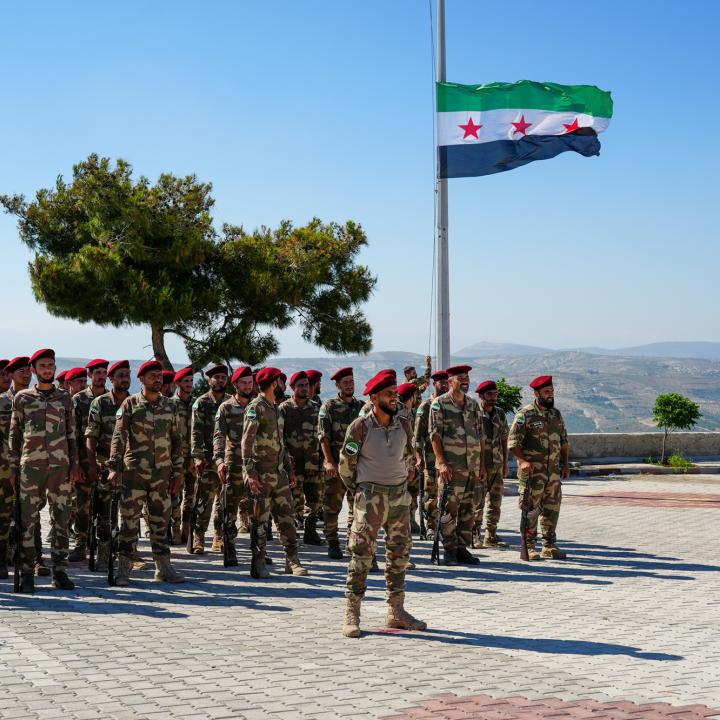
At the same time, however, Syria has restrained its military posture and focused on securing its own territory. On March 3, it reportedly deployed thousands of troops, armored vehicles, and short-range rocket systems to the borders with Lebanon and Iraq. One report indicated that the units sent to the Lebanese frontier included elite Uzbek and Uyghur elements who have been integrated into Syria’s armed forces over the past year, highlighting the military’s evolving force structure and continued reliance on foreign fighters, some of whom may be affiliated with extremist ideologies.
Syrian officials have been consistent in framing these deployments as defensive. Military officers described them as an effort to combat infiltration and drug/weapon smuggling by Hezbollah and other Shia militias. And on March 5, the Syrian Defense Ministry stated that the reinforcements were intended to enhance surveillance, patrol border crossings, and counter smuggling—not to prepare for offensive operations. Similarly, the reports of rocket deployments were downplayed as part of a broader deterrent posture, with officials emphasizing that Syrian territory would not be used as a platform for confrontation.
Practical Constraints and Escalation Risks
At the political level, Damascus has been explicit in aligning with U.S. objectives against Hezbollah, a militia that helped the former Assad regime brutally suppress Syrian opposition elements during the civil war, including Sharaa’s former group Hayat Tahrir al-Sham. On March 9, Sharaa publicly affirmed Syria’s support for Lebanese President Joseph Aoun’s efforts to disarm Hezbollah. Yet he also warned that the recent regional escalation poses an “existential threat” to both Middle Eastern stability and global economic stability.
Sharaa’s cautious political and military positioning is rooted in the practical constraints of Syria’s evolving security sector. The government is still in the process of consolidating its military and internal security forces after years of fragmentation and civil war under the Assad regime. Although former rebel factions have been formally integrated into the Defense Ministry, reports and analyses indicate that many units retain significant autonomy, limiting efforts to centralize command and control. The integration of foreign fighters into elite units has further complicated cohesion and raises questions about discipline and reliability in a cross-border operation.
Internal security threats persist as well. Earlier this month, Syrian authorities conducted operations against Islamic State (IS) cells in Deir al-Zour and near Damascus, arresting operatives and disrupting planned attacks. Meanwhile, the United States continues to draw down its forces in Syria, putting more of the counter-IS burden on Sharaa’s government.
These ongoing internal security demands underscore a basic reality: a government still working to secure its interior is not well positioned to open a new front in Lebanon or Iraq. In fact, a Syrian intervention in Lebanon would carry significant risks in the current environment—not only for Syria, but also for Washington’s regional strategy:
It could quickly escalate beyond local clashes, drawing in other Iranian threat networks and potentially provoking retaliatory actions across Syria, Iraq, and beyond.
It could inflame sectarian dynamics in Lebanon and across the Levant. Hezbollah would quickly claim the mantle of “resistance” and paint Syrian forces as a mob of Sunni jihadists bent on killing Shia civilians, potentially mobilizing support among this core community and further upsetting Lebanon’s already fragile sectarian balance.
It could undermine the legitimacy of the Lebanese state as pressure mounts for it to disarm Hezbollah. Given Syria’s brutal three-decade occupation of Lebanon during the Assad era, a new Syrian military intervention would likely be perceived as external coercion rather than sovereign decisionmaking, with high risk of backfiring.
Rather than contemplating expeditionary action, the Syrian government’s actions during the current crisis suggest a different hierarchy of priorities. First, Damascus seeks to prevent wartime spillover inside Syria—hence its increased reinforcements, surveillance, and patrols along the borders with Lebanon and Iraq.
Second, it aims to maintain public political alignment with Arab states and Washington—though not Israel. Its diplomatic outreach and consistent condemnation of Iranian actions signal a desire to reposition Syria within the regional order after years of being a mere hub for Iran and its militias. At the same time, Sharaa reportedly told Lebanese officials to be wary of potential Israeli attempts to create problems between Arab countries, including through military operations that push Hezbollah or Iraqi militias toward the Syrian border. Notably, however,Damascus appears to have assented to—or, at least, not publicly opposed—Israel’s repeated use of its airspace to carry out strikes against Iran.
Third, Damascus is intent on managing domestic pressures. The Iran war is already having economic repercussions such as energy supply disruptions and panic-buying of fuel. Meanwhile, more than 125,000 Syrian refugees crossed the border from Lebanon within days, placing additional strain on local resources.
U.S. Policy Implications
Syria’s wartime posture aligns with U.S. efforts to prevent Iran from further destabilizing the Middle East. Yet U.S. officials can do more to help insulate Damascus from the conflict’s spillover and draw the new government closer to the United States and its regional allies. Specifically, Washington should:
Make clear that it does not expect Syrian military intervention in Lebanon at this time. Even the perception of such expectations could create dangerous incentives and miscalculations among various actors, potentially leading them to take actions that threaten U.S. interests. An unambiguous public stance on this issue would help clarify regional expectations and reduce the risk of escalation.
Support Syria’s border security efforts. Recent deployments indicate that Damascus is already focused on preventing smuggling and infiltration, so the United States should reinforce this approach through intelligence sharing, technical assistance, and coordination with authorities in Lebanon, Iraq, and elsewhere. Strengthening border control is a practical way to constrain Hezbollah’s logistical networks without triggering open conflict. The Trump administration should also consider more concerted U.S. action against pro-Iran militias in Iraq, especially given this week’s cross-border rocket strikes on a military base in northeast Syria.
Integrate Syria into a broader regional framework for containing Iran. This includes coordination with Gulf states, European partners, and Lebanon during and after the current conflict, covering issues such as refugee flows, humanitarian access, and postwar reconstruction. Syria’s geographic position makes it a critical node in any regional strategy even if it is not a frontline combatant.
Avoid overloading the relationship with demands that exceed Syria’s capacity. Pressuring Damascus to take on missions it cannot sustain would risk destabilizing the fragile state, potentially creating openings for IS resurgence and undermining broader regional objectives.
In pursuing such cooperation, a good benchmark for U.S. policy is not whether Syria enters Lebanon or Iraq to fight Iran’s proxies, but whether it continues taking steps that support regional stability, such as securing its borders, limiting the flow of Iranian weapons and fighters, coordinating politically with Lebanon and other neighbors, and maintaining distance from Tehran’s military agenda. On these measures, Syria’s behavior since February 28 has been broadly aligned with U.S. interests. It has condemned Iran’s actions, strengthened its border defenses, and avoided actions that might escalate the conflict.
To be sure, this alignment is still fragile and contingent. It reflects a convergence of interests rather than a formal alliance, and it could shift if regional dynamics change. Yet it is nonetheless a meaningful development—one that Washington should seek to reinforce rather than disrupt as the budding alliance with Damascus grows.
The idea of Sharaa’s Syria acting as a proxy force against Hezbollah may be tempting in the abstract, particularly given Lebanon’s internal constraints. In practice, however, it is a high-risk proposition with limited upside. Syria is not militarily, politically, or economically positioned to undertake such a role at the moment, and encouraging it to do so could hamper the regional order the United States is trying to shape. A more effective approach is to work with Syria as it is, not as Washington might wish it to be: namely, a new government that is focused on rebuilding the shattered country, securing its borders, cautiously reengaging with regional partners, and avoiding entanglement in a widening war.
Andrew Tabler is the Martin J. Gross Senior Fellow at The Washington Institute. Previously, he served as senior advisor to the U.S. special envoy for Syria and director for Syria at the National Security Council.