
- Policy Analysis
- PolicyWatch 4143
Oil from Northern Iraq Arrives in the United States After Pipeline Reopens
Dec 5, 2025
Also available in
About the Authors


Brief Analysis
In addition to providing discounted crude of a quality desired by American refiners, the resumption of oil flows via the ITP is already showing promise of furthering U.S. policy toward partners and adversaries alike.
On November 24—two months after the reopening of the Iraq-Turkey Pipeline (ITP)—an oil tanker laden with crude from the Kurdistan Region of Iraq (KRI) and sailing from the Turkish port of Ceyhan discharged at the Louisiana Offshore Oil Port terminal. Although U.S. oil imports are generally driven by private trade and pricing dynamics, this particular shipment would not have been possible without a U.S.-facilitated interim deal in September under which Baghdad, KRI officials in Erbil, and international oil companies (IOCs) operating in northern Iraq agreed to reopen the ITP after a halt of more than two years.
Washington has played an influential role in Iraq’s energy landscape for decades—it ensured that the country’s 2005 constitution recognized Kurdish co-management rights for “new oil”; it threaded the needle between encouraging American IOC engagement in southern Iraq and supporting American firms in the north; it brokered several earlier Baghdad-Erbil deals on sharing oil earnings; and it encouraged Turkey, Iraq, and the KRI to compromise on the latest ITP breakthrough. U.S. officials should maintain this close engagement today given its importance for the stability of Iraq (a major oil producer and exporter to global markets) and for U.S. companies looking to expand their projects in the north or return to developing upstream assets in the south (e.g., as seen in a recent deal with Exxon Mobil). Equally important, American sponsorship of Baghdad’s primary economic asset can help counter Iranian influence by showing Iraqis that there are concrete benefits to cooperation with the United States.
Why Are U.S. Refiners Importing Northern Iraqi Crude?
According to data published by the market intelligence firm Kpler, the tanker Seaways Brazos (IMO identification number 9594731) loaded around 1 million barrels of northern Iraqi crude at the Ceyhan terminal in late October before sailing to Louisiana. The authors also confirmed with Kpler and TankerTrackers.com that more such vessels are expected to discharge in the United States in the near future.
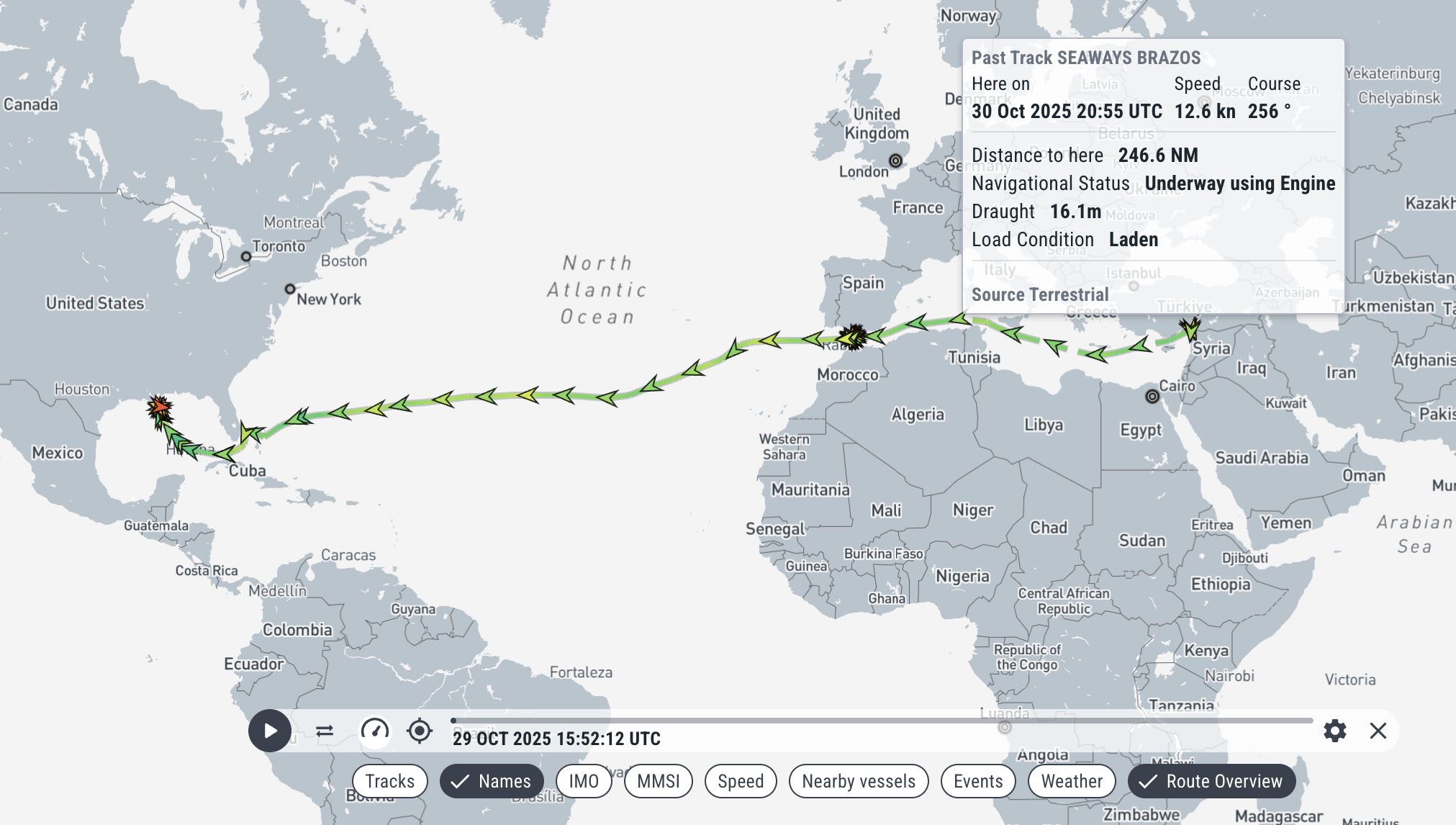

These shipments are partly driven by an appetite for medium sour crudes of the type produced in northern Iraq. U.S. refineries run on different varieties of oil, but not all types are produced domestically or transportable in a cost-effective way. Although the United States exports light sweet crude, it imports medium, heavy sour, and other types from places such as the Middle East and Latin America in order to address demand from refineries designed to operate on these feedstocks.
To attract buyers, firms exporting Iraqi Kurdish oil via Ceyhan reportedly offered steep discounts after the ITP reopened, and exports soon resumed. According to Kpler, the first such cargoes were mainly destined for Mediterranean and European refiners—the typical purchasers of northern Iraqi crude prior to the ITP’s closure in March 2023.
Notably, different reports have referred to the crude in these new shipments as “Kirkuk” grade, even though oil from fields in the Kirkuk area is not currently being sent to Ceyhan for export. Rather, all the crude pumped to Ceyhan so far has originated from Kurdish fields, according to Iraq Oil Report. Nevertheless, various market sources indicate that “Kirkuk grade” may have become the new label for all northern Iraqi crude, including Kurdish supplies. Kurdish oil used to be known as KBT (Kurdish Blend Test), but the rebranding comes as little surprise now that the Iraqi federal government’s State Oil Marketing Organization (SOMO) is the sole authority controlling the marketing process.
As for expected export volumes, the ITP was transporting around 400,000-450,000 barrels per day prior to its 2023 closure, including around 350,000-375,000 b/d of KBT and 75,000-100,000 b/d of oil produced by the federal government. So far, however, current levels remain lower than what was being exported before the shutdown.
The ITP’s Geostrategic Significance
The interim ITP agreement has paved the way for further Baghdad-Erbil negotiations over the controversial issue of oil production and exports from northern Iraq, as well as talks regarding the over $1 billion in arrears that Erbil owes to IOCs. Now that ITP oil is flowing again, the terms of the September deal call for a Western consulting firm to conduct the assessments needed to resolve the IOC payments. The agreement is also expected to undergo a monthly renewal process after December 31.
These talks and the ITP itself hold considerable significance for both global energy markets and Washington’s geostrategic interests. The pipeline’s route begins in Kirkuk outside the KRI, giving SOMO the option of eventually exporting non-Kurdish Iraqi oil through Turkey as done in relatively large quantities before 1990. The ITP’s twin lines also have a much larger theoretical capacity of about 1.5 million b/d, though the route’s actual current capacity remains well below that absent refurbishment. In any case, the more Baghdad uses the ITP for exporting oil from other parts of Iraq, the closer its bilateral bonds will be with Turkey. Ideally, this would also lessen Iran’s sway in Baghdad, especially on energy matters (see below).
Other Energy Opportunities
At present, most of Iraq’s other top energy resource—natural gas—is produced as a byproduct of crude oil production, mainly in the south. But Kurdistan is relatively rich in both “non-associated” gas reserves and electricity generation compared to the rest of Iraq. As Baghdad’s energy rapport with Erbil grows, IOCs and other investors could expand their KRI operations in ways that enable the Kurds to “export” gas to the rest of Iraq, thus reducing Baghdad’s dependence on Iran and increasing electricity cooperation between the KRI and federal government. In this context, it comes as little surprise that pro-Iran militias reportedly hit the KRI’s biggest gas production complex with a rocket strike just last week.
Other positive outcomes could include amiable resolution of the fallout from Iraq’s international legal case against Turkey for importing Kurdish oil over the past decade without Baghdad’s permission. U.S. officials should also do what they can to facilitate successful Iraq-Turkey talks on a much broader ITP agreement.
Finally, U.S. and EU pressure has seemingly compelled Turkey to decrease its imports of Russian crude—which averaged around 300,000 b/d during the first nine months of this year—and diversify its oil sources. The ITP could offer Ankara a similar type of crude from a nearby source, with possibly steep discounts.
Noam Raydan is a senior fellow at The Washington Institute and co-creator of its Maritime Spotlight platform. James Jeffrey is the Institute’s Philip Solondz Distinguished Fellow and former U.S. ambassador to Iraq and Turkey.
Share