- Policy Analysis
- PolicyWatch 4187
Great Power Competition During (and After) the Iran War
Mar 19, 2026
Also available in

Brief Analysis
Three experts examine how Moscow, Beijing, and European capitals are navigating the crisis and what their choices reveal about the future of the global order.
On March 18, The Washington Institute held a virtual Policy Forum with Anna Borshchevskaya, Souhire Medini, and Henry Tugendhat, moderated by Grant Rumley. Borshchevskaya is the Harold Grinspoon Senior Fellow in the Institute’s Diane and Guilford Glazer Foundation Program on Great Power Competition and the Middle East, and coauthor of its recent report “After Ukraine: Prospects for a Russian Resurgence in the Middle East.” Medini is a visiting fellow at the Institute, in residence from the French Ministry for Europe and Foreign Affairs. Tugendhat is a Soref Fellow in the Glazer Foundation Program. The following is a rapporteurs’ summary of their remarks.
Anna Borshchevskaya
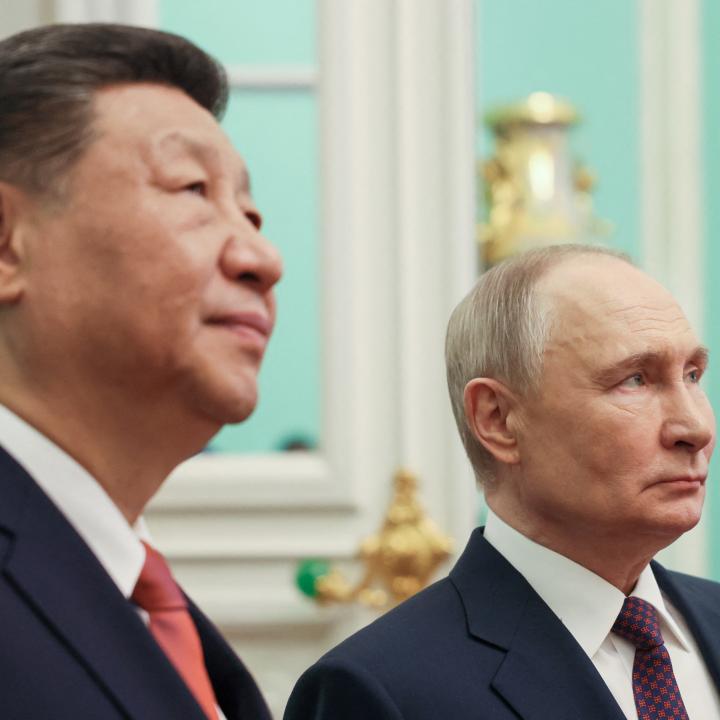
The Russian approach to the Iran war—and to Middle East conflicts in general—should be viewed through the lens of Vladimir Putin’s wider goal: establishing a fundamentally different world order in which the United States is no longer the dominant power. With that in mind, Moscow is applying a sophisticated brand of restraint to the current crisis, publicly criticizing Washington while covertly providing Iran with assistance such as satellite imagery and other intelligence. Putin sees no reason to engage in a direct military clash with America in the Iranian context. From his perspective, there are short-term gains to be won from this war—most notably, the spike in oil prices and the Trump administration’s temporary easing of sanctions on Russia have injected much-needed resources into the Kremlin’s war on Ukraine. Furthermore, potential rifts among NATO countries could help him by dividing and weakening the United States and Europe.
On the Ukraine front, the Iran war is having two immediate impacts so far. First, Russia now has a surge of oil income that will almost certainly be directed toward its depleted forces in that conflict zone. Second, Ukraine has quickly offered its expertise in countering Iranian drones to embattled Persian Gulf states, proving that Kyiv is an asset to the West in this and future crises. Yet as long as Europe and Washington are both divided and focused on the Middle East, Russia will continue exerting pressure on Ukraine. Even if the war in Ukraine is not a top policy priority for certain Western governments, Moscow and Kyiv remain completely dedicated to prevailing.
Moscow is also paying close attention to the efficacy of the U.S.-Israeli air campaign against Iran, including their decapitation strikes against regime leaders. Russian officials have long studied major U.S. military campaigns to extract lessons for future competition, and the current operation is likely reinforcing their conventional wisdom of avoiding confrontations with the U.S. military and pursuing a strategy of indirect warfare instead. As such, Russia will continue seeking ways of forcing the United States to expend its weaponry and overextend its military resources across the world. Putin is not beholden to the short timelines of democratic electoral cycles—he can play this long game in a way that U.S. presidents cannot. Hence, Moscow can afford to remain disengaged from the Iran war while integrating new intelligence about U.S. capabilities into its long-term strategic picture.
Russia’s approach is also fundamentally flexible—for example, Putin sought to engage closely with Syria’s current leaders shortly after they deposed his previous Assad regime partners. This may explain why Moscow has maintained relative equanimity in the face of potential regime change in Iran. Even in the (increasingly unlikely) event that a new pro-Western government emerges in Tehran, Russia would still likely move fast to establish useful ties.
In short, Moscow’s long-term thinking and flexible approach are permitting it to maintain distance from the current crisis even as it capitalizes on the resultant chaos and finds short-term gains. As ever, Russia is fighting a global battle, and its overall goals remain the same even when its relationships and circumstances in the Middle East change.
Souhire Medini
Europe has been drawn into a conflict that it neither initiated nor wanted, and several converging pressures are forcing EU member states into an uncomfortable position. On March 12, one French soldier was killed and others wounded in northern Iraq, where their unit had been deployed as part of the international coalition against the Islamic State. Days earlier, an Iranian strike on EU member Cyprus prompted the deployment of forces to the Mediterranean region. Several European countries that have preexisting defense agreements with Gulf partners have deployed further still. Meanwhile, the closure of the Strait of Hormuz has raised energy prices for European consumers, highlighting the EU’s continued reliance on fossil fuels and its accelerating interest in nuclear and renewable alternatives. The Trump administration’s decision to issue sanctions waivers to Russia—justified as a move to curb oil prices—has left several European countries frustrated given the likely impact on Moscow’s war effort in Ukraine.
Amid these pressures, European governments have struggled to define the boundaries of their involvement. The United Kingdom initially refused to allow U.S. forces to access its bases, then reversed course and permitted access for defensive purposes—though the resultant operations have included destroying Iranian missile assets inside Iranian territory and framing these actions as defensive. For its part, Spain outright refused to allow the United States to use joint military bases, drawing criticism and trade threats from the Trump administration.
Trump’s calls for a new “coalition of the willing” to reopen the Strait of Hormuz, paired with his sharp criticism of NATO, have only heightened the pressure on European capitals. (Notably, NATO member Turkey was not specifically mentioned.) The alliance is a defensive coalition by definition, built around the principle of mutual defense rather than joint offensive action. That said, NATO has a history of participating in offensive combat operations in the region. In 2011, it intervened in Libya; more recently, it joined the U.S.-led coalition against the Islamic State. Yet both of those precedents involved genuine “coalitions of the willing”—the United States coordinated and planned with its alliance partners before any military action was taken. Crucially, those interventions also rested on the solid legal foundation of a UN Security Council resolution. Neither of those conditions has been met in the current Iran campaign.
Although European countries have not ruled out action in the Strait of Hormuz, they insist that any such involvement must be clearly separated from the current offensive campaign against Iran. Otherwise, official statements on a potential defensive mission have been vague so far. Going forward, this situation will be another litmus test for the continent’s ability to implement its long-discussed vision of European strategic autonomy.
Henry Tugendhat
China aims to avoid direct involvement in this war and prefers to play a diplomatic role behind the scenes. It has repeatedly condemned U.S. and Israeli “belligerence” against Iran and will likely continue selling weapons to the regime. At the same time, Iran’s attacks against Saudi Arabia and other Chinese partners in the Gulf are putting Beijing in a difficult position.
Ultimately, the long-term challenges of this conflict outweigh any short-term gains for China. Beijing may immediately benefit from the diversion of U.S. military resources in the Indo-Pacific region, as well as the opportunity to study the role of alliances and bases in U.S. military strategy. Yet its long-term economic concerns are significant—China depends on Middle East stability for both imports and exports and is invested in infrastructure projects across the region. Despite solidifying its energy independence over decades to withstand energy shocks, Beijing is unable to control the global ramifications of such crises.
For example, Europe is a critical Chinese export market, yet it is vulnerable to energy shocks that could lower its ability to absorb Chinese goods. Major export markets are key drivers of China’s domestic growth; if energy shocks force these markets to contract, the country’s economy could face a corresponding contraction. China is able to withstand weeks of fighting in Iran, but an additional two to three months would raise serious concerns.
Regarding Taiwan, the Iran war is unlikely to affect Beijing’s calculations over a potential invasion. So long as the Middle East crisis remains unresolved, there is little chance China will imminently open a new front. President Xi Jinping fired the Central Military Commission’s senior leadership in January, suggesting that the military is not prepared for a large-scale invasion. Instead, Beijing will seize this opportunity to understand how Taiwan reacts under stress when cut off from the energy supplies and inputs needed to drive its production of semiconductors and other core industries. Chinese leaders might also take note of domestic anti-war sentiment in the United States during the Iran crisis. If a clash over Taiwan erupts, they will likely emphasize that the island’s fate is an internal Chinese matter that does not concern American citizens and poses no existential threat to the United States.
Traditionally, Beijing has avoided alliances and prioritized self-sufficiency as the basis of its national security. As Iran grows increasingly isolated, however, China may learn the value of allies in times of crisis. Regardless of the outcome in Tehran, Chinese foreign policy is flexible and pragmatic, allowing it to sustain strong economic relations. In the aftermath of the current war, Beijing will no doubt leverage its vast international partnerships to find common ground with key partners in Iran.
This summary was prepared by Zack Apt, Kate Chesnutt, and Virginia MacArthur. The Policy Forum series is made possible through the generosity of the Winkler Lowy Foundation.
About the Authors




Share