Robert Satloff is the Segal Executive Director of The Washington Institute, a post he assumed in January 1993.
Articles & Testimony
Defining victory in Gaza is hardly simple when Hamas is still armed, ruling nearly half the Strip, and flush with significant diplomatic achievements.
When President Trump meets Israeli Prime Minister Benjamin Netanyahu for the sixth time this year on December 29, the two leaders should ask themselves a question they thought was already settled: Who won the Hamas-Israel war? When he visited Jerusalem in October, Trump proclaimed Israel the victor: “You’ve won,” he told Israel’s parliament. But Hamas leaders called the war a failure for Israel and a “victory for resistance and steadfastness.” And three months into the ceasefire, the answer is not so simple. While the Palestinian people in Gaza suffered horrific losses, Hamas itself did not lose—at least, not yet.
This much is clear: Of Israel’s five war aims, outlined by Netanyahu when he stood next to Trump at the White House on September 29, only two have been achieved—the near-miraculous return of Israel’s surviving hostages and the establishment of an extensive IDF buffer zone inside Gaza to prevent another October 7-style attack. Israel secured none of the other three war aims, and none is on the horizon: the disarmament of Hamas, the demilitarization of Gaza, and the establishment of a peaceful, Palestinian-led civilian administration to govern all of Gaza.
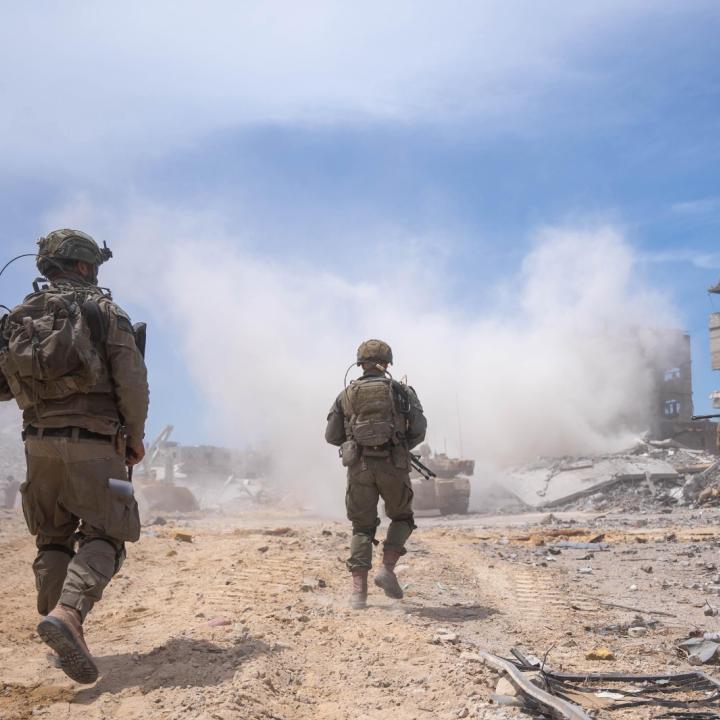
So the most likely near-term scenario for Gaza is that tomorrow will look very much like today: the continuation of an ad hoc situation in which Israeli troops hold just more than half of Gaza, with about 15 percent of the population, while the remnants of Hamas control a slightly smaller strip along the Mediterranean coast with about 85 percent of the population. As Israel’s army chief recently said, the so-called yellow line dividing the two zones is “a new border line.”
In this environment, there are no practical plans for any outside military to disarm Hamas’s still-potent, 20,000-man force, even though disarming Hamas is the key to full implementation of Trump’s 20-point ceasefire. The only two realistic candidates for this daunting task are Israeli troops and Palestinian police, and neither is a serious option, at least in the near term.
A war-weary Israel is unlikely to mount a major operation to disarm Hamas that would signal the collapse of the ceasefire, preferring instead to patrol its slice of Gaza and prevent Hamas from illicit resupply efforts and hit-and-run attacks. As for Palestinian police, training an effective PA force is woefully behind schedule and, even if it existed, Netanyahu has long opposed its deployment.
To be sure, Israel had additional successes during the war. These range from preventing a violent eruption in the West Bank to maintaining all its regional peace treaties, despite widespread Arab anger at its Gaza tactics. It is also no small achievement for Israel to have retained the support of its chief ally, the United States, under the very different Biden and Trump administrations.
Each of these Israeli achievements, however, has its darker side, from the deepening frigidity of Israel’s ties with all its Arab peace partners to Israel’s shrinking support within parts of both US political parties. It is too early to determine which trends—the positive or the negative—will be the most consequential.
On the Palestinian side of the ledger, ordinary Gazans suffered incalculable losses during the war—including more than 5 percent of the population killed or injured, the Strip razed, and almost all of Gaza’s Palestinians displaced. But little of that appeared to matter to Hamas, whose perverse strategy depended on maximizing civilian casualties. So Hamas’s cynical postwar scorecard looks relatively bright. Hamas not only survived as both a military force and a governing body in the face of a fully mobilized Israeli army; it still controls nearly half of Gaza two years after Israel’s ferocious post-October 7 counterattack.
Moreover, Hamas has good reason to believe it is now an accepted regional diplomatic player. After all, its leaders have for the first time met face-to-face with senior US officials, including Trump’s special envoy Steve Witkoff, and Hamas’s longtime patrons, Turkey and Qatar, emerged from the war as close partners of Trump. Hamas’ successes included derailing Saudi Arabia’s push for normal ties with Israel and the satisfaction at seeing Israel, its leaders, and its ideological rationale—Zionism—suffer global condemnation, including from some key elements of both major US political parties.
Fundamentally Unstable
Israel and Hamas both secured important benefits from the ceasefire. The answer to “who won the war” depends on the yardstick each defines for victory. The answer can legitimately be both.
This is important because, with no clear victor and vanquished, the ceasefire is itself fundamentally unstable and may well not mark the end of the war. Trump may grow weary, irked to see his signature agreement stuck in neutral. Egypt, Qatar, and Turkey—the ceasefire’s guarantors—may not want to bless what looks increasingly like long-term Israeli control of more than half of Gaza. And Israeli public opinion may begin to shift from celebrating the surviving hostages’ release to focusing on completing the dismantling of Hamas, and Israel’s domestic divisions will be fed by its coming elections.
So the Hamas-Israel conflict almost surely has a next phase. That makes it far too early to definitively answer who won the war—a war that has been paused, not ended.