- Policy Analysis
- PolicyWatch 4148
Tunisia’s Growing Protests Open a Door for Low-Cost U.S. Initiatives
Amid mounting domestic pressure on President Saied, the Trump administration should take modest but useful and forward-looking steps like lifting tariffs, supporting less-politicized trade projects, and otherwise backing the people’s vision for a more prosperous future.
Tunisia has been witnessing a gradual but notable uptick in protest movements, whether stemming from economic troubles, political issues, local grievances, or other concerns. In an environment of deteriorating civil liberties and institutions, such events command attention. Given President Kais Saied’s apparent scorn for the country’s traditionally strong partnerships with the West, the increasing public discontent may offer opportunities to restore a more promising trajectory.
A Turbulent Year
Ranging from demonstrations and strikes to online mobilization, nearly 5,000 protest actions have occurred since the start of this year, according to the Tunisian Forum for Economic and Social Rights (FTDES). This represents an 84 percent increase over the previous year. The second half of 2025 has seen some particularly notable movements.
In late August, as part of a broader standoff with the president, the Tunisian General Labor Union (UGTT) mobilized thousands of supporters to protest the government’s economic and political actions. The union has lost credibility in recent years given its failure to consistently criticize Saied coupled with the growing divergence between its leadership and base. Nevertheless, the August demonstrations indicated that the president feels threatened by the UGTT, which is still the country’s largest membership organization.
In mid-October, citizens from the central coastal city of Gabes launched protests after dozens were hospitalized due to heavy air pollution caused by the local chemical plant. After the initial demonstrations were met with forceful repression by security services, they grew into a wider movement calling for the plant’s closure. By month’s end, workers had organized a general strike that temporarily succeeded in bringing much of the entire Gabes governorate to a halt.
The plant is operated by Groupe Chimique Tunisien (GCT), a state-run firm that processes phosphates from the central region into fertilizers for export and domestic agricultural use. The environmental and health repercussions caused by the facility have led to confrontations in the past, and in 2017, the government promised to relocate the plant. Yet it has not lived up to that pledge eight years later.
The movement in Gabes has drawn particular attention for two reasons. First, observers note that mobilization driven by environmental issues is relatively new in Tunisia and may be increasing. Second, Gabes borders a historically restive mining region that is home to the Gafsa Phosphate Company, another state-run chemical firm. The government has long been loath to reform this company or the GCT, partly due to the central role they play as economic drivers and major employers, but also because of the vested elite interests that might be challenged by such changes.
In response to the October movement, Saied has engaged the Chinese government on potentially helping Tunis rehabilitate the Gabes plant. At the same time, he has predictably blamed conspirators and local corruption for the problems that spurred the protests. Notably, unlike his response to grievances in other governorates, he has not paid a visit to Gabes, though an appearance by Deputy Interior Minister Sofiane Bessadok seemed to calm the situation somewhat. So far, the movement has been limited to Gabes and a few solidarity protests in Tunis, but the government likely fears it will spread.
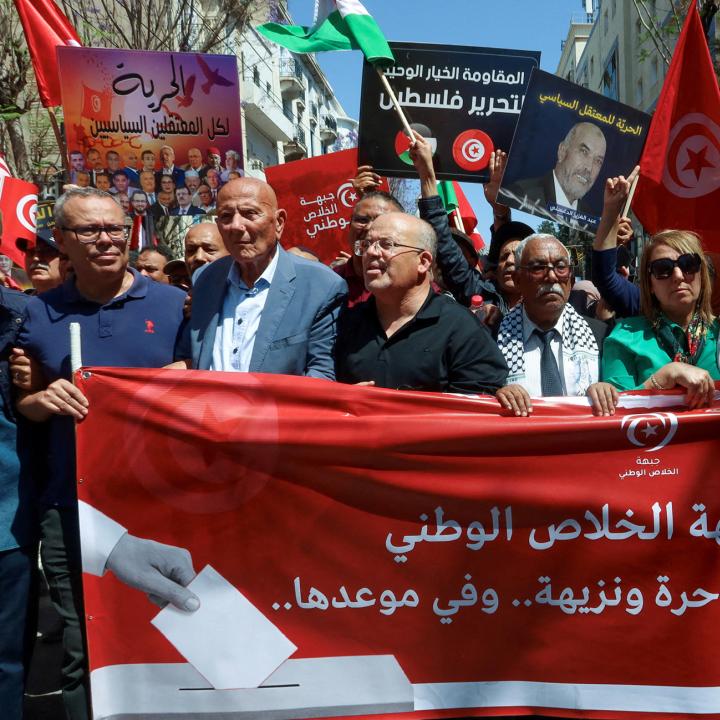
Meanwhile, a series of political mobilizations recently emerged in the nation’s capital following arrests and sentencing related to the so-called “conspiracy against the state” case. Forty high-profile politicians and opposition figures have been accused of threatening state security, with many sentenced to lengthy prison terms (in some instances exceeding sixty years). The defendants were charged with violating Tunisia’s penal code and counterterrorism law, but human rights groups argue that the case is politically motivated. The government’s handling of the prosecutions has also been subject to a variety of procedural criticisms. In response to the controversy, Tunis has seen demonstrations on successive Saturdays since mid-November, raising the possibility of a more sustained movement against the judicial sector.
Elsewhere, protesters and security forces clashed in the central city of al-Qayrawan last weekend after police apparently killed a man. More broadly, FTDES reported that the number of “political/civil” protests last month had grown to exceed the number of economic/social protests.
Whether or not democratic demands are rising, most Tunisians remain concerned about the economy, as reflected in the recent spate of strikes by doctors, bankers, transportation workers, and other employees. This week, the UGTT announced a nationwide general strike planned for next month, coinciding with the anniversary of the 2011 revolution, a date that has seen large demonstrations in the past. And all of these developments are occurring against a backdrop of increasing constraints on civil society.
Untenable in the Long Term?
Although Tunisian expressions of discontent appear to be growing, it is important not to overstate the likelihood of a political or economic collapse in the near term. For one thing, widespread protest movements (including by Gen Z activists) have become something of a global trend, with varying outcomes. In Tunisia, demonstrations have been common since the 2011 Arab Spring, and the current sense of broad uncertainty has been present since at least 2022, when Saied carried out several of his high-profile power grabs. Today, few predict that he will soon be ousted.
Instead, many Tunisians are choosing migration over mobilization. Among those leaving in greater numbers are skilled workers, raising concerns about a national brain drain. The government is doing little to counter this other than enhancing its border patrol efforts, suggesting that economic prospects may continue to erode.
At the same time, the recent accumulation of public confrontations with the government suggest that Tunisia’s Western partners should still be wary of an unexpected upheaval or sudden economic collapse—not to mention potential changes stemming from the president’s poor health. In particular, officials would be wise to assess how long the country’s seemingly untenable situation can continue, and what might happen in the event of a power vacuum.
U.S. Policy Implications
Given these problems, Washington should consider how it can help address Tunisia’s pressing needs while moving beyond the current approach of managing security concerns and challenging Saied’s outreach to adversaries such as Iran. Despite its small size and often-problematic policies, Tunisia can still do much to bolster the U.S. goals of promoting stability and prosperity in the Middle East and Africa. Like Morocco, its geographical proximity and close ties with Europe make it a good candidate to contribute to global supply chains, especially if Tunis undertakes reforms to expand production in high-value sectors. Moreover, the country still has more working-age people than dependents, which could enable it to play a lead role in expanding entrepreneurship and productivity in Africa while simultaneously alleviating unemployment and budgetary concerns at home.
Observers also assess that Saied remains susceptible to Western pressure, despite bold actions such as refusing an IMF loan package. Prior to the Trump administration’s dismantling of the U.S. Agency for International Development and tariff hikes on Tunisian imports, bilateral cooperation was relatively firm. More recently, legislative calls from Washington and Brussels appear to have had some influence on targeted issues (e.g., securing the release of rights advocate Sonia Dahmani).
Going forward, the U.S. government can help Tunisia significantly without investing substantial resources. Quietly encouraging reforms in less politicized areas—such as supporting critical trade infrastructure projects—can help stave off economic erosion while reassuring the Tunisian public that Washington has not entirely abandoned them. At minimum, the United States should support efforts being implemented by other donors in the country’s energy industry and other sectors. Reversing the 25 percent tariffs on Tunisian goods would also be a low-cost but valuable step.
Finally, the United States can do more to help Tunisians come together around the vision of a more prosperous future. In 2011, the Obama administration backed local democratization efforts through bold measures such as establishing the Tunisian American Enterprise Fund and a Millennium Challenge Corporation compact, bolstering the many citizens who were trying to lead a substantive break from the past. To resume that hopeful trajectory, Tunisians need similarly bold actions from the Trump administration, lending symbolic weight—and, ideally, concrete assistance—to their push for a more inclusive economy.
Sabina Henneberg is a senior fellow at The Washington Institute and director of its Junior Research Program.