- Policy Analysis
- PolicyWatch 4246
Reaching Viable Management Arrangements in the Strait of Hormuz
Aug 5, 2026
Also available in
About the Authors


Brief Analysis
Any postwar system must preserve the “transit passage” regime, enable ships to safely resume use of the original IMO route, and reject mandatory fees, veto rights, or other Iranian tactics for exerting permanent control over one of the world’s most critical energy chokepoints.
Since the start of the Iran war, the Strait of Hormuz has been Tehran’s most consequential strategic asset. By sowing uncertainty over the presence of mines in the waterway’s traditional central corridor, attacking or threatening vessels using the U.S.-protected corridor through Omani waters, and compelling commercial traffic into their own waters, Iranian authorities have effectively established a new navigational order. The internationally recognized traffic separation scheme (TSS) adopted in 1968 under the auspices of the International Maritime Organization (IMO) has been rendered effectively unnavigable for many operators, while Iran has intimidated seafarers into complying with instructions from the Islamic Revolutionary Guard Corps (IRGC) and demonstrated its willingness to strike vessels that do not accept its terms (as documented by The Washington Institute’s Maritime Attack Tracker).
Tehran now seeks to convert this wartime disruption into a lasting advantage. Rather than merely participating in arrangements initiated by others, it wants a dominant or at least leading role in any future management of the strait. This ambition is visible in its recent rejection of Oman’s proposal for regional management, which reportedly enjoyed backing from other Gulf states. That proposal appears to be loosely modeled on the Cooperative Mechanism established in the Strait of Malacca, which emphasizes navigational safety, environmental protection, and voluntary contributions in exchange for navigational help, in line with Article 43 of the UN Convention on the Law of the Sea (UNCLOS). Iran insists that governance of Hormuz should only be shared between the two coastal states—itself and Oman—but with Tehran maintaining final say on which ships are allowed to enter and exit the Persian Gulf.

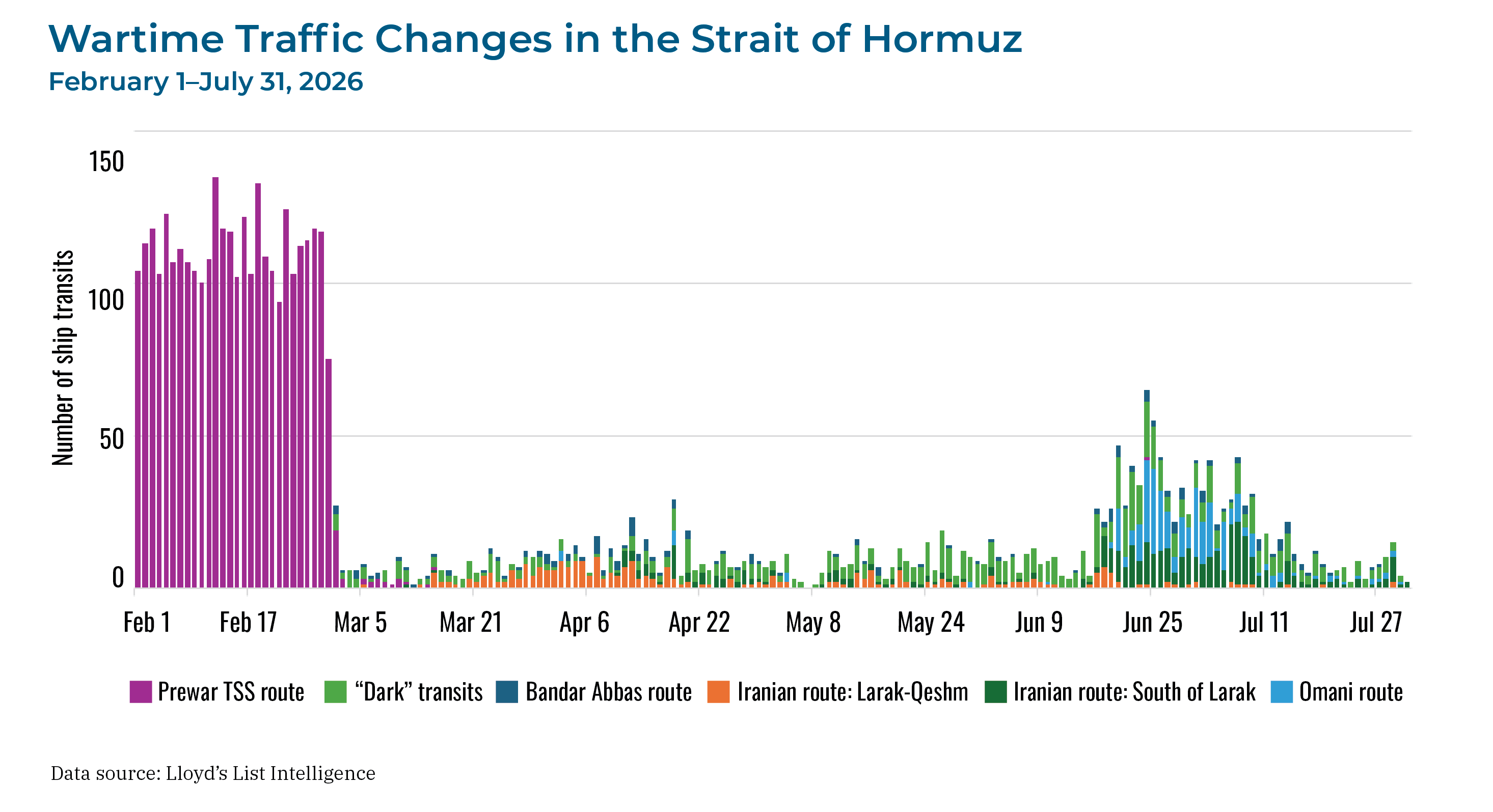
Recent shipping data underscores Iran’s intentions. After its memorandum of understanding with the United States collapsed and violence resumed in early July, tanker transits along the Omani corridor fell sharply. Overall crossings had risen to an average of roughly 45 per day following the June memorandum, but they plummeted to around 13 per day after its demise. Similarly, data from Lloyd’s List Intelligence shows a substantial decline in overall commercial transits after July 7, when Iran attacked three laden tankers (two carrying crude oil, one carrying liquefied natural gas) while they were using the Omani route. As of this writing, more ships appear to be using the Iranian lanes south of Larak Island than the Omani corridor, and the number of “dark” transits (i.e., ships not transmitting Automatic Identification System data) has continued to increase. At various points, Iran has also steered ships along a more northerly route between Larak and Qeshm Island.

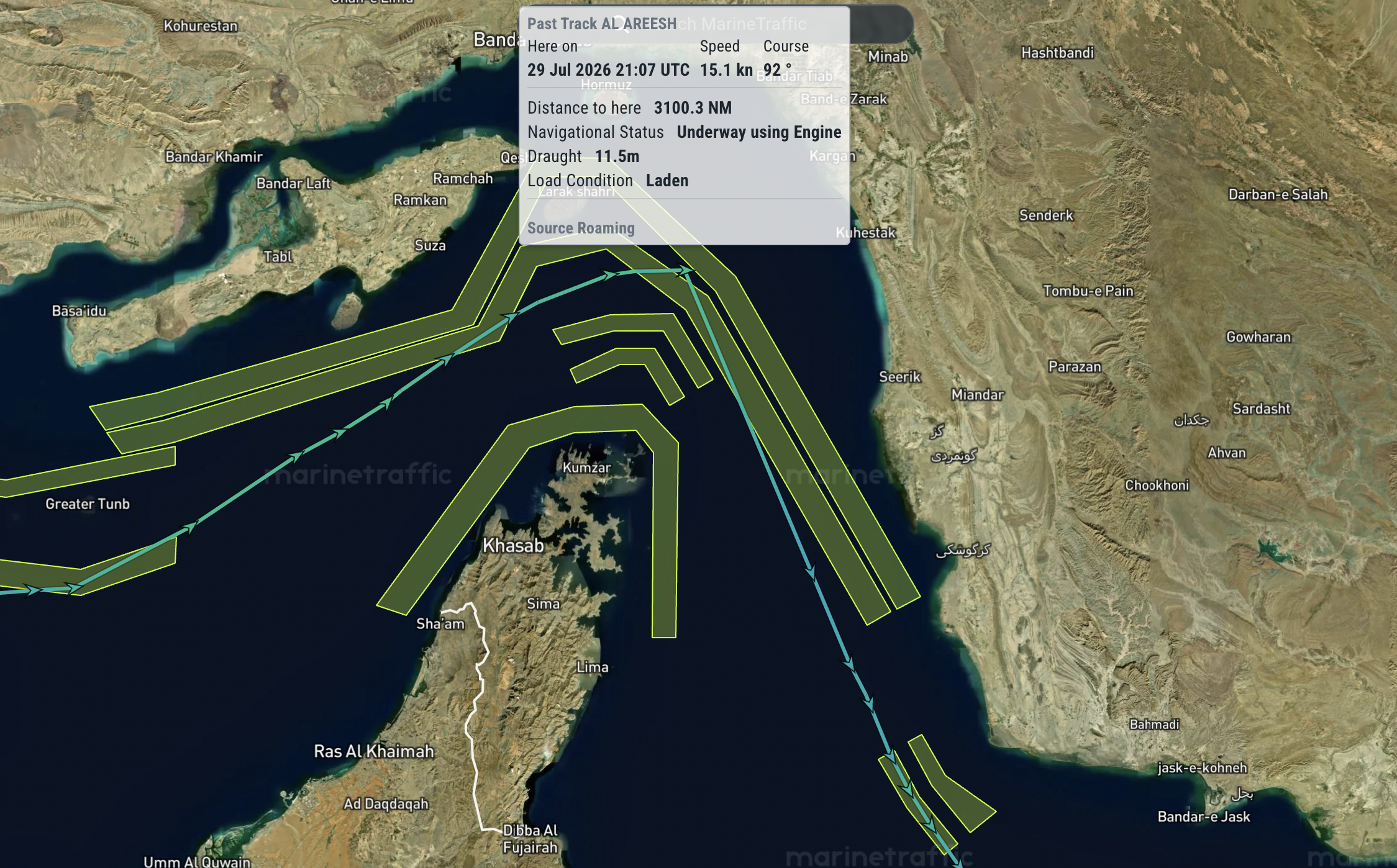
Of particular note was the July 29 transit of the LNG tanker Al Areesh (IMO identification number 9325697), a QatarEnergy-linked vessel that exited the area via an Iranian-controlled lane. That was the first Hormuz transit by a Qatar-linked LNG tanker since July 7, when Al Rekayyat (IMO 9397339) was attacked off Limah, Oman, while attempting to take the Omani route. Such developments may signal that Doha and other major energy exporters are potentially susceptible to Tehran’s coercive tactics in practice even as they push for more legally sound arrangements in principle.

Meanwhile, at least four more ships have been attacked since July 31, and hundreds of other vessels and thousands of seafarers have remained stranded in the Gulf since the IMO evacuation plan was suspended on June 25. These trends demonstrate Iran’s determination to herd traffic along routes it can influence while making the U.S.-facilitated southern corridor appear unsafe.
Historical and Legal Context
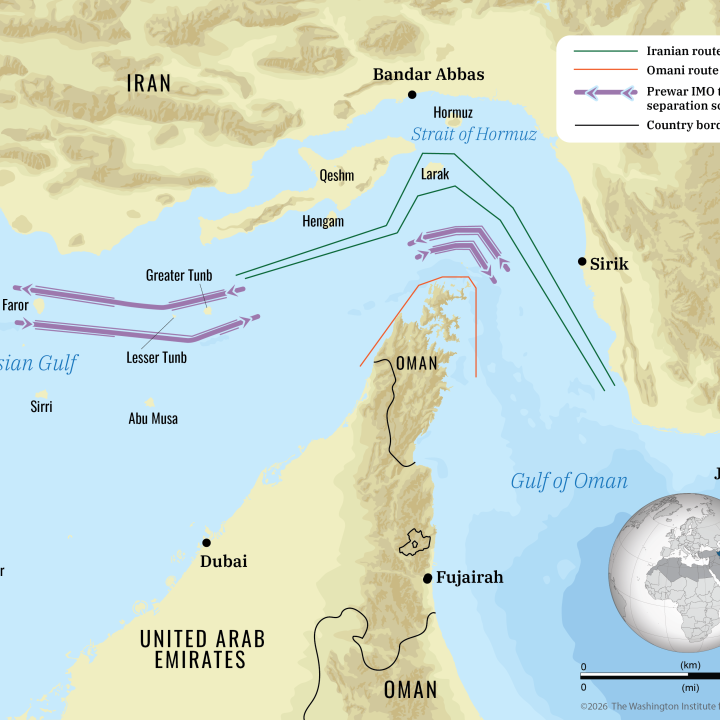
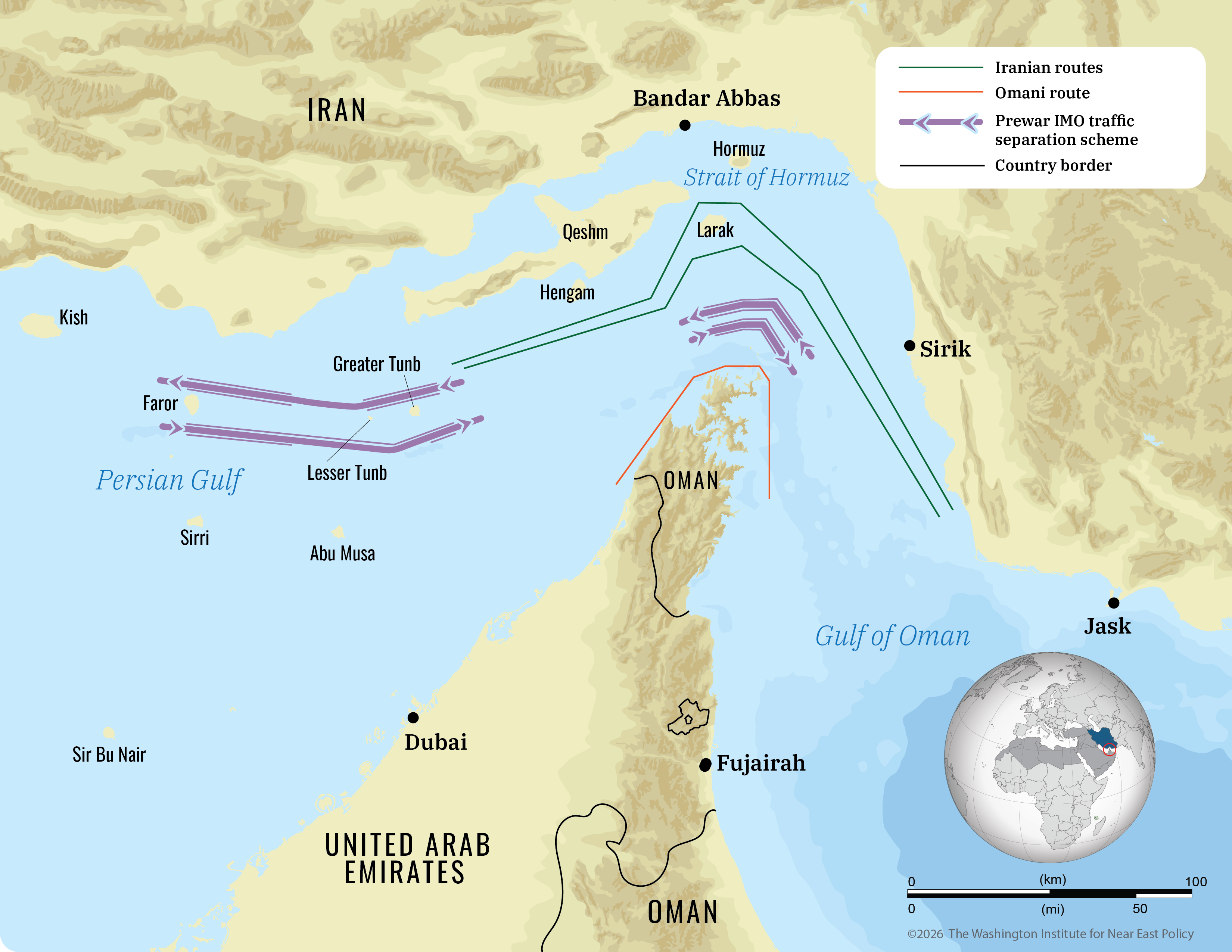
Since 1968, traffic through the Strait of Hormuz has been governed by an IMO-mandated TSS consisting of two inbound and outbound lanes, each two nautical miles wide and separated by a two-mile separation zone. The entire TSS lies within Omani territorial waters and was echoed by the subsequent Iran-Oman continental shelf agreement, which placed the median line in such a way that the navigable deep-water channels fall predominantly on the Omani side. A 1979 amendment added an inshore traffic zone closer to the Omani coast along the Musandam Peninsula.
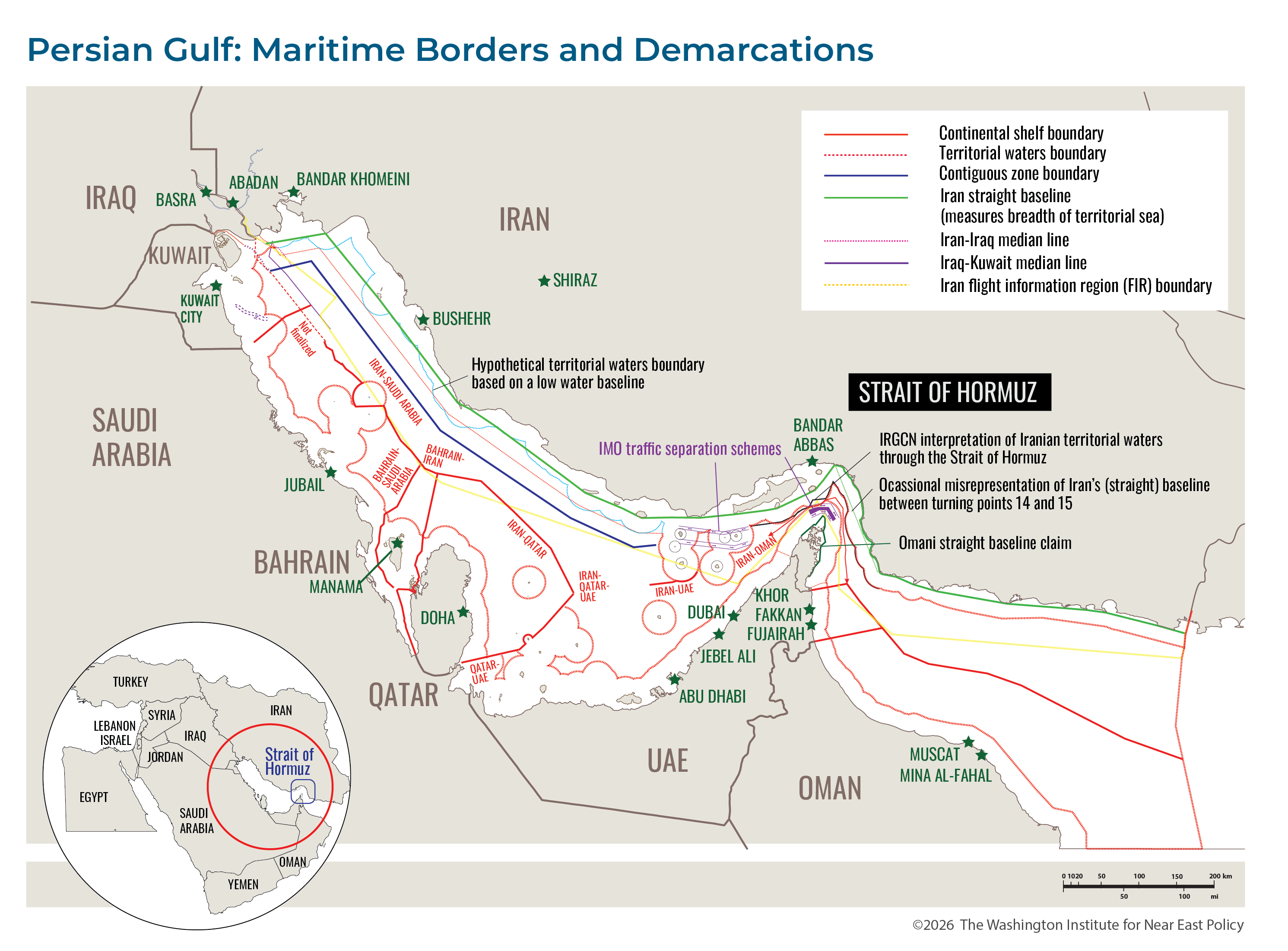

Under UNCLOS, Hormuz qualifies as an international strait used for “continuous and expeditious” transit (Articles 37-44). The governing regime is therefore “transit passage,” which is legally defined as non-suspendible, non-discriminatory, and free of state authorization or tolls for the mere act of transit. Coastal states may adopt separation schemes and safety regulations only in consultation with the IMO, and only if those measures do not impair the right of transit passage (Articles 41-42).
Of course, Iran is not a party to UNCLOS and has long rejected the transit passage regime in favor of an expansive “innocent passage” interpretation, based on its own 1993 maritime law. According to this view, the strait is subject to full coastal-state sovereignty, including the theoretical right to suspend passage and impose prior authorization. In contrast, Oman is a party to UNCLOS and bound by the obligations of indiscriminate transit passage, which most states around the world regard as customary maritime law. Muscat is therefore hesitant to embrace any arrangement that would alter lane placement, impose mandatory fees for passage itself, or create a state veto right.
Iran’s Goals and Red Lines
Tehran’s strategic objective is to control entry into the Gulf, whether by institutionalizing the “Persian Gulf Strait Authority” that it created in May or by implementing a successor mechanism that requires vessels to obtain Iranian authorization for transit, pay fees framed as “service charges,” and accept its routing and inspection protocols. Throughout the war, government officials and IRGC officers have repeatedly asserted that Hormuz transits are allowed only with Tehran’s permission. These claims serve both operational and negotiating purposes: they demonstrate Iran’s residual coercive capacity and raise the perceived cost of any arrangement that excludes Iranian control. In the short term, military operations and wartime hazards (e.g., suspected mines and unexploded ordnance) give Tehran temporary justification for altering traffic-management measures, especially amid ongoing delays in mine clearing operations.
As noted above, Tehran’s preferred end state is a bilateral Iran-Oman framework that excludes international oversight and treats the two coastal states as the sole decisionmakers. Since June, Foreign Minister Abbas Araghchi has described discussions with Muscat as an exercise of their “natural right” to coordinate safe passage arrangements and reserve final authority for Iran and Oman alone. By framing its strategy as pragmatic bilateral cooperation, Tehran is attempting to whitewash what would amount to a unilateral power grab. Moreover, an unnamed Iranian official quoted recently by the IRGC-affiliated outlet Fars News indicated that irrespective of a deal with Oman, Tehran intends to keep the strait shut until the United States withdraws its naval blockade, removes oil and petrochemical sanctions, and releases the regime’s blocked assets.
These red lines appear to be rigid. After rejecting Oman’s “regional consortium” concept, Iran advanced a counterproposal under which the entire inbound lane and parts of the outbound lane would be within its territorial waters, essentially giving it physical control over both primary traffic pathways. Yet for reasons discussed below, granting Iran control over an entire lane should be a nonstarter for the United States, even if only for portions of the route.
Policy Recommendations
The immediate priority for Washington and its partners should be to activate a focused, time-limited plan for escorting the hundreds of commercial vessels still stranded in the Persian Gulf. To resume limited two-way traffic in the near term and ease pressure on energy markets, the most practical path is a carefully structured coordination mechanism with Iran and Oman, operating under the principles below and backed with U.S.-led naval support. Longer-term governance talks can proceed in parallel once these initial priorities are under way. Throughout the transition process, the Trump administration should marshal regional states and the wider international community to do the following:
- Reject any Iranian effort to convert its wartime coercion into dominant control of the waterway.
- Continue supporting arrangements that keep the Omani corridor viable until a permanent solution is implemented.
- Prioritize the resumption of two-way tanker traffic in the strait. The temporary relief provided by emergency oil stock releases, increased supplies from various regions, and other buffers has been helpful, but it cannot prop up global energy security indefinitely—especially if renewed tensions in the Red Sea further roil the markets.
- Ensure that any longer-term arrangements rest on three core tenets: preserving freedom of navigation consistent with the UNCLOS regime of transit passage; rejecting any unilateral Iranian right of authorization or veto over commercial shipping; and instituting practical safety and traffic-management measures consistent with UNCLOS and IMO mandates.
- Insist that no bilateral Iran-Oman mechanism will be accepted unless it (1) is developed in close consultation with other Gulf coastal states, (2) remains permanently open to appropriate input from major user states and the IMO, and (3) explicitly affirms the transit passage regime with no provisions authorizing suspension, discrimination, or mandatory prior permission. The United States should engage constructively with any framework meeting these conditions, while also continuing whatever military operations are necessary to restore freedom of navigation and reinforce the legal regime.
- Retain the prewar, IMO-mandated TSS in Omani territorial waters as the operational baseline. Any northward adjustment of the inbound lane may be considered solely as part of a comprehensive package in which Iran accepts IMO oversight of the revised scheme and formally recognizes that transit passage reflects customary international law. Shifting the lanes without such commitments would risk converting temporary operational patterns into lasting Iranian leverage. Moreover, the United States should reject Iranian demands to move the inbound lane entirely inside Iranian territorial waters. This would put inbound ships—including U.S. Navy vessels—inside a potential IRGC capture or kill zone surrounded by Iranian shores on three sides, so the idea should be discarded for that reason alone. An inbound lane further to the south—that is, sitting partially in a strip of international waters that narrowly separates Omani and Iranian waters, and partially in Iranian territorial waters—would be a more acceptable alternative.
- Limit any fees to voluntary payments for actual services rendered, such as pilotage, traffic assistance, hydrographic support, environmental protection, or search and rescue. No charges should be attached to the mere right of transit. Yet some voluntary fees may be justified given the fact that the hundreds of vessels still stranded in the Gulf will require safety guarantees before exiting the area even if a U.S.-Iran deal ends the war. They will also likely need ship escorts and/or guidance for safe navigation.
Ultimately, models that combine the cooperative safety practices used in the Strait of Malacca with the open transit character of the Strait of Gibraltar offer the most suitable reference for durable, UNCLOS-compliant arrangements in the Strait of Hormuz. Given Iran’s coercive tactics and clearly stated intentions, only arrangements that uphold transit passage, reject unilateral control or mandatory fees, and keep the existing IMO traffic separation scheme as the baseline can restore reliable navigation through the strait—an indispensable prerequisite for protecting global commercial interests and international law.
Noam Raydan is the Sudhaus Senior Fellow at The Washington Institute, where Farzin Nadimi is a Senior Fellow. Their other joint projects include the Institute’s Maritime Spotlight portal.
Share