- Policy Analysis
- PolicyWatch 4274
One Year After the Gaza Ceasefire: Moving from War to Enduring Security Control
Part of a series: One Year After the Gaza Ceasefire
or see Part 1: Overview: Assessing the Gaza Ceasefire, Year One
A veteran Israeli intelligence and defense official assesses the country’s military strategy in Gaza since the ceasefire and makes recommendations for the path forward.
This PolicyWatch is part of a Washington Institute series analyzing the risks and opportunities in Gaza since the October 2025 ceasefire and offering recommendations for policymakers going forward. See the full series.
Last October’s ceasefire marked the end of the period of intensive warfare in the Gaza Strip that began after Hamas’s 2023 attack, heralding a significant shift in Israel’s military approach. After two years of sustained fighting and major degradation of Hamas’s military infrastructure, the Israel Defense Forces moved toward a different operational concept. Within days, IDF units redeployed to what became known as the “Yellow Line,” while the final twenty living Israeli hostages were released.
Nearly a year later, Israel faces a fundamental strategic question: does the current security architecture in Gaza represent a temporary postwar deployment or the foundation of a long-term posture? If the former, under what circumstances could the IDF gradually reduce its territorial footprint and redeploy back toward Israel?
October 7 also represented the collapse of the Gaza security concept on which Israel had relied for years. Deterrence, intelligence superiority, technological barriers, and a relatively static border posture all failed simultaneously, resulting in both a strategic catastrophe and a profound national trauma for Israel’s society and security establishment. Recovering from that trauma and rebuilding confidence in the state’s ability to protect its border communities will take time, so any rapid return to the pre-October 7 lines will be difficult even if conditions in Gaza improve.
Therefore, the challenge for the coming months and beyond is to determine how much territorial depth Israel needs, and whether the essential security functions currently provided by territorial control can eventually be achieved through a substantially smaller military footprint. This question cannot be considered in isolation from the regional and international environment. In particular, the United States and Saudi Arabia have the economic, diplomatic, and strategic leverage needed to give Israel more room for maneuver. If they choose to exert that leverage—for example, through a Saudi offer of normalization as part of the Abraham Accords—they could fundamentally alter the strategic equation.
From Offensive Campaign to Enduring Security Control?
Between October 2023 and October 2025, Israel’s campaign evolved from destroying Hamas’s military and governmental infrastructure via fires and combat maneuver into a prolonged campaign of attrition, territorial control, and follow-on operations against the group’s remaining capabilities. Yet the ceasefire marked a doctrinal transition. Instead of continuous large-scale maneuver, the IDF began emphasizing four interconnected principles: forward defense to create physical distance between hostile forces and Israeli communities; persistent intelligence superiority to identify emerging threats before they mature; operational freedom of action to continue striking or entering areas controlled by other actors when necessary; and preventive efforts to ensure that Hamas and other armed groups cannot reconstitute the military capabilities needed for another large-scale attack.
In other words, Israel no longer seeks to simply destroy Hamas through decisive maneuver. Nor does it seek to administer Gaza or assume responsibility for the territory’s civilian population. Rather, it seeks sufficient control over the physical and informational environment to prevent the emergence of a strategic military threat, while leaving civilian governance to Palestinian and/or international mechanisms. Accordingly, the relevant measure of success is no longer how many Hamas fighters are killed or how much of the group’s infrastructure is destroyed—it is whether Hamas can once again function as an integrated military organization capable of mounting another major attack.
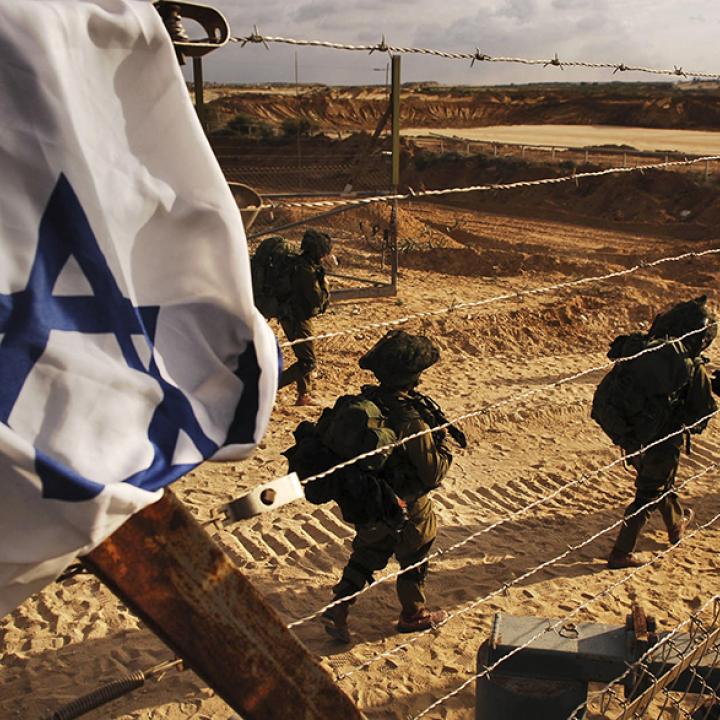
The Yellow Line is the physical expression of this concept. It was not conceived as an international border, but as an operational line of control providing surveillance, early warning, protection for Israeli border communities, and rapid response to developing threats. The military logic behind this line rests on distancing Israel from such threats and increasing its warning time. As such, the roughly 60 percent of Gaza territory lying on the Israeli side of the line has evolved from a temporary battlefield into a forward security zone. This zone is characterized by military presence, surveillance, intelligence collection, engineering activity, rapid-reaction capabilities, and the ability to conduct localized military operations without immediately returning to the scale of maneuver seen during the war.
On the other side of the line lies Gaza’s principal civilian space, where most of the Palestinian population is concentrated and where governance is intended to be conducted by Palestinian and/or international mechanisms, not by Israel. Yet Israel may periodically feel compelled to enter that space militarily in order to ensure security control.
This creates a paradox. International actors will continue to criticize Israel for maintaining a presence in Gaza and conducting operations across the Yellow Line. Yet these operations are currently required to prevent Hamas from reconstituting its military capabilities, and the more successful these operations are, the greater the possibility that Israel can eventually reduce its territorial presence. In contrast, if Hamas is permitted to reconstitute itself, Israel may conclude that permanent forward territorial control is indispensable.
Jerusalem’s long-term thinking on such issues has of course been fundamentally reshaped by the October 7 attack. Before that date, Israel largely sought to manage the threat emanating from Gaza, but it now seeks to prevent the Strip from birthing strategic military threats. This emerging security concept rests on the premise that distance itself is a security capability, since strategic depth reduces the possibility that a localized tactical penetration like the October 7 assault can immediately become a strategic catastrophe.
But strategic depth has costs. The deeper that Israeli forces remain inside Gaza, the greater the military burden and risk to soldiers, and the higher the political, diplomatic, and economic costs. A prolonged Israeli military presence could even erode U.S. political support for the current security architecture.
Despite these costs, Israel seems unlikely to relinquish any of its newfound strategic depth anytime soon. Yet its posture could change quickly if political or diplomatic conditions shift—particularly if Saudi Arabia were to extend a credible offer of normalization conditioned on significant Israeli redeployment from Gaza. Hence, the central strategic question is not whether Israel benefits from strategic depth, but how much territory it needs to obtain those benefits, and under what circumstances it would be willing to withdraw to new lines. Put another way: if the Yellow Line remains a temporary security arrangement, it can serve as an instrument for building a different security architecture and paving the way toward phased, zone-by-zone redeployments, as described in the introductory essay of this series. But if conditions on the ground do not change and the Israeli military zone grows larger or more entrenched, then it could represent a shift toward a more permanent territorial doctrine for Gaza.
Preparing for Conditional Redeployment
Israel should begin planning now for the possibility of a future redeployment, well before it concludes that such a move is politically or militarily feasible. Waiting until diplomatic or political pressure heightens would leave Israel and the IDF in a reactive position, whereas advance planning would enable them to determine which security functions provided by the current forward zone would have to be replaced before territory could safely be relinquished.
Specifically, such planning must identify what geographic line could provide adequate defense, which intelligence and surveillance capabilities could compensate for reduced territorial depth, what rapid-reaction forces would be required, and what indicators would trigger a return to a more forward posture. The principle should be straightforward: even if Israel cannot currently commit to reducing its territorial footprint, it can and must start planning for that scenario.
Moreover, all parties must bear in mind that any future redeployment will need to be conditions-based rather than calendar-based. Several conditions would need to converge over time before any Israeli withdrawals could begin:
- Hamas must no longer possess the weapon systems or the organizational, logistical, and command capabilities required for a large-scale attack. Effective disarmament mechanisms must be applied to Palestinian Islamic Jihad as well.
- An alternative governing authority must demonstrate the ability to maintain internal order and prevent armed organizations from reconstituting their capabilities.
- Effective mechanisms must be implemented to prevent weapons, malign actors, and the components needed to rebuild military infrastructure from entering Gaza.
- Israel must retain sufficient intelligence access to identify military reconstitution efforts before they become an operational threat.
- International actors must demonstrate the actual capacity to enforce postwar arrangements, not merely the stated willingness to do so.
- Israel must have confidence that it can defend its border communities.
If these conditions cannot be met, Israel may conclude that continued forward military control remains necessary.
October 2026-October 2027: The Test Year
The coming year should be treated as a period of strategic assessment rather than just a continuation of the existing deployment. By October 2027—or perhaps sooner under the right conditions—Israel should be able to judge whether the postwar architecture has produced sustainable change. Again, the key tests will be whether Hamas has been prevented from rebuilding an organized military force; whether an alternative governing structure has demonstrated durability; whether authorities feel confident they can prevent Gaza from being used as a launchpad for military attacks; and whether Israel can maintain reliable intelligence and adequate protection for its border communities with less extensive territorial control. The performance of the international mechanisms tasked with disarmament and enforcement will greatly affect the test results.
Ultimately, the most pressing question is whether the security benefits provided by a continued Israeli presence inside Gaza remain greater than those achievable through a smaller perimeter-based deployment. If the evidence gathered in the coming months suggests that essential security functions can be maintained with less territory, Israel should begin a gradual transition toward perimeter defense. If not, then maintaining a forward military presence may remain the more prudent option—that is, not an optional buffer, but a necessary component of national defense.
Even in the transition scenario, Israel would not simply return to the pre-October 7 security model. Any future perimeter defense would require deep intelligence penetration, continuous surveillance, layered physical defenses, rapid-reaction forces, a clear doctrine of preventive action against emerging threats, and a demonstrated willingness to effectively implement this new doctrine via appropriate deployment and resourcing decisions. Such an approach would reflect another hard-earned lesson of October 7: that Israel can never again rely solely on deterrence, technological superiority, or static border defenses to protect its citizens.
Zohar Palti is the Zlatkin International Fellow with The Washington Institute. Previously, he headed the Mossad Intelligence Directorate and the Policy and Political-Military Bureau at Israel’s Ministry of Defense.