- Policy Analysis
- PolicyWatch 4286
Iraq’s Energy Challenges Amid the Hormuz Crisis
by
Noam Raydan
Oct 21, 2026
About the Authors

Brief Analysis
The recent rebound in crude exports is welcome but only partial, and officials have yet to find answers for the wider fiscal, management, and security problems impeding Iraq’s energy sector.
Over the past two months, Iraq’s crude oil exports from its southern terminals in Basra began to recover more fully from the wartime cut-off in tanker traffic through the Strait of Hormuz. This came as good news for Baghdad, whose budget relies heavily on oil revenues, especially to finance an ever-growing public payroll. Yet the signs of export recovery are only partial and should not be viewed as a panacea for the country’s persistent energy challenges, whose consequences can easily trigger public discontent and ministerial shake-ups. One of OPEC’s largest oil producers has yet to regain its prewar export levels via Basra, and the flow is likely to continue fluctuating if Iranian ship attacks in Hormuz and surrounding waterways keep escalating. (At least twenty-eight attacks have occurred so far in October; see The Washington Institute’s Maritime Attack Tracker for details on these incidents.) Indeed, the war has amplified Iraq’s longstanding energy problems, and this issue will need extra U.S. attention as Washington seeks to transition the bilateral relationship from a security focus to a partnership based on economic cooperation.
Fluctuating Exports and Fiscal Challenges
According to government and private estimates, oil exports via Basra averaged between 2.4 million and 2.6 million barrels per day in September as more tankers loaded deep inside the Persian Gulf. This was a noteworthy recovery from March (when exports plummeted below 1 million bpd) and July (when they hovered around 1.3 million bpd). A few additional crude cargoes could have been shipped by vessels sailing with their Automatic Identification Systems turned off. Yet all of these figures are still well below prewar levels, with around 3.4 million bpd exported in February.
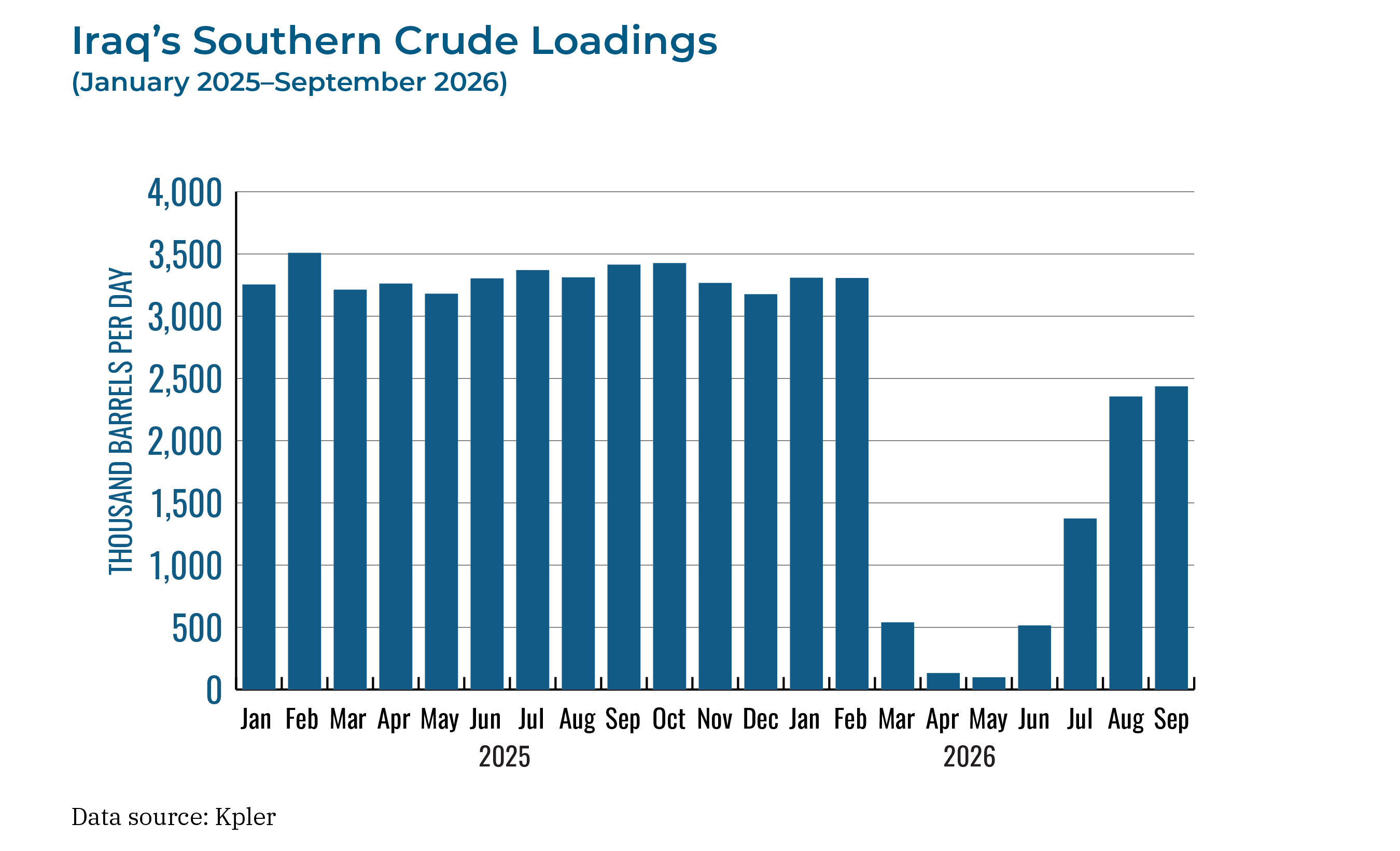

The budgetary impact has been substantial. In February, oil export revenues were estimated at $6.8 billion per month, but they plunged during the first four months of the war, reaching around $1.5 billion in June. The latest official figures suggest they have now rebounded to between $4.5 and $5 billion per month, with some reports estimating higher revenues amid higher oil prices. Yet fluctuating profits, wartime costs, increased Iranian attacks, and related factors have deepened Baghdad’s wider fiscal challenges and made the path to further recovery uncertain.
For example, the government recently devalued the national currency from 1,300 to 1,500 Iraqi dinars per U.S. dollar. While this move was seen as an attempt to generate more dinars to pay public salaries, it is very unpopular among citizens due to the impact on consumer prices. Similarly, the oil and budget crunches are affecting the long-beleaguered electricity sector, which depends on government funding and struggled once again to provide reliable power this summer (see below).
Limits to the Recovery?
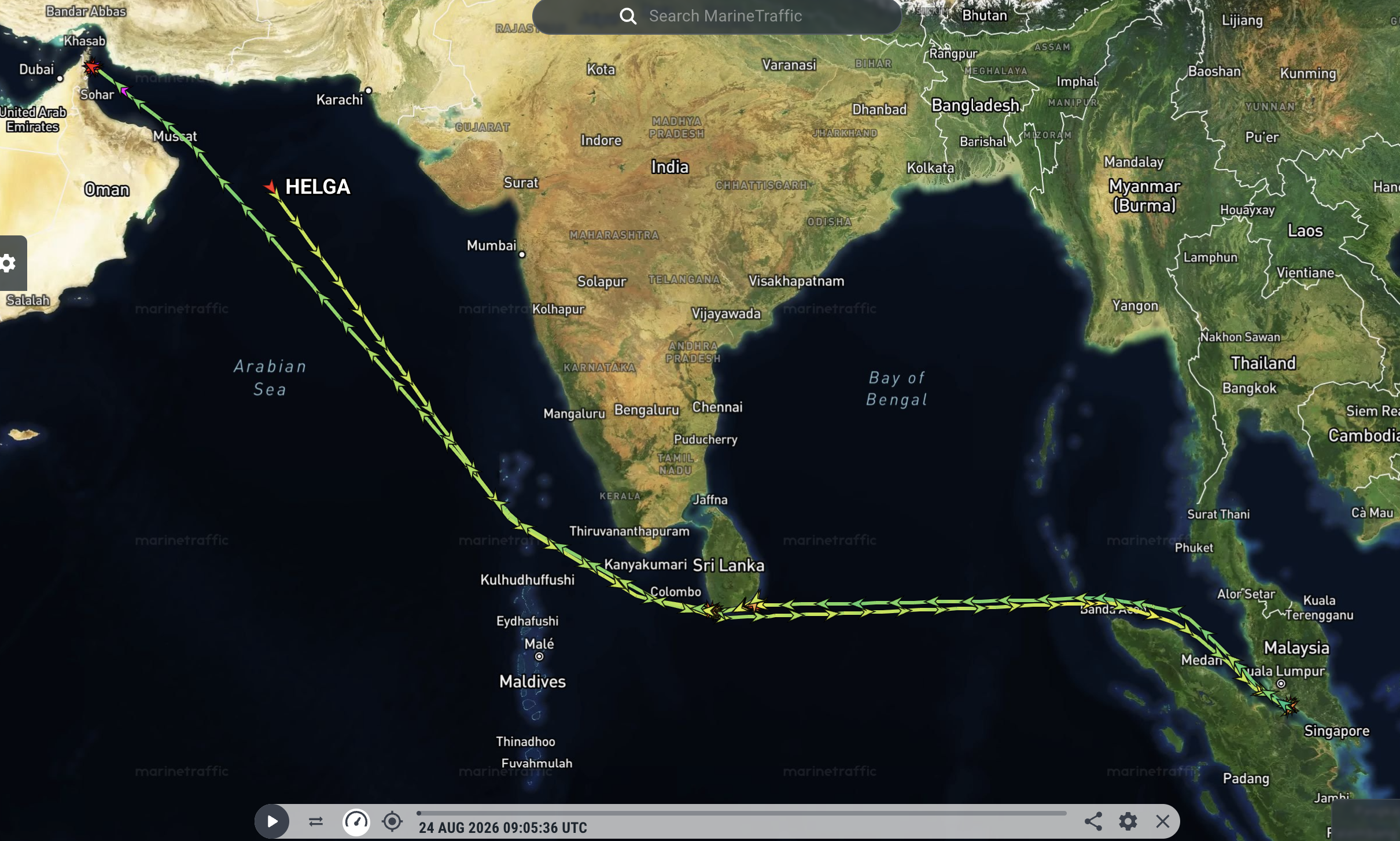
Baghdad has tried various means of adapting to the wartime export restrictions via the Strait of Hormuz. Although some oil tankers have sailed directly from Basra to their final destinations over the past few months, tracking data from MarineTraffic and Kpler shows that other crude shipments have relied on ship-to-ship transfers, with tankers loading in Basra and offloading to other vessels in waters near Fujairah in the United Arab Emirates or Sohar in Oman. This “shuttle trade”—which includes crude shipments from other Gulf exporters—has helped enable the resumption of oil flows, as several ship owners and charterers are hesitant to navigate the high-risk strait and prefer to collect cargoes in the Gulf of Oman, despite knowing that the infrastructure there has limitations. For example, congestion in the portion of the Gulf of Oman where many ship-to-ship transfers are conducted has seemingly added extra steps to the export process, as some buyers have been requesting to collect their cargoes in different ship-to-ship hubs. Such was the case when the tanker Helga (IMO 9176993) loaded at Basra in early August and then sailed to Malaysian waters, where it transferred its cargo to another tanker before heading back to the Gulf region on September 9, based on data from MarineTraffic and Kpler.

Baghdad also seeks to compensate for the fact that it does not own a tanker fleet of its own, in part by planning to charter more vessels so that it can exert more control over its southern oil exports. In addition, it has had to offer heavy discounts on its crude oil to encourage buyers to load deep inside the Persian Gulf amid the high risks in the Strait of Hormuz. Yet according to statements made by the director-general of the State Oil Marketing Organization (SOMO) during a September 20 parliamentary session, Iraq has been facing competition from other Gulf exporters, who were apparently offering steeper discounts than Iraq as of last month.
Baghdad has also been trying to boost its northern crude exports via a pipeline linked to Turkey’s Mediterranean hub at Ceyhan, and by trucking extra volumes from the south. As of September, however, data from Kpler and figures announced by an Oil Ministry spokesperson indicated that Iraqi exports via Ceyhan stood at less than 300,000 bpd. This is hardly surprising given the major infrastructure and security challenges presented by the northern route. Some oil fields in the Kurdistan Region had to shut down this spring due to drone attacks by Iran-aligned militias—a threat that predates the war and persists today. Northern gas fields have experienced similar disruptions, particularly the Khor Mor field, which feeds a vital power station in Kirkuk and is run by the federal government.
Old Electricity Troubles, Now Worse
In July, while struggling to boost its oil exports and revenues, the government was also grappling with a familiar spate of power outages. Peak demand reached as high as 60,000 megawatts, but data from the Ministry of Electricity indicated that the grid could only supply around 22,000 MW.
The head of the ministry, Ali Saadi Wahib, shed further light on this troubled sector during a parliamentary session on July 27. Laying out the technical, political, and financial reasons for the latest power crisis, he specified several factors: the reduction in gas supplies from Khor Mor and other sources; disruptions in the estimated 600 MW of electricity imported from Turkey due to payment problems stemming from Baghdad’s fiscal crunch; and other payment issues with gas piped from Iran. On the latter, he noted that during his visit to Washington in July, Baghdad asked for U.S. approval to facilitate some payments to Iran for gas imports from money held in an account at the Trade Bank of Iraq (TBI). Over the years, Baghdad has sought U.S. waivers to pay for Iranian energy supplies by transferring the funds to Iranian accounts at TBI. According to the minister, the amount is around 6.5 billion euros. “The American side has some demands [we need] to address so that we can settle some of the payments to the Iranian side,” he told parliament.
The power sector has long suffered from persistent political interference, inefficiencies, and financial losses. It is heavily dependent on subsidies and budgetary support while still lacking an effective billing and collection system. According to Wahib, his ministry’s combined operating and investment/capital budget for the three-year period between 2022 and 2025 was around 54 trillion dinars, equivalent to about $40 billion. This points to the ministry’s longstanding financial imbalance—it requires billions of dollars from the government budget while being unable to generate sufficient revenues or provide reliable services.
These and other policy missteps have kept Baghdad dependent on neighbors for energy imports, with Tehran’s unreliable gas supplies remaining critical for power generation in the absence of sufficient alternatives. The Iran war has also been blamed for reduced associated gas output from Iraq’s southern oil fields, as the country curtailed oil production at the start of the conflict, knowing that the gas captured alongside crude oil production is not enough to meet domestic power demands.
The crisis has also delayed an urgently needed project between Baghdad and the U.S.-based firm Excelerate Energy to develop an integrated floating terminal for importing liquefied natural gas at Khor al-Zubair. Excelerate was scheduled to deploy a floating storage and regasification unit there this summer, but the war forced its postponement until at least 2027.
Implications for U.S. Policy
In praising new Iraqi government deals with U.S. businesses on July 17, Energy Secretary Chris Wright told attendees at a high-level business summit, “There is so much room to drive improvement in Iraq, to raise oil production, reduce dependencies on hostile neighbors, to bring freedom, prosperity, and abundant energy to the nation of Iraq.” Current circumstances make these objectives difficult to achieve immediately, but there are opportunities to secure and perhaps expedite some projects that were delayed by—and made more urgent as a result of—the Iran war.
The most prominent is the LNG project with Excelerate Energy, which could help advance the wider bilateral economic partnership by diversifying Iraq’s fuel supply, reducing its reliance on Iranian gas, and gradually strengthening its energy security. The new gas platform is expected to begin operations by mid-2027, and implementation will require close monitoring given its importance to both Iraq’s energy security and U.S. energy priorities—especially if military tensions persist in the Strait of Hormuz.
Meanwhile, some U.S. and Iraqi officials have been encouraging the construction of pipelines to neighboring countries, including to the Syrian port of Baniyas. The idea is to give Iraq a second outlet for its southern exports and avoid overreliance on the Hormuz route. Yet it is unclear whether Baghdad can overcome the financial, political, and bureaucratic hurdles encountered with past pipeline plans, and the Syrian project would require several years to complete even if it does get off the ground.
Noam Raydan is the Sudhaus Senior Fellow at The Washington Institute and co-creator of its Maritime Spotlight portal.
Share