- Policy Analysis
- PolicyWatch 4244
How to Prevent Militias from Disrupting Iraqi-Saudi Relations
As the dust settles from new attacks in both countries, Baghdad will need U.S. support to make progress against Iran-backed militias while assuaging Riyadh’s security concerns.
On July 28, American and Saudi aircraft conducted strikes on at least seven sites in Iraq that U.S. Central Command described as “terrorist logistics and weapons sites” used by Iran-backed militias. The action came in response to two days of Iraqi militia drone launches into Saudi Arabia, echoing the spate of similar attacks from Iraqi soil during Operation Epic Fury in February-April. Prime Minister Ali al-Zaidi’s planned visit to the kingdom was postponed due to the exchange of fire—an outcome that no doubt pleased Tehran just days after it hosted Zaidi on July 23. The United States must do what it can to get a Baghdad-Riyadh summit back on track, toward the broader goal of buttressing this complex triangular relationship through a mix of military and diplomatic measures.
Militia Attacks, Allied Response
Saudi Arabia was attacked multiple times from Iraqi territory this week: first with a series of drone launches that were intercepted en route to Riyadh and the oil-rich Eastern Province on July 27, and second via a successful July 28 attack on Abqaiq, the world’s largest oil-processing facility. The latter operation appeared to hit the exact same aimpoints targeted by the September 2019 drone attack on Abqaiq, which was also launched from or through Iraq, making it particularly provocative.
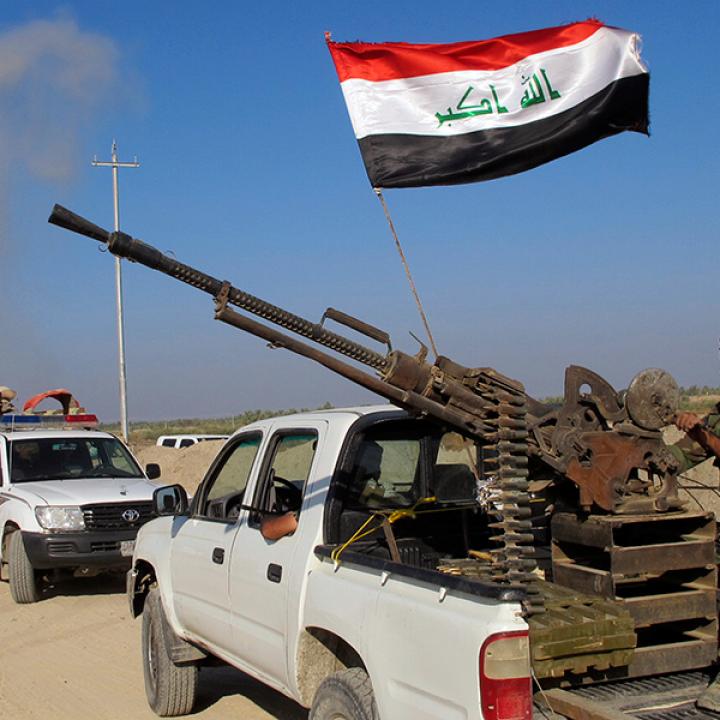
Gulf attacks are hardly novel for Iran’s Iraqi militia proxies. From 2019 to 2022, U.S.-designated terrorist groups such as Kataib Hezbollah (or its facade group Alwiyat al-Waad al-Haq) struck the East-West Pipeline extending from Abqaiq to Yanbu, government buildings in Riyadh, and civilian sites in the United Arab Emirates. And during the current Iran war, Iraqi groups lashed out at Saudi Arabia soon after the conflict erupted in late February, as part of a wider campaign against U.S. bases and civilian infrastructure in Bahrain, Jordan, Kuwait, and the UAE. Although militias were coy about claiming the Saudi attacks, press reporting suggests they launched as many as 500 in February-April alone, spurring the kingdom to undertake counterstrikes inside Iraq. Riyadh has not disavowed such reports, and shortly before the July 28 reprisal strikes, the Foreign Ministry publicly warned that Saudi forces would respond to Iraqi militia attacks.
Specifically, CENTCOM confirmed that U.S. and Saudi aircraft were involved in hitting multiple Iraqi targets. In the north, three clusters of militia sites were struck in the Nineveh Plains, Amerli, and Dibis. These operations were probably carried out by American forces, judging by the pattern of U.S. strikes since February and the probable use of these northern launch areas in the recent flurry of militia attacks on U.S. and partner sites in the Kurdistan Region of Iraq.
At least four other sites were struck in central and southern Iraq: Camp Ashraf in Diyala province, a militia guesthouse in Karbala, at least one site just south of Baghdad, and another in al-Deir north of Basra. Some of these locations were likely struck by Saudi aircraft, similar to their focus on southern Iraqi launch sites used to threaten the kingdom during Operation Epic Fury.
According to the Popular Mobilization Forces—the Iraqi government body that Iran-backed militias exploit for official cover and material support—twenty PMF members were killed in this week’s strikes and another thirty-two were injured. Notably, five coffins draped in Iranian flags were also shown on Iranian media, suggesting that military figures from the Islamic Revolutionary Guard Corps (IRGC) or other Iranian entities may have been killed as well. This makes the July 28 strikes one of the deadlier U.S.-supported bombing operations in Iraq in years. (In December 2019, twenty-eight Kataib Hezbollah terrorists were killed in a U.S. strike, triggering a militia effort to overrun the U.S. embassy, which in turn helped crystallize President Trump’s decision to kill IRGC-Qods Force commander Qasem Soleimani and Iraqi militia kingpin Abu Mahdi al-Muhandis in January 2020.)
Broader Iranian-Houthi Context
The latest exchange took place just as another Iranian partner—Yemen’s Houthis—began striking airports, oil tankers, and onshore oil facilities on Saudi Arabia’s west coast. Concurrently, Iran attacked three ships trying to use the U.S.-protected corridor in the Strait of Hormuz, and launched ballistic missiles at a U.S. base in Jordan.
Untangling this mess of actions is tricky, but Iran’s “axis of resistance” appears to have shifted its focus to Saudi Arabia as the latest fulcrum for pressuring the United States into de-escalation. In early April, as the Trump administration implemented an oil blockade on the Islamic Republic and considered wider options such as seizing nuclear sites or invading southern Iran, the regime responded by escalating against Saudi infrastructure for the first time in the war. Major petrochemical and oil-loading sites were struck in the kingdom’s Eastern Province, and the Houthis might have become involved as well had Washington not backed away.
Going forward, the Saudis will likely face revenge attacks from Iraqi militias along with more attacks from Yemen, unless Riyadh makes some kind of deal with the Houthis. One probable focus of these attacks will be the East-West Pipeline, which the kingdom has been leaning on more heavily as an alternative to the constricted Hormuz oil export route. Washington may therefore be called on to help Riyadh craft a deterrence approach to Iran’s partners in Iraq and Yemen. If so, the July 28 strikes may be the beginning, not the end, of a new military sequence—one that might extend into Yemen as well.
U.S. Policy Considerations
The Trump administration has to consider two important relationships at this fraught moment: with the new Iraqi government led by Prime Minister Zaidi, and with its old partner, Saudi Arabia. As this triangular set of relationships becomes more interconnected, it is getting more difficult to keep everyone happy.
U.S. officials gave Zaidi a hero’s welcome in Washington two weeks ago, but now he has to cope with the fact that U.S. forces are dropping bombs on Iraqi soil again. For months now, the administration has been quietly advising Riyadh on how to prepare sovereign deterrent options when Iran-backed groups attack the kingdom, and Washington has not hesitated to openly side with the Saudis this week. The trick now is how to maintain positive momentum with Zaidi while still “showing up” for Gulf partners when they need U.S. security help.
For its part, Tehran will undoubtedly continue using Iraqi proxy attacks on Saudi Arabia and other Gulf states in an attempt to cut Zaidi off from the broader Arab support he needs to make progress on his rather optimistic pledge to bring all arms under state control by September 30—the same day that U.S. combat forces are expected to vacate Iraq. Washington should take the following steps to give Zaidi the best chance of making a successful start, and to help convince Riyadh and other Arab capitals that he needs more time to achieve results:
- Keep Riyadh and Baghdad talking. U.S. interests are not served by letting Iran divide two U.S. partners who also happen to be the top two OPEC oil producers. Although a public Iraqi-Saudi summit may be hard to reschedule, this should be the eventual aim within the next few weeks or months. In the interim, the Trump administration should use its good offices to convene detailed, ongoing security dialogue between Iraqi and Saudi intelligence agencies.
- Support targeted raids on militia drone storage sites. The United States has lots of evidence of Iran providing drones to Iraqi groups, but it previously lacked executive and judicial partners who could be counted on to act on these tip-offs. With Prime Minister Zaidi cooperating closely with Faeq Zaidan, the newly anti-militia head of the Supreme Judicial Council, both of their branches should be given a chance to show what they can do when presented with actionable intelligence. This should be done quietly, and the focus should be on disrupting the drone supply chain, including storage, reassembly, and maintenance sites.
- If Iraqi self-policing fails, target the worst militia leaders. Iran’s militia proxies have never limited their attacks purely because their rank-and-file members and weapon storage facilities were struck. Only senior leadership casualties have altered their behavior—and even then only temporarily, though still with positive effects that make military action worthwhile. For instance, from February 2021 to December 2023, U.S. forces struck multiple junior militia members with no effect on attack rates against U.S. sites. Yet three leadership strikes on senior militia figures in December 2023 and January-February 2024 measurably quieted attacks on U.S. forces in Iraq for most of 2024-25.
- Help Western companies in Iraq import counter-drone defenses. The Iraqi government has committed to easing the bureaucracy impeding Western oil companies and other firms from importing such defenses to protect their local facilities and personnel. With militias frequently striking sites run by American investors and forcing them to shut in much-needed oil exports, this should be a priority mission for the U.S. embassy in Baghdad. And if the Iraqi government cooperates on reducing militia attacks, it should also receive expedited access to these in-demand defense systems for key leadership locations.
Michael Knights is an adjunct fellow with The Washington Institute, co-creator of its Militia Spotlight platform, and chief product officer for Horizon Engage.