- Policy Analysis
- PolicyWatch 4173
Epic Fury and Roaring Lion: From War Scenarios to Pressing Postwar Questions in Iran
by
Assaf Orion, Michael Eisenstadt, Holly Dagres, Patrick Clawson, Hanin Ghaddar, April Longley Alley, Richard Nephew
Mar 1, 2026
Also available in
Brief Analysis
Washington Institute experts assess the immediate implications of U.S.-Israeli military strikes on Iran, including the regime’s future after major leadership losses, reactions inside Iran and Lebanon, the fallout for the Gulf states, the contours of potential diplomacy once the fighting stops, and more.
Israeli-U.S. War Goals and Military Coordination
By Assaf Orion
The statements made by President Trump and Prime Minister Binyamin Netanyahu announcing this weekend’s operations—codenamed “Epic Fury” by the United States and “Roaring Lion” by Israel—reflect close coordination but also some differences. Both recalled the Iranian regime’s lethal legacy, vowed to prevent it from acquiring nuclear weapons, and called for its fall, though without committing to topple it directly.
President Trump stated that his central goal is to defend the United States, and that the operation will be a massive and protracted campaign aimed at destroying Iran’s missiles and navy, preventing Tehran from ever obtaining a nuclear weapon, and neutralizing its regional terrorist proxies. He also called on the regime’s security and police agencies to surrender, and for the Iranian people to take power once the operation is over.
Netanyahu stated that the campaign’s central goal is to remove an existential threat to Israel. He also declared that it would create conditions for the Iranian people to rid themselves of tyranny.
Interestingly, Trump described the campaign as an American operation without mentioning Israel as a partner. In contrast, Netanyahu characterized it as a joint operation and thanked Trump for his historic leadership.
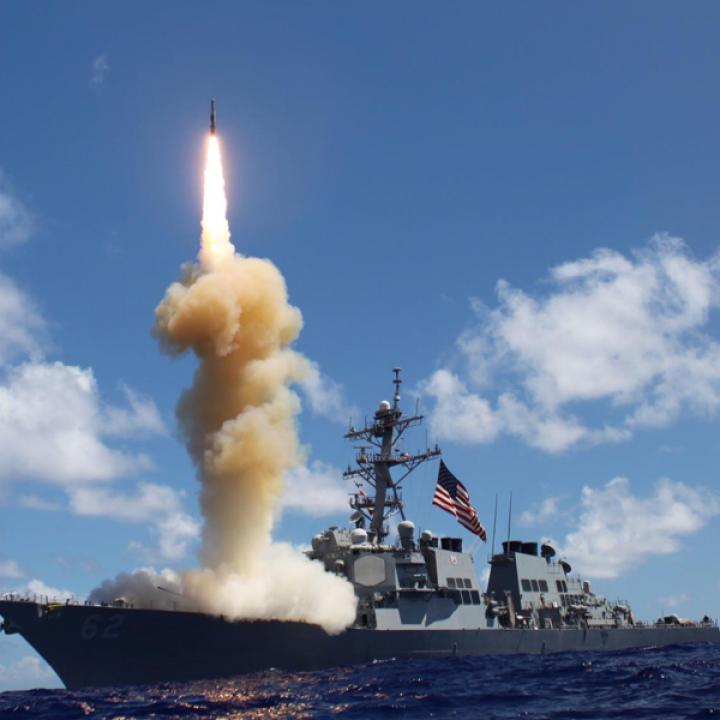
Militarily, the two allies have been cooperating very closely, dividing targets, sectors, missions, and more. Israel has provided vital intelligence, carried out decapitation strikes on top Iranian officials, and played a central role in suppressing the regime’s air defense systems to ensure supremacy in the skies for both allied militaries. Israeli forces have already struck hundreds of targets in western and central Iran, and U.S. forces are seemingly responsible for striking other parts of the country and destroying Iran’s navy. An Israeli military video also shows it hunting medium-range ballistic missile launchers.
Concurrently, a joint air defense effort is underway to protect U.S. forces and allies in the region. As of this writing, Iran’s hundreds of missiles and drones have caused increasing damage to its enemies—mostly material, but with some casualties. Effective suppression efforts against these weapon systems may help allies save their more limited defensive interception resources. Taken together, the various elements of this impressive joint campaign are enabling allied military and strategic preponderance over the Iranian regime, maximizing synergy between the relative strengths of the Israeli and U.S. armed forces.
Iran’s Regional Military Response and Strategic Limitations
By Michael Eisenstadt
In recent weeks, Iranian officials threatened to respond to a potential U.S. attack using all means at their disposal, striking American bases throughout the region and waging a long, costly war. In answering this weekend’s joint U.S.-Israeli strikes, Tehran has been true to its word: it launched hundreds of ballistic missiles and drones against U.S. bases in Bahrain, Jordan, Kuwait, Qatar, Saudi Arabia, the United Arab Emirates, and the Kurdistan Region of Iraq. The U.S. military has reported three American service members killed so far and five wounded. Iran also launched scores of missiles against a wide array of targets in Israel.
In addition to military sites, Iran’s counterstrikes have targeted civilian sites in several countries, including residential structures (Bahrain and Israel), hotels (UAE), and international airports (Kuwait, UAE, Erbil). This approach may reflect a wedge strategy that aims to spur Washington’s Arab allies to press for a halt to the war. Yet Iran’s strikes seem to have had the opposite effect, with the Gulf Cooperation Council, Jordan, and Syria openly condemning the attacks and asserting their right to self-defense under the UN Charter.
These actions hint at Iran’s wider military strategy—and its possible limitations. By spreading its effort over a wide target set in multiple countries, the regime seems willing to dilute the physical effects of its strikes in order to maximize their psychological impact, conveying the message that no one allied with the United States is safe. Yet this strategy seems to have boomeranged against Tehran—though it is unclear whether this will have a tangible effect on the war effort. The regime has apparently forgotten one of the most important lessons of the 1980s Iran-Iraq War: it cannot win a prolonged conflict against better-resourced adversaries when its actions stiffen enemy resolve, further isolate Iran internationally, and require the expenditure of finite assets (in this case, missiles and drones) that it cannot readily replenish.
Iranian Public Reactions and the Future of the Protest Movement
By Holly Dagres
Although the internet blackout that the regime imposed when the attack began has made it difficult to get a clear read of events on the ground, numerous videos posted before the shutdown showed young and old Iranians celebrating the strikes. The fact that these people were celebrating rather than cowering in fear is a telling reminder of what the Islamic Republic has done to the populace over the past forty-seven years. Those reactions continued after the killing of Supreme Leader Ali Khamenei, with posts shared online via Starlink indicating public celebrations in numerous cities across Iran.
This response is unsurprising given the scale of the massacre the regime committed in recent weeks. Many Iranians, including prominent human rights lawyer Nasrin Sotoudeh, have been calling on the international community to invoke its “responsibility to protect” (R2P) principle and intervene against the regime. President Trump’s prewar promise that “help is on its way” made them hopeful, though it remains unclear how these Iranians will feel in the longer term if many civilians are killed in the process, or if regime remnants manage to emerge from the ashes and take over.
For now, most of the public will have little protection from—and limited information about—the current hostilities. As the June 2025 war showed, there are no air raid sirens to give them warning of imminent attacks, nor shelters where they can take cover. Those who can afford to have begun fleeing the capital for the north. Meanwhile, diaspora satellite channels have been jammed for days, making it harder for people to access the information they need to keep up with and respond to key developments. Most notably, Article 111 of the Iranian constitution has now been invoked: it calls for a three-person council—consisting of the president, the judiciary chief, and a cleric from the Guardian Council—to temporarily assume the Supreme Leader’s duties when he passes. As of this writing, these figures are still alive. So long as they and the remainder of the clerical establishment remain intact, the Islamic Republic can endure—at least for the time being.
Regime Decisionmaking Post-Khamenei
By Patrick Clawson
Now that Khamenei has been killed, the Islamic Republic will be challenged to sustain government continuity. Through his staff of more than 5,000, the Supreme Leader long micromanaged decisionmaking on personnel, security issues, cultural matters, the economy, and more. Although he often stayed in the background and relied on advice from the influential Supreme National Security Council, he was ultimately the one to make the most important decisions, and it is unclear how that process will work without him.
The last time a Supreme Leader died, the constitutional niceties about the Assembly of Experts choosing a new leader were a mere fig leaf for decisions that were actually made behind closed doors by a few top officials. Yet there is no one to take the reins and play that role today. Officials laid some of the groundwork for maintaining regime continuity over the years, such as designating potential successors for top posts and authorizing lower-level authorities to act on their own initiative if they lose contact with Tehran. Similarly, Khamenei is said to have designated three candidates to succeed him, though it is unclear how much that will weigh in actual succession decisions.
What is clear is that a wide spectrum of powerful figures will soon be jockeying for control even as they try to evade military strikes. Yet supposing the regime does manage to survive and designate a new Supreme Leader, no such individual will start out with the same deference given to Khamenei. (Consider that even he needed the better part of a decade to gain true control after ascending to his position in 1989.) The instinct of some powerful figures, especially in the Islamic Revolutionary Guard Corps (IRGC), is that they should run the show, with the next Supreme Leader playing a modest role.
On the foreign policy front, if those who think like Khamenei remain in control, Trump’s proclaimed objective of getting Tehran to “capitulate” may be hard to achieve—a point illustrated by Khamenei’s recent declarations that concessions to Washington will only embolden Trump to “swallow” Iran, and that the people should remember the ancient example of Karbala, where the revered Imam Hussein and his outnumbered followers accepted certain death in battle rather than concede. Yet some important Iranian figures may be just as likely to seek a deal with the United States depending on how the situation develops. The challenge for Washington will be determining whether those who propose such a deal have the staying power to carry it through.
Hezbollah’s Dilemma
By Hanin Ghaddar
Hezbollah’s immediate reaction yesterday was to condemn the U.S.-Israeli “aggression” against Iran, express its full solidarity with the Islamic Republic, and defend Tehran’s right to develop peaceful nuclear capabilities and defensive missile systems, though it did not threaten retaliation at first or promise military support. Today, however, Secretary-General Naim Qassem reportedly signaled a different message, sounding more confrontational and willing to retaliate: “We will carry out our duty in confronting the aggression, confident in God’s victory, guidance, and support...No matter the sacrifices, we will not abandon the field of honor, resistance, and confrontation of American tyranny and Zionist criminality.”
If Hezbollah officials do decide to enter the war, this likely means they have concluded that the Iranian regime—their chief foreign patron—is facing an imminent collapse and that they have nothing left to lose. Yet they also understand that any kinetic reaction against Israel, the U.S. embassy in Lebanon, or similar targets is (1) likely to fail and (2) guaranteed to invite a devastating Israeli escalation against Hezbollah’s remaining infrastructure.
These dilemmas are only growing as the fighting continues. For instance, a senior Hezbollah official stated last week that the group would not intervene militarily in the event of “limited” U.S. strikes against Iran, but that any direct targeting of the Supreme Leader would constitute a “red line.” Given Khamenei’s death and Qassem’s new declaration, the group may now intend to make good on that warning, but Israel has made clear that its response will be strong if Hezbollah does so.
On one hand, Hezbollah leaders know that regime change in Iran could mean the end of their power in Lebanon given how much they rely on Iranian funding and other support. On the other hand, they are well aware of their limited military capacity after more than two years of intensive Israeli attacks. Launching a few missiles against Israel would not save the Iranian regime, but it would give Jerusalem the perfect excuse to not only hit the group’s military infrastructure even harder, but also target its political leadership.
For now, Hezbollah’s main calculations are twofold: (1) Can it afford to lose what is left of its weapons, particularly if Iran might not be able to restock this arsenal? (2) Can it afford to further aggravate its core constituency—Lebanon’s Shia community—by sparking Israeli escalation at a time when many are still displaced due to previous fighting? Without the Iranian regime’s continued backing, Hezbollah cannot afford to lose the support of this constituency and its essential voting power in this May’s crucial parliamentary election. The question is whether these considerations will outweigh the leadership’s previous redlines and latest “resistance” declarations.
Omani Mediation and the Gulf States
By April Longley Alley
The current attack on Iran began just hours after Omani Foreign Minister Badr bin Hamad al-Busaidi visited Washington to plead for continued diplomacy. As in the past, Oman was instrumental in facilitating the recent talks, and Busaidi’s latest overture argued that “a peace deal is within our reach” to ensure Tehran never acquires the nuclear material needed to make a weapon. After hostilities erupted, he expressed dismay, urging the United States “not to get sucked in further” and claiming “this is not your war”—seemingly implying that Israel had drawn Washington into the conflict.
Oman has a long history of supporting any dialogue or deal that averts conflict, and this position might not change despite the current fighting. Muscat will probably stand ready to facilitate new discussions once both sides are ready to resume communication. After all, this is not the first time mediation has been upended by war. The June 2025 military campaign against Iran began immediately before a sixth round of negotiations was scheduled to be held in Muscat, yet Omani mediators returned to work as soon as the parties were ready. For now, though, the diplomatic path is closed, and the militaries are doing the talking.
One potentially important difference in the current cycle is that Oman is now suffering direct and indirect effects from the fighting despite its close ties to Tehran and lack of permanent U.S. military bases. For one, Iran launched a drone that hit housing facilities at the Omani port of Duqm on the Arabian Sea. Muscat could also be affected by the many strikes against other Gulf Cooperation Council states, including attacks on American bases in Qatar, the UAE, Bahrain, and Kuwait, and apparent missile fire on Saudi Arabia’s Riyadh and Eastern Province, which may indicate an attempt to target critical oil infrastructure. The Gulf’s reputation as an island of stability has been shaken by images of missiles and drones damaging civilian targets. In the lead-up to the strikes, Gulf leaders sought to stay out of the fight by publicly supporting diplomacy and announcing that the United States could not use their territories or airspace to stage attacks. Yet they now risk being pulled in anyway.
Prospects for Postwar Diplomacy?
By Richard Nephew
Before this weekend’s attacks, it was difficult to see a path to a diplomatic agreement with Iran. The regime’s reluctance to deal with Washington after President Trump’s 2018 withdrawal from the nuclear deal was a key barrier, as were the technical advances in Iran’s capabilities, the effects of the June 2025 war, and the regime’s obscenely violent crackdown on protesters this year. U.S. demands expanded at the same time as Tehran’s sense of vulnerability intensified, making the leadership extremely reluctant to offer concessions on core areas of external and internal security.
The current military strikes will not improve the chances for a long-term, credible agreement with the Islamic Republic even if a ceasefire is eventually struck. Indeed, reports out of Israel suggest that the Trump administration may have been using the latest round of negotiations purely as cover for the coming attack—a revelation that could hinder U.S. diplomacy with Iran and other parties for the duration of the president’s term.
As such, the best chances for a deal will come with a successor regime in Tehran. Although the scope of such an agreement remains speculative amid ongoing hostilities, the demands that U.S. and Israeli negotiators would bring to the table are obvious: no nuclear program of consequence, no threatening missile program, and an end to support for foreign proxy groups. The question is who would be on the other side of the table. In all likelihood, the late Supreme Leader will be succeeded not by a democratically elected, Western-friendly leadership group, but rather by a junta effectively headed by the IRGC. Yet one could imagine such a regime seeking to cut its losses abroad for the time being in a bid to retain domestic control. President Trump may be willing to accept this type of deal, much like he has apparently accepted the regime status quo in Venezuela after removing that country’s leader.
About the Authors







Share