Haisam Hassanein is a Middle East analyst specializing in Arab-Israel relations, Egypt, and U.S. policy in the region.
Brief Analysis
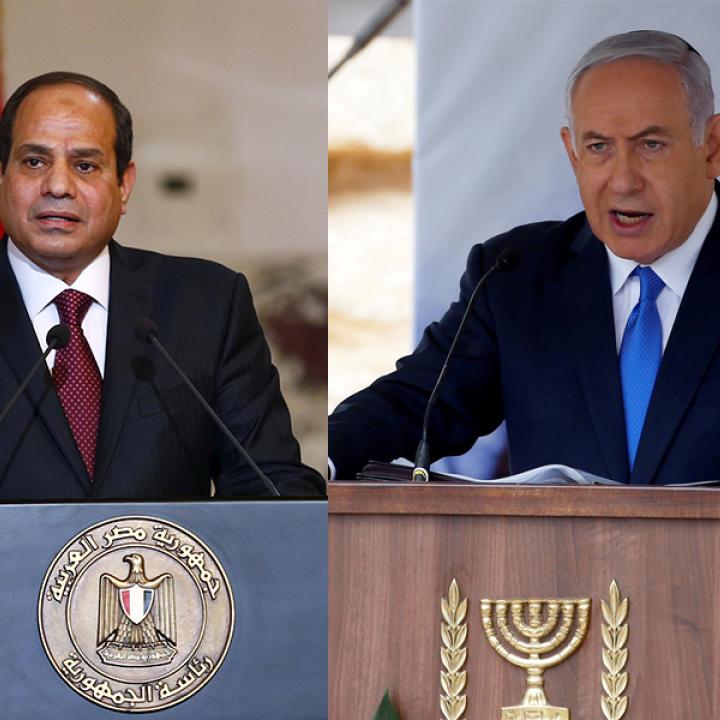
If Netanyahu and Sisi meet this month, Washington should press both leaders to treat the summit as the beginning of a structured trilateral process on Gaza, not a one-off symbolic encounter.
U.S. officials are working quietly to broker the first public meeting in years between Israeli Prime Minister Binyamin Netanyahu and Egyptian President Abdul Fattah al-Sisi. The summit, if it takes place, will be more than a symbolic reset: it will test whether Cairo, Jerusalem, and Washington can move from wartime crisis management to a more structured approach on Gaza stabilization and broader regional diplomacy.
The push comes as the Trump administration tries to reconstitute regional partnerships frayed by the Gaza war, restore visible Arab-Israel engagement, and give form to still-vague ideas for postwar governance and security arrangements in Gaza. A Netanyahu-Sisi meeting would be an early indicator of whether key actors are prepared to reengage at the leadership level on these issues.
An Opportunity for Renewed Egypt-Israel Engagement
Despite long stretches of political distance, Egypt and Israel have maintained an indispensable—if quiet—security partnership. Cairo controls Gaza’s Rafah crossing, has mediated every major ceasefire in the territory since 2007, and cooperated with Israel against jihadist networks in the Sinai Peninsula. That cooperation persisted through sharp public disagreements since 2023 over Israeli operations near Rafah and the war’s impact along the border.
At the same time, the dispute over traffic at the Rafah crossing has become a telling bilateral flashpoint. Cairo has pushed for more regular two-way traffic, allowing humanitarian aid to enter Gaza and people/goods to exit under agreed controls. During the war, Egyptian authorities did permit limited departures, but those leaving were charged high fees, leading to criticism worldwide and underscoring the political risks of being seen as profiting from Gaza’s misery.
Jerusalem, by contrast, has preferred a more restrictive, largely one-way arrangement focused on aid deliveries into Gaza. It has tied any broader two-way movement to stringent inspections and security on the Gaza side, citing longstanding concerns that lax overland controls through Egypt allowed weapons and other contraband to reach Hamas before the October 7 attack. Egyptian officials fear that a formal one-way framework would lock Gazans in a permanent siege or evolve into pressure for large-scale, one-way movement of Palestinians into Egypt with no credible prospect of return. Turnover among Israeli officials handling this file has made matters worse, with some newer interlocutors making statements about restricting two-way traffic through Rafah that their Egyptian counterparts view as tone-deaf and dismissive of Cairo’s political constraints. These practical disagreements will likely feature prominently if the summit goes ahead.
The Gaza war has also caused broader strain between the two countries. Egyptian officials bristled at Israeli public statements about tunnel smuggling activity via Sinai and worried about spillover into the peninsula. They also faced intense public anger over Israel’s Gaza campaign, sharpened by incidents in Rafah in which Egyptian troops opened fire on Israeli soldiers and several Egyptians were killed. The absence of public, high-level meetings since 2023 reflects both domestic political caution in Cairo and mistrust between the leaders, though Netanyahu did apologize to Sisi by phone after missing the October summit in Sharm al-Sheikh.
Against that backdrop, a new meeting would carry real value by signaling that Cairo sees renewed strategic benefit in engaging Israel at the leadership level, and that Jerusalem recognizes Egypt’s central role in any workable Gaza plan. For Washington, it would be a step toward restoring predictability to a core regional relationship that has deteriorated under wartime pressure.
U.S. Strategic Objectives
For Washington, shepherding this meeting serves several near-term objectives. First, it would inject momentum into Middle East diplomacy, which has slowed under the weight of U.S. domestic politics and fatigue over regional conflicts. A successful summit would show that Arab-Israel engagement is still possible despite the tensions raised by the Gaza war, giving Washington leverage as it encourages Egypt, Jordan, and Gulf partners to define their roles in postwar stabilization and, eventually, renewed normalization efforts.
Second, Egypt is uniquely positioned to influence developments in Gaza. No security architecture, humanitarian mechanism, or policing framework can function without Cairo’s participation. U.S. officials are seeking to consolidate and expand Egyptian support for a phased Gaza plan that builds on Cairo’s existing role in training Palestinian security personnel, improving border coordination, and overseeing reconstruction with regional and international backing. Direct leader-to-leader engagement would help legitimize these efforts and clarify what Egypt is—and is not—willing to do.
Third, the summit offers a way to link economic incentives with diplomatic stabilization. An expanded natural gas export arrangement between Israel and Egypt is reportedly central to the discussions. Washington sees energy cooperation as a tool for strengthening state-to-state ties and easing Egypt’s acute energy shortages, which have fueled rolling blackouts and public frustration. At the same time, Israel’s ability to modulate gas flows has given it leverage over Cairo at politically sensitive moments, reinforcing perceptions that Sisi is uncomfortably dependent on Israeli supplies. The key question is whether such arrangements can be structured to support substantive coordination on Gaza and border security rather than substitute for them.
Egypt’s Calculus
Cairo’s position is shaped by economic need, public sentiment, and distrust of Israel’s leaders. Economically, Egypt faces one of the most challenging environments in the region: high debt, inflationary pressures, and persistent currency stress. Additional gas imports from Israel, coupled with Western and Gulf support, would relieve pressure on the energy sector and generate foreign currency. If a summit unlocks tangible economic gains, it would help Sisi justify the political risk of appearing publicly with Netanyahu.
Yet the Gaza situation has greatly inflamed Egyptian public opinion. Meeting with Israel’s prime minister would be difficult to defend domestically without accompanying progress on humanitarian access, Rafah coordination, and/or Palestinian political arrangements. Cairo is therefore likely to insist on clear assurances that Israel will coordinate closely on operations near the border, avoid actions that risk spillover into Sinai, and support mechanisms for Palestinian administration in Gaza that do not saddle Egypt with direct responsibility.
Israel’s Interests
For Israel, the summit offers three main benefits. First, it would help repair a vital regional channel that has been strained by the war. Restored engagement between leaders is important for coordinating border security, sharing intelligence, and taking measures to prevent Hamas or other militant actors from rebuilding infrastructure along the Egypt-Gaza frontier.
Second, if Jerusalem stands alongside Cairo, it would counter perceptions of growing Israeli diplomatic isolation. Visible engagement with Sisi can reassure other regional actors that cooperation with Israel remains politically viable if framed around stability, security, and concrete economic benefits.
Third, Israel needs Egyptian cooperation for the next phase of its Gaza strategy. Plans that envision Palestinian police forces, transitional governance arrangements, and tighter border controls will be difficult to implement if Egypt is ambivalent or hostile. A summit gives Netanyahu an opportunity to align expectations directly with Sisi rather than relying solely on indirect channels.
Policy Implications and the Risks of Failure
If efforts to convene the summit stall or the meeting collapses in disagreement, mistrust could deepen. Egypt might narrow its cooperation on Gaza issues, take a more publicly critical line, or further distance itself from U.S. stabilization efforts. Jordanian and Gulf leaders could read the failure as evidence that Israel cannot repair key regional relationships, which could complicate broader normalization tracks. An abortive summit would also raise questions about Washington’s ability to broker even modest diplomatic steps on the Gaza and Egypt-Israel files, undercutting the momentum it is trying to build on this track.
Accordingly, the value of a summit should be judged less by optics and more by whether it produces specific, follow-on commitments. Useful indicators of success would include:
Concrete movement toward a phased gas export arrangement that addresses Egypt’s energy needs while reinforcing—not replacing—coordination on Gaza.
Egyptian agreement in principle to support training and deployment of Palestinian police and other internal security forces under a U.S.-backed framework.
Establishment of trilateral U.S.-Egypt-Israel coordination mechanisms on Rafah, humanitarian flows, and reconstruction oversight.
A commitment to continued high-level engagement, ideally through a scheduled follow-up meeting or a standing trilateral channel. Such engagement should include setting expectations for any technocratic Palestinian government in Gaza.
Indeed, U.S. officials should privately press Netanyahu and Sisi to treat the summit as the start of a structured trilateral process on Gaza’s security and political tracks, not a one-off symbolic encounter. That includes using the meeting to narrow gaps on questions about phase 2 of the Gaza ceasefire agreement, such as how Hamas will be constrained, how internal security forces will be configured, and what role a technocratic governing committee can realistically play.
At the same time, Washington should avoid overselling the meeting in public. The summit should be framed as a pragmatic step in a longer process rather than a breakthrough. This would help Sisi manage domestic sensitivities while still giving Netanyahu a visible incentive to broaden regional coordination.
Handled carefully, a summit could help re-anchor U.S. regional strategy, align Egypt and Israel around shared objectives in Gaza, and generate modest but real diplomatic momentum at a time when it is badly needed. If mishandled, however, it would risk reinforcing perceptions of drift and deepening the very mistrust it is meant to ease.
Haisam Hassanein is a Middle East analyst specializing in Arab-Israel relations, Egypt, and U.S. policy in the region.