- Policy Analysis
- PolicyWatch 4145
Getting to Phase 2 in Gaza: Red Lines and Recommendations
Dec 12, 2025
Also available in
Brief Analysis
Washington Institute experts and former officials lay out the urgent need for clarity on vital questions related to U.S. oversight, the stalled International Stabilization Force, Israel’s red lines, Hamas opposition to multilateral proposals, the contours of the PA’s role, and more.
Laying Out Priorities for the Board of Peace
By Dennis Ross
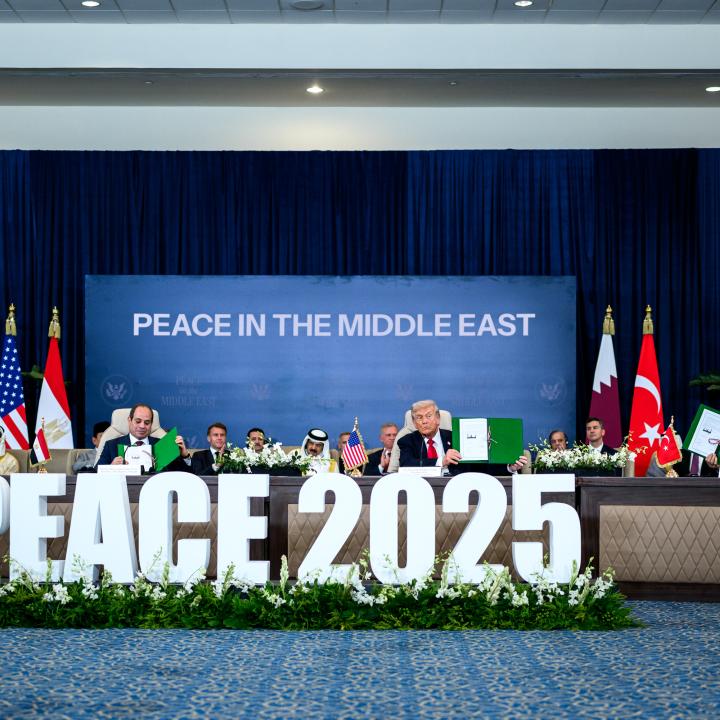
President Trump has recently stated his desire for phase 2 of the Gaza ceasefire agreement to begin soon. And even though the body of one Israeli hostage—Ran Gvili—has not yet been returned, Prime Minister Binyamin Netanyahu has likewise said he expects to be moving to phase 2 shortly. Hence, there is a good chance the next stage of the process will be launched before or during their planned December 29 meeting.
Phase 1 may not have gone completely as expected, but it still produced a great deal: a UN Security Council Resolution (2803) enshrining the president’s peace plan, the release of all live hostages, a ceasefire, a surge in humanitarian assistance, the release of Palestinian prisoners, and Israeli military withdrawals from large parts of Gaza. Yet the next stage will carry more daunting challenges, from disarming Hamas and destroying the rest of its tunnel networks to securing further Israeli withdrawals and beginning reconstruction.
The clearest sign that phase 2 is about to be launched is the apparently imminent announcement that the parties have completed the formation of the Board of Peace, an executive committee, and the technocratic Palestinian committee for administering Gaza. To be sure, the International Stabilization Force (ISF) will be essential to ensuring that alternative actors are able to take over governance of Gaza in place of Hamas. Yet it is the Board of Peace that will serve as the umbrella under which both the ISF and the other committees operate. President Trump will head this board, joined by leaders from the Middle East and beyond (see below). Executive committee members will assume a direct oversight role, providing guidance to the technocratic Palestinian committee when it runs into political bottlenecks and other obstacles while managing the daily administration of Gaza.
Unfortunately, because the composition and respective roles of these bodies were not announced earlier, Hamas has used the intervening time to muddy the process and create the impression that it is not going anywhere. Yet the mere act of launching the Board of Peace will put more pressure on Hamas even before authorities answer all the questions about the ISF and actually deploy the force. Indeed, the board will have to take the lead in pressing for implementation of the ISF and the plan’s other difficult points.
As for who exactly will join President Trump on the board, Turkish President Recep Tayyip Erdogan is a likely candidate, despite Israel’s desire to keep Turkish forces out of the ISF. Erdogan’s leverage over Hamas will be crucial in phase 2, even as he and Qatar count on President Trump to ensure that Israel fulfills its obligations.
In the end, everything will likely hinge on implementing a credible approach to demilitarizing Gaza—not only because Israel will demand it, but also because Saudi Arabia and the United Arab Emirates have made clear there will be no major Gulf investment in reconstruction so long as Hamas retains access to military weapons and infrastructure. A phased approach may be needed to get the process going and prevent Hamas from simply waiting out the international community (e.g., beginning reconstruction in parts of Gaza that have been secured while carefully vetting the Palestinians permitted to enter these zones in order to screen out Hamas adherents). Whatever the case, a comprehensive plan is needed that synchronizes all of these moving parts.
Clarifying the Crucial ISF Component
By Neomi Neumann
Even as the Trump administration reportedly prepares to announce the transition to phase 2, many of the details are still unclear regarding one of its most critical elements: the composition and planned January deployment of the International Stabilization Force. According to various reports, the United States is expected to oversee a mission that will focus on three stages:
- Stabilizing the security situation through broad deployments in Gaza, supervision of public order, and training of Palestinian police forces in order to prevent anarchy and the rebuilding of terrorist infrastructure.
- Leading the disarmament of Hamas and other factions, and also establishing a continuous monitoring mechanism to prevent rearmament.
- Assisting the Board of Peace and/or other civilian organs with the transfer of local authority to the Palestinian Authority, initially in the form of a temporary technocratic committee and later via reformed PA institutions, thereby enabling the establishment of moderate and responsible Palestinian governance in Gaza.
Still unknown, however, is which countries will agree to participate, under what conditions they will deploy, and at which specific locations. Meanwhile, Hamas has firmly declared its opposition to disarmament, particularly in Arabic outlets, offering vague formulas about “freezing” or “storing” its military weapons instead. Egypt and Turkey insist that the ISF should first focus on creating a buffer between Israeli and Hamas forces and only afterward address disarmament. For its part, Israel has signaled it will maintain a prolonged presence along the “yellow line”—the informal boundary inside Gaza that most of its troops withdrew to in phase 1, essentially cutting off around half of the Strip.
Defining the ISF’s mandate—including precise delineation of its missions and authorities—is expected to be one of the central issues in Prime Minister Netanyahu’s upcoming discussions with senior U.S. officials at the end of this month. Because this issue may have the greatest impact on shaping Gaza’s near-term reality, officials should prioritize the following steps:
- Urge Washington to set aside its usual preference for broad principles and momentum-building, instead engaging directly with contentious details.
- Ensure that the United States, Israel, Egypt, the PA, and additional Arab states anchor the ISF’s mandate in a concrete, agreed security protocol—one that clearly defines the force’s areas of responsibility, authorities, rules of engagement, and direct coordination mechanisms with Israel.
- Formally specify other crucial goals for the ISF, namely: conducting operations to disarm Hamas and other factions while implementing the demilitarization of the territory over time, creating the conditions for moderate, responsible, and sustainable Palestinian governance in Gaza.
Alternatively, if the ISF is not given a clear mandate and full enforcement powers, or if Hamas refuses to surrender its weapons, Israel will press for continued freedom of action against renewed rearmament efforts, a freeze on any planned Gaza reconstruction efforts beyond the yellow line, and freedom to remain in its current Gaza deployment zones until these issues are addressed.
In short, the success of phase 2 and the long-term survival of the ceasefire will depend on a combination of immediate security stabilization, gradual disarmament, and the transfer of authority to a reformed PA—none of which are possible without a clear definition of the ISF’s mandate, sustained American involvement, close coordination with Israel, and the active participation of moderate Arab states. Failing that, the risks of anarchy and rearmament will remain high, and the current framework will lose its strategic validity.
Jumpstarting the Palestinian Training Mission
By Michael Jacobson
In President Trump’s twenty-point plan for Gaza, the ISF is charged with training vetted Palestinian police forces as the “long-term internal security solution.” While this is a key part of the overall strategy, there is no clear, agreed plan as to how it will be carried out and who will fund it. Last week, U.S. Ambassador Mike Waltz mentioned progress on this front, noting that the Jordan International Police Training Center (JIPTC) was ready to begin preparing officers for Gaza. Yet strong U.S. leadership will still be required to build consensus on a path forward.
First, the Trump administration and its partners need to secure funding—likely hundreds of millions of dollars—for the training and equipping of Palestinian officers. Neither Jordan nor Egypt is likely to pony up due to economic troubles and other factors. And the United States is currently not well positioned to pay for this type of large-scale project given the administration’s dramatic proposed cuts to the State Department’s Bureau of International Narcotics and Law Enforcement, which has traditionally funded and overseen Palestinian training. If the administration wants true progress on this issue, it will need to ask Congress to reverse course on these potential cuts, then leverage U.S. funding to press others—such as the European Union, Saudi Arabia, and the UAE—to contribute as well.
Second, the United States, Jordan, and Egypt have each developed their own training plans, and Israel has yet to back any of them. To move forward, the Trump administration must get all of these governments on board with a consensus plan. And this plan must address many of the same elements that need to be defined for the ISF itself, such as command and control, formal authorities, alignment between mission and capabilities/equipment, and so forth.
Notably, there will soon be new leadership at the Office of Security Cooperation at the U.S. embassy in Jerusalem, which serves as the training liaison between Israel, the Palestinians, and Jordan (i.e., the former Office of the U.S. Security Coordinator, or USSC). The Trump administration should empower these new leaders to bring the Gaza postwar training effort together. This includes better integrating the OSC effort with the larger Central Command-led planning effort already taking place at the Civil-Military Coordination Center in Kiryat Gat, Israel.
Even under the best of circumstances, building a capable Palestinian security force for this mission will be extremely challenging and take years to complete. The initial signs are not promising, but the United States still has ample opportunity to set the process on a better path.
A “Middle of the Road” Role for the PA?
By Ghaith al-Omari
The Palestinian Authority is currently trying to balance between two objectives. On one hand, it understands that taking over Gaza governance is not in the cards, so it now seeks a lesser but still visible role in the Strip—for instance, placing a PA minister on the “apolitical technocratic committee” called for in the U.S. plan, or having a say in the committee’s composition.
On the other hand, the PA is wary of any moves that might give legitimacy to Hamas. This is why it has resisted Egyptian pressure to conclude a reconciliation agreement with the group, which Cairo hoped would help untangle knotty issues like forming the technocratic committee and demilitarizing Gaza. In Ramallah’s view, such an agreement would give Hamas a path to taking over the Palestine Liberation Organization while also delegitimizing the PA internationally by associating it with a terrorist group.
The United States should take Ramallah’s side on this issue, making clear that it opposes any PA agreement with Hamas. This would not only help shield the PA from regional pressure, but also address the concerns of those Arab states who are unwilling to engage in Gaza if Hamas retains any role.
As for what the PA’s role in Gaza should look like, Washington needs to strike a balance. Allowing for an immediate PA operational role would go against the U.S. plan and signal that Washington’s demands for PA reform are not serious. Yet completely excluding the PA would serve Hamas’s goals and may face opposition from Arab states. Accordingly, the Trump administration should consider a compromise approach that limits the PA to a useful symbolic role at the outset, such as naming a PA liaison to the Board of Peace or its executive arm.
Hamas’s Political Calculus in Gaza and Abroad
By Ehud Yaari
According to Palestinian sources and Hamas public statements, the group’s leaders have not yet formed a unified position on demilitarization—a central clause in the U.S. peace plan that they accepted even before the UN Security Council did. So far, the United States and Arab governments have not presented any detailed blueprint, timetable, or mechanism for transferring or decommissioning the group’s weapons, while remarks by Hamas leaders have signaled a range of stances, including flat rejection, a long-term freeze on using or parading arms, and storing heavy weapons under the supervision of Gaza’s future Palestinian administration.
These diverging views reflect a fierce debate in the organization’s top echelon—part of a wider struggle over choosing a successor to the late Ismail Haniyeh as chair of the Hamas Political Bureau. The top candidates include Khaled Mashal (a former chair who has criticized the group’s alliance with Iran), Khalil al-Hayya, Muhammad Ismail Darwish, and Zaher Jabarin. Tension is also growing between the remaining military command in Gaza (led by Raed Saad) and the outside leadership, whom Saad and others accuse of “abandoning” the fighters.
Behind closed doors, some Hamas figures have advocated seeking a deal with the PA brokered by the Gulf states, Egypt, and Turkey. This would assure Hamas of a political role in Gaza during the transition, as well as an opportunity to take part in future elections and eventually take over the West Bank too. Other figures prefer to simply disrupt the arrangements envisioned by Trump’s plan and deter international participation in the ISF.
Above all, Hamas factions fear any scenario in which the IDF remains deployed along the “yellow line,” thereby cutting off more than half of Gaza’s territory and likely slowing the reconstruction process. This would leave the group straddling vast amounts of rubble indefinitely and facing around two million impoverished, angry Palestinians. These fears may ultimately dictate whether Hamas feels compelled to offer concessions on demilitarization and accept a “safe passage” formula for members who choose to depart Gaza.
About the Authors





Share