- Policy Analysis
- PolicyWatch 4262
Building an Effective Train-and-Equip Mission for Lebanon Post-UNIFIL
Authorities should view the end of UNIFIL not as a prelude to a security vacuum, but as a chance to establish a workable U.S.-led transition mechanism that brings in Arab, European, and international partners, with the ultimate goal of helping Lebanon exercise full sovereignty over its territory without the support of foreign forces.
This week, France is hosting a multilateral meeting to assess the needs of the Lebanese Armed Forces (LAF) and coordinate international support toward strengthening its capabilities. The gathering also provides a good opportunity to start filling a crucial gap in the international approach. Last year, authorities extended the mandate of the UN Interim Force in Lebanon (UNIFIL) for the final time until December 31, 2026, after which an orderly withdrawal process will begin. In announcing that decision, the Security Council explicitly established the strategic goal for the post-UNIFIL period: to make the Lebanese government “the sole provider of security in southern Lebanon.” Yet the mechanism for achieving this goal was not defined.
At the same time, recent months have produced an extraordinary diplomatic opportunity between Israel and Lebanon, as efforts to address the immediate security situation evolved into a direct channel for broader talks. Seven rounds of U.S.-facilitated discussions have already taken place, with further rounds expected. The process reached another milestone on June 26, when the two governments signed their most significant bilateral agreement in decades. The very existence of a sustained, direct channel and the possibility of moving toward a wider agreement create an opportunity that Israel and Lebanon have not had in more than forty years. The objective of the June framework is not simply to stabilize the current situation, but to lay the foundation for a comprehensive peace and security agreement. Its terms link the progressive redeployment of Israeli forces with the deployment of LAF troops to formerly occupied areas, the disarming and dismantling of the military and civil institutions of nonstate armed groups (especially Hezbollah), and the restoration of full Lebanese sovereignty.
This opportunity has been made possible not only by the diplomatic process, but also by a fundamental change in Lebanon’s strategic environment. Hezbollah has been significantly weakened, and the government is now led by a president and prime minister who are willing to take political risks in order to restore genuine sovereignty, in ways that were not feasible when Hezbollah exercised a more suffocating grip over the state.
The opportunity is real, but fragile—diplomatic success will depend on many factors, such as denying Hezbollah access to reconstruction funds and expelling the Iranian military officers who have guided the group’s operations during the past three years of war. Changing the security reality in the south is a critical first step in this process.
Reimagining the Security Model
The imminent end of UNIFIL’s mandate should be viewed in this context. It does not mean the international community is withdrawing from Lebanon—rather, it should be seen as an opportunity to replace a security model unsuited to the current reality with a new, focused, and temporary international mechanism. Crucially, the purpose of this mechanism is not just to monitor developments in the south, but to help change them.
For nearly five decades, UNIFIL sought to play a stabilizing role there, but its effectiveness was limited. Although it kept channels of communication open between the two sides and maintained an international presence, it failed to prevent Hezbollah from building extensive military infrastructure and capabilities across the south. The latest war did not create these shortcomings; it exposed how inadequate the existing model had become over the course of many years. Rather than attempting to preserve or replicate UNIFIL, the task now is to establish a transitional international mechanism focused on transferring security responsibility to the Lebanese state and building the LAF’s capacity to exercise it.
In formulating this new model, decisionmakers should not conflate three distinct functions: Israel-LAF coordination, a job currently performed by U.S. officers; the post-UNIFIL train-and-equip mission proposed below; and verification of implementation, a task that is the subject of intense Israeli-Lebanese discussion but so far remains undefined. (Verification should not require another large international force or broad deployments across the south. It should be conducted by a relatively small, professional mechanism that relies primarily on precise U.S. and Israeli intelligence along with targeted visits to verify progress on the ground.)
For years, the fundamental problem has remained unchanged: alongside the Lebanese state, Hezbollah has operated as an armed terrorist organization in the south and other parts of the country, possessing its own military capabilities, weapon systems, infrastructure, and command and control outside state authority. If this reality persists, no international presence will ever be able to foster true Lebanese sovereignty. Hence, simply monitoring the security situation is no longer sufficient.
The need for a different approach has become even more urgent following the latest war, which changed the situation on the ground, the balance of power with Hezbollah, and Israel’s fundamental security doctrine. In the post-October 7 era, Jerusalem is no longer willing to simply manage the situation in order to prevent war—it is now intent on doing whatever is needed to keep Hezbollah from rebuilding the cross-border capabilities that could enable it to surprise or threaten Israel in the future. As such, it will not immediately withdraw to the border and leave a security vacuum based solely on promises that Lebanese or international authorities will eventually fill it. Yet a permanent Israeli presence is undesirable as well, since it would perpetuate friction, weaken the Lebanese state, and give Hezbollah a pretext for rebuilding itself as a “resistance” force. It is therefore in Israel’s interest to support an approach that allows for redeployment without creating a vacuum—namely, a phased transition in which the LAF gradually builds the capacity needed to take over responsibility from Israeli and international forces.
Who Should Help—and Pay
Washington should lead this effort by assigning an American commander to spearhead the transitional mechanism and coordinate among participating countries. Adding a senior officer from Saudi Arabia or the United Arab Emirates would give the effort a meaningful Arab dimension without requiring a large operational presence from the Gulf states. In addition, France, Germany, Italy, and the United Kingdom could contribute military experience, training, and equipment to vetted LAF units, while the European Union, the Gulf states, Japan, and other donors could provide additional financing and resources.
On the latter point, the overall funding model must change. The international community currently spends around half a billion dollars each year on UNIFIL. With the end of the force’s mandate, comparable resources should be redirected from maintaining a large international presence to building Lebanese capabilities that can replace this presence. Yet this does not mean simply transferring UNIFIL’s budget into LAF accounts. Whether resources are administered through an existing UN framework or a new mechanism is less important than ensuring that they finance a much smaller multinational staff, and that they are directed to select LAF units in phases (see below).
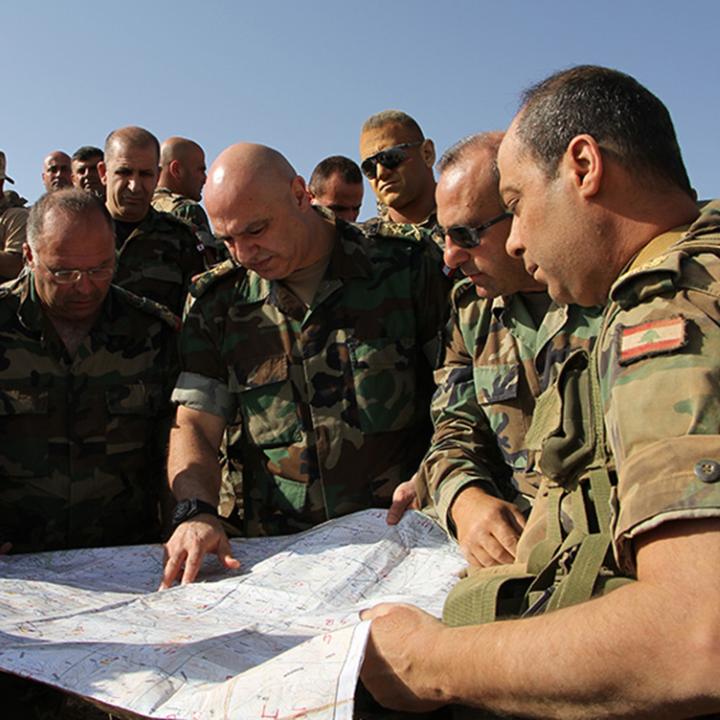
Recruitment and salary support alone will not be enough; the priority must be to start building genuinely capable operational units by helping them with training, equipment, intelligence, engineering, logistics, mobility, rapid deployment, and command and control. The initial target should be to establish several high-quality LAF units that are capable of acting on precise intelligence—including Israeli information provided directly or through the United States—in order to locate and secure Hezbollah’s long-range rockets, advanced missiles, and other strategically important weapons. If necessary, these forces should be willing and able to prevail in limited, localized confrontations with Hezbollah. These select units could be trained at the King Abdullah II Special Operations Training Center (KASOTC) in Jordan, with financing from Saudi Arabia, the UAE, and/or other partners.
Three Phases
Whether Lebanon’s current leaders have the political will to fully confront the Hezbollah challenge remains to be seen, but building the LAF’s operational capacity would at least prevent Beirut from using military shortfalls as an excuse for inaction. Yet international support must be tied to measurable LAF performance, with effective action on the ground unlocking additional training, equipment, and funding in three phases:
- Phase I should focus on building the capabilities of select LAF units, comprehensively mapping terrorist infrastructure in the south, and preparing a structured plan for gradually deploying the LAF there to remove this infrastructure. This plan should include a systematic process for dismantling sites that armed groups could use to conduct attacks, transferring weapons to state control, and otherwise dismantling Hezbollah’s military capabilities.
- Phase II should expand LAF responsibilities as agreed benchmarks are met. This does not mean a massive LAF deployment across every part of the south. As the Israel Defense Forces vacate positions, capable Lebanese units should move into them and build on the substantial work the IDF has already done to dismantle Hezbollah sites.
- Phase III should complete the transfer of security responsibility to the LAF while the international mechanism gradually reduces its presence.
This progress should not be tied to any arbitrary timetable; rather, it should be based on how well the LAF meets the central objective of restoring the state’s monopoly over weapons through the disarming and dismantling of armed nonstate actors.
Meanwhile, the new international mechanism should not deploy foreign forces across southern Lebanon, but instead serve a focused train-and-equip and implementation role. This includes establishing and tracking a structured work plan, coordinating the LAF’s training and deployment, and overseeing implementation throughout the transition. The idea is not to stand up another international “police force” inside Lebanon and simply report violations, but to foster the conditions under which LAF personnel can become the sole security force in the south and put a stop to such violations themselves.
As for the UN-designated Blue Line, it will remain a central reference point in shaping Israeli-Lebanese discussions and preventing friction, but it cannot constitute the entirety of the post-UNIFIL security concept. The issue is not simply whether one party or another crosses that line, but who truly controls the territory on the Lebanese side of that frontier, and whether a nonstate armed group will be allowed to perpetuate the risk of war by stockpiling weapons and military infrastructure in close proximity to that frontier.
The transition plan should also lay out the future of UNIFIL facilities in Lebanon. Some could be transferred to the LAF, others used temporarily by the new mechanism, and some may no longer be necessary. These decisions should derive from the LAF deployment plan, with a focus on preventing a gap between UNIFIL’s departure and effective Lebanese state control.
For Jerusalem, the new model would enable a phased IDF withdrawal from Lebanon and improve the prospect of long-term security for northern Israeli communities. For Beirut, strengthening and deploying the LAF would do more than just fulfill an Israeli interest or American demand—it would provide a historic chance to exercise genuine sovereignty, which is essential to Lebanon’s political and economic recovery. For the international community, ending UNIFIL would give officials a chance to redirect resources and decades of accumulated experience toward better objectives: a stronger Lebanese state, a Lebanese army that is capable of controlling the south, a Hezbollah that is unable to rebuild its military capabilities, and an Israel that can withdraw without leaving a security vacuum.
UNIFIL was a solution for a different era. A strengthened LAF, temporarily supported by a credible international capacity-building mechanism, can serve as the bridge to a new era—one in which emerging diplomatic channels between Israel and Lebanon develop into a comprehensive peace and security agreement.
Zohar Palti is the Zlatkin International Fellow with The Washington Institute. Previously, he headed the Mossad Intelligence Directorate and the Policy and Political-Military Bureau at Israel’s Ministry of Defense.