Aaron Y. Zelin is the Gloria and Ken Levy Senior Fellow at the Washington Institute for Near East Policy, where his research focuses on Sunni Arab jihadist groups in North Africa and Syria, foreign fighting, and online jihadism.
Brief Analysis
Washington should treat the recent public discontent not as a sign that Syria’s transition is failing, but as an opportunity to help ensure that Damascus does not repeat the mistakes of previous governments.
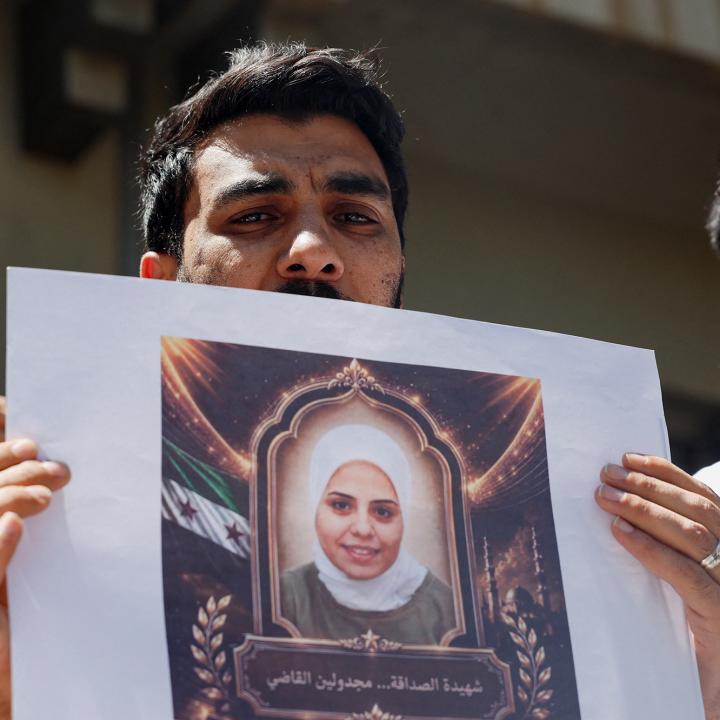
Since the beginning of the year, Syrian transport workers, farmers, nurses, teachers, lawyers, university students, municipal employees, and other citizens have been engaging in various acts of public protest across nearly every governorate, demanding relief from deteriorating economic conditions, perceived wage injustice, and governance shortcomings. Understanding what this wave means for Syria’s transition and U.S. policy requires looking past the individual protests to the structural conditions that are spurring them.
As the country’s modern history makes clear, these conditions are not new—the protest geography of 2026 overlaps with recurring fault lines that have triggered political contestation in Syria for a century, including center-periphery tensions, economic shocks, friction between professional civil society and state control, and the difficulty of balancing economic liberalization with political stabilization. Today, the young government is trying to simultaneously run an economy, manage competing constituencies, consolidate power, and build state institutions from scratch, all while facing a postwar reconstruction tab estimated at around $216 billion. That is a very tall order even for an experienced, well-resourced state.
In this sense, the protests are not surprising—they are the predictable outcome of a difficult postwar transition process colliding with a population that expected to see tangible improvements soon after the fall of Bashar al-Assad’s regime. The public discontent has also put a spotlight on several structural vulnerabilities in Syria’s governance architecture, and these problems may pose greater risks to stability in the medium term than the protests themselves.
What the Protests Are Not
The current protest wave is not a coordinated opposition movement, nor an Assad loyalist campaign to destabilize the new order, nor a sign that Syria is on the verge of collapse. Rather, it represents a functioning society trying to hold their new government accountable through the only channel currently available to them: public demonstrations. The vast majority of protesters are members of the government’s own social base within Syria’s Sunni Arab majority—for instance, truckers flying the revolutionary flag while protesting government customs policy; farmers in the agricultural heartland of Raqqa demanding recognition for their vital role in food production via sit-ins dubbed “Ears of Dignity”; a nurse in Daraa demanding wage parity with the doctor working beside her. These are not enemies of the transitional order; they are its stakeholders. As such, they want a greater role in decisionmaking and at least some tangible benefits.
For now, the government is tolerating the demonstrations and occasionally responding with concessions. That is qualitatively better than what the previous fifty years of responses from Damascus looked like (though that is admittedly a low bar). Going forward, the risk is not a dramatic rupture, but slow-motion erosion. If that scenario comes to pass, the government will be unable to deliver economic improvements and will likely wind up concentrating power in ways that make course corrections more difficult, responding to pressure on an ad hoc basis, and gradually losing its base as the public runs out of patience.
What Are the Protests About?
This year’s demonstrations have touched on multiple socioeconomic and political issues:
Cost of living and economic policy. These issues have generated the most widespread and sustained protests because they cut across every region and social class: high fuel and electricity bills hit urban households, wheat pricing disparities hit farming communities, reducedbread subsidies hit small business owners, and so forth.
Labor and professional rights. These protests reflect a newly emboldened workforce testing the post-Assad civic space and engaging the state as a negotiating partner for the first time. Rather than demanding sweeping change, they have called out specific regulatory decisions such as arbitrary dismissals, cargo load restrictions, and political interference in union structures.
Detainees and the disappeared. These protests are generally family-driven rather than politically organized, and their demands are narrowly humanitarian (e.g., appeals for information, trials, release). Protests over detainees are largely concentrated in the east (e.g., Deir al-Zour and Hasaka provinces) and focused on individuals in two categories: those still held by the Kurdish-led Syrian Democratic Forces, and SDF members detained by the government. Yet protests have also emerged in Damascus against Israel’s capture of Syrians along the southwestern frontier, showing that detainee issues have a national dimension as well. Other demonstrators have accused the government of failing to account for the many Syrians who were “disappeared” under the Assad regime.
Land, displacement, and property rights. These issues are the most structurally intractable because they involve competing claims between different domestic communities, and in some cases between Syrians and foreign actors. For example, villagers in Suwayda who were displaced by sectarian violence now seek to return home; farmers in Quneitra face reinstated mortgage liens; and families in Jabal Aqil have been displaced by a local Turkish military base.
Governance, rights, and political transition. These issues are the most politically charged. In Palmyra, for example, demonstrations erupted over the improper release of a former regime figure, while lawyers in Aleppo objected to political interference in their union; in both cases, the protests were essentially about whether the new government will be structurally different from the Assad regime.
What ties these themes together and distinguishes the current wave from earlier protest cycles is its non-ideological, horizontally dispersed character. Unlike Arab nationalism against the French Mandate, socialism and land redistribution in the post-independence era, liberal and Islamist claims against the Baath regime in the 1970s and ‘80s, and the 2011 revolution’s push for freedom from totalitarian rule, this year’s protests are not animated by a unifying, transformative vision. Rather, they are organized around discrete issues like those described above.
Government Policy and Reaction
Over the past few months, the government’s pattern has remained largely unchanged. First, it announces major policy decisions that it knows will be controversial but still deems necessary for standing up the new state—for instance, an 800 percent hike on electricity tariffs; a government wheat purchase price set at roughly $330 per ton when farmers are demanding $550; and unevenly applied salary increases within some ministries. When citizens push back, officials publicly defend the policies or grant partial concessions if that seems insufficient (e.g., President Ahmed al-Sharaa added a wheat delivery bonus that brought the effective price to approximately $400 per ton). In other cases, the government quietly walks certain policies back if public pressure is deemed too high.
Some of these policies reflect genuine fiscal constraint rather than indifference to public needs. The electricity tariff hike was an attempt to move toward a sustainable pricing model in a sector that had been subsidized into dysfunction for decades. The wheat price reflected real limits on what the government can afford to pay at scale. And the salary increases, partial as they were, represented the first attempt to restructure a public-sector wage scale that Assad had deliberately kept at subsistence levels.
Yet the manner of implementation has been problematic. On the salary issue, for example, Finance Minister Mohammed Yisr Barnieh publicly described the measure as the first step in a gradual restructuring plan. Yet it was rolled out via a series of surprise announcements with no prior consultation, and its uneven application within the same institutions transformed managed reform into a grievance engine. Indeed, the problem is not always what the government is doing, but its process.
So far, Syrian officials have framed the protests as evidence of new freedoms while quietly hoping they do not morph into a coordinated political force. Yet will this tolerant approach hold if economic protests begin to link across sectors or acquire more explicit political coordination? This concern could help explain why the recent cabinet shuffle showed more continuity with Sharaa’s past Salvation Government networks, since Damascus may feel it needs to cement internal cohesion and trust for the challenges ahead.
Policy Implications
The protests documented above are the inevitable result of lingering governance deficits in a transitioning state—especially over-concentrated decisionmaking, opaque finances, and a lack of consultative mechanisms. Economic liberalization without protection for vulnerable communities does not produce stability; it produces the conditions for the next crisis. Therefore, the government has a majordilemma: it needs to liberalize economically and consolidate authority, but each step in those directions risks alienating the constituencies that gave it legitimacy after Assad’s fall.
Amid these challenges, proceeding with deeper U.S.-Syria economic engagement remains the appropriate next step, just as Washington’s previous decision to lift the Caesar Act sanctions was the right policy. U.S. officials have substantial access to senior Syrian officials, including those responsible for economic policy. They must use that access to convey—privately and consistently—the steps Damascus should take to adjust its state-building process and ease the risks of deeper public unrest, including:
meaningful budget transparency;
consultative processes before major economic decisions are announced;
clear protections for peaceful protest as a legitimate channel for grievance; and
substantive progress on inclusive governance rather than just nominal gestures.
On the latter point, President Sharaa has the authority to appoint a third of the legislators in the incoming parliament, giving him a potentially powerful tool for furthering inclusivity in a state long plagued by various divisions. Washington should also urge its allies in Europe, the Gulf states, Japan, and Turkey to assist with each of these asks.
Meanwhile, the U.S. government should formally announce that Syria is no longer designated as a State Sponsor of Terrorism, based on the “fundamental change” certification issued by President Trump. Although this move alone would not untangle the Gordian knot of Syria’s institutional limitations, it could alleviate some international business worries over risk compliance, making investors less hesitant to enter Syria’s economy. Yet U.S. officials still need to remind Damascus that until its institutions are in conformity with international business and financial standards, there will be a ceiling on how much investment is likely.
As for the country’s steep humanitarian challenges, if the Trump administration does not wish to contribute U.S. funds to this sector, it could at least collaborate with or push international bodies to participate in reconstruction. In April, for instance, the World Bank pledged $225 million to help restore health and water services in Syria.
In any case, the fact is that Syrians are still engaging their new state rather than rejecting it. Washington should therefore treat the current moment not as a sign that the transition is failing, but as an opportunity to help ensure that Damascus does not repeat the mistakes of previous Syrian governments over the past century.