- Policy Analysis
- PolicyWatch 4156
Recognizing Somaliland: Israel’s Return to the Red Sea
Israel’s agreement with Somaliland will boost its security in the Red Sea Basin and may encourage the United States and other countries to follow suit, though political obstacles and complications abound.
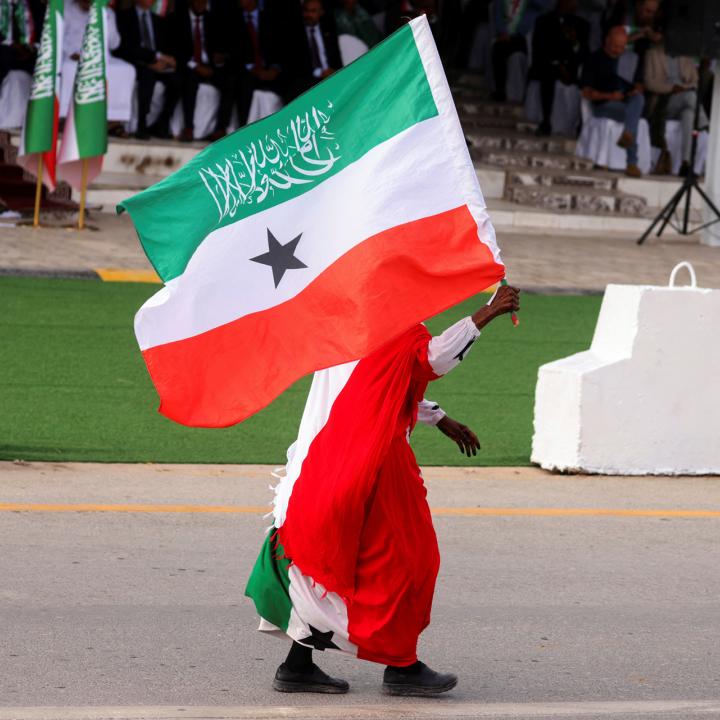
The surprise announcement on December 26 that Israel will be the first country to grant Somaliland full recognition has ignited new dynamics in the Red Sea Basin. As part of the agreement, Israel will establish a diplomatic presence and possible security presence in the area for the first time since relations with Eritrea broke down in 2020. Israeli relations had been further degraded by the suspension of normalization with Sudan since civil war broke out there in April 2023. The Somaliland breakthrough gives Jerusalem an opportunity to move past those setbacks and could spur other governments to recognize the republic as well.
Why Normalize with Somaliland?
A former British colony, Somaliland gained independence in June 1960 and five days later united with Somalia, which had been an Italian colony. In 1991, however—following the brutal dictatorship of Gen. Muhammad Siad Barre, the collapse of the Somali state, and the country’s defeat in the Ogaden War with Ethiopia—Somaliland’s clans “restored sovereignty” and declared full independence with Hargeisa as their capital. In the thirty-five years since then, the Republic of Somaliland has maintained a democratic system with free elections and avoided the terrorist threats prevalent in Somalia.
Normalization of relations with Israel may open opportunities for bilateral cooperation in many spheres, including intelligence sharing and access to naval and air bases. (Notably, Somaliland has allocated only a minimal budget to its small military throughout its existence.) An ambitious program for Israeli civilian aid in water management, agricultural modernization, and information technologies is also being planned, and a large delegation from Hargeisa is expected in Israel soon.
Jerusalem was forced to seek allies with access to the Gulf of Aden, the Bab al-Mandab Strait, and the Red Sea after the Yemeni Houthis began a concerted attack campaign on October 19, 2023, targeting ships bound for Israel and launching missile and drone strikes on Israeli soil. Theoretically, Somaliland’s 850 kilometers of coastline across from Yemen could offer certain advantages to the Israel Defense Forces, who have mounted a series of massive airstrikes and occasional naval strikes against the Houthis. Although the IDF does not want a base in Somaliland, it does seek access rights when needed, as well as intelligence facilities to monitor the Houthis. (Relatedly, Arab states claimed for years that Israel had established an intelligence-gathering facility on top of a mountain range in Eritrea and a naval base in the Dahlak Islands. Yet according to various sources consulted by the author, there were no permanent IDF bases, just occasional Israeli use of Eritrean facilities.) Israeli planners assume that confrontations with the Houthis will resume if fighting erupts with Iran or Hamas. Importantly, the port of Eilat—Israel’s only outlet to the Red Sea—has all but ceased operations, and Jerusalem will not tolerate this state of affairs indefinitely.
Initial discussions about establishing relations between Israel and Somaliland began four years ago—well before the Houthi crisis—and intensified after former president Muse Bihi Abdi visited Washington in March 2022. The objective at that time was to exchange trade offices and/or diplomatic missions, not full recognition. Eager to reach an agreement, authorities in Somaliland quietly sent high-level envoys to Jerusalem (hosted by the author). Successive Israeli governments were reluctant to strike a deal, but by April 2025, the pace of negotiations with Somaliland’s new democratically elected president, Abdirahman Mohamed Abdilahi (aka Irro), was accelerating, eventually leading to the current breakthrough.
Other Potential Partners (and Complications)
Ethiopia—Somaliland’s closest neighbor, which governed the area during different periods in the more distant past—has long been weighing recognition but continues to postpone a decision. In January 2025, the two governments signed a memorandum of understanding that would give Addis Ababa access to the port of Berbera in return for recognition of Somaliland, thereby replacing the port of Djibouti as Ethiopia’s main trading route while meeting Prime Minister Abiy Ahmed’s top strategic goal of securing maritime access for his landlocked country. This idea was hotly debated because it would mean Ethiopia backing down from the “One Somalia” policy and flouting Mogadishu’s argument that Berbera is still part of its territory. In any case, implementation has stalled, and the prospects for reviving the deal are not clear.
Similarly, Taiwan has cultivated very close economic cooperation with Somaliland and helped develop the republic’s coast guard, but it, too, is hesitant to go further. Although it has exchanged trade and diplomatic representatives with Hargeisa, it has not granted formal recognition, mainly because China has been pressuring Somaliland not to recognize Taiwan.
The United Arab Emirates maintains close relations with Somaliland as well, running the republic’s ports and serving as its main export destination. Moreover, the UAE was one of the few Arab League members that did not join the chorus denouncing Israel’s recognition. Nevertheless, Abu Dhabi has avoided granting recognition—though this did not stop Somalia’s government from retaliating against the UAE after Israel’s recognition, announcing that it would terminate all Emirati port security deals and annul all defense agreements. Notably, however, two of the three ports covered by these canceled deals—Berbera and Bosaso—are not actually under Mogadishu’s control. Somaliland controls Berbera, while Bosaso lies in Somalia’s semiautonomous Puntland region, which cooperates closely with the UAE under President Said Abdullahi Deni and may eventually decide to secede from Somalia if the circumstances are favorable. (Both ports are also significant to U.S. military operations, as discussed in the next section.)
Most Arab states, particularly Saudi Arabia, seem to view Israel’s recognition of Somaliland as part of its wider cooperation with the UAE. Riyadh publicly denounced the move, describing it as an attempt to establish “parallel entities” in Somalia, though it ignored Mogadishu’s request to bomb Somaliland. Meanwhile, many Arab media outlets argue that Israel’s recognition announcement is connected to the recent UAE-sponsored offensive in eastern Yemen, in which the Southern Transitional Council captured large swaths of territory only to be turned back by a Saudi-led counteroffensive. They point out that STC leader Aidarous al-Zubaidi—who seeks the secession of “South Yemen” and peace with Israel—fled to the UAE through Somaliland after his offensive was defeated.
In Jerusalem, some officials felt that revealing Israel’s secret contacts with Somalia would be more beneficial than recognizing Somaliland. Yet the decision to favor Hargeisa instead was greatly influenced by Mogadishu’s lack of progress toward joining the Abraham Accords. Somali President Hassan Sheikh Mohamud met with Israeli Prime Minister Binyamin Netanyahu in Nairobi in 2016, and six years later, his spokesmen made public statements about the government’s desire for normalization with Israel. Yet Somalia’s deteriorating security situation—largely a product of intensifying offensives by the terrorist group al-Shabab—led Mohamud to rely on Turkish and Qatari military support, and the dialogue with Israel was suspended.
Next Steps and U.S. Interests
President Irro is hoping that the breakthrough with Israel will spur other countries—mainly the United States but also the United Kingdom and India—to review their stand on recognition, publicly declaring that “many” governments will follow Israel’s lead. For his part, Netanyahu would no doubt like the United States to recognize Somaliland, though it is unknown if he has spoken with Washington about this. He has urged India to recognize the republic, and Foreign Minister Gideon Saar has been consulting with Ethiopia and Kenya on this issue as well.
As for the future scope of cooperation with Israel, Hargeisa has consistently denied that it will provide Jerusalem with military bases. In a series of X/Twitter posts on January 1, Somaliland’s Foreign Ministry issued a strong statement on the matter: “The Government of the Republic of Somaliland firmly rejects false claims made by the President of Somalia alleging the resettlement of Palestinians or the establishment of military bases in Somaliland. Somaliland’s engagement with the State of Israel is purely diplomatic, conducted in full respect of international law and the mutual sovereign interests of both countries.” This statement may not reflect the longer-term intentions of both parties, however, and predicting how the emerging alliance will advance is premature at the moment.
Ultimately, much will depend on how the U.S. position evolves, and whether Washington wishes to build on its military operations from facilities in the strategically located port of Berbera. Notably, the Puntland-controlled port of Bosaso offers similar advantages on the Gulf of Aden and has repeatedly hosted U.S. operations against local al-Shabab mountain hideouts.
If the Trump administration decides to accept the fait accompli of Somaliland’s independence and recognize the republic, this may encourage more countries to adopt a different approach to the chronic crisis in the Horn of Africa. To be sure, this decision would carry the risk (or, in some eyes, the benefit) of fracturing Washington’s troubled relations with Somalia. Yet when it comes to staving off al-Shabab and other security threats, Mogadishu has no alternative to the counterterrorism assistance provided by U.S. Africa Command (AFRICOM), so it may not be willing to sever this relationship regardless of what happens with Somaliland.
Ehud Yaari is The Washington Institute’s Lafer International Fellow and a Middle East commentator for Israel’s Channel 12 television.