- Policy Analysis
- PolicyWatch 4149
Yemen’s Seismic Shift Has Consequences Beyond Its Borders
Dec 22, 2025
Also available in
About the Authors

Brief Analysis
U.S. allies Saudi Arabia and the UAE are on a collision course in Yemen, as local forces threaten to reopen a war that could boost the Houthis, deepen Red Sea instability, and otherwise undermine the Trump administration’s Middle East goals.
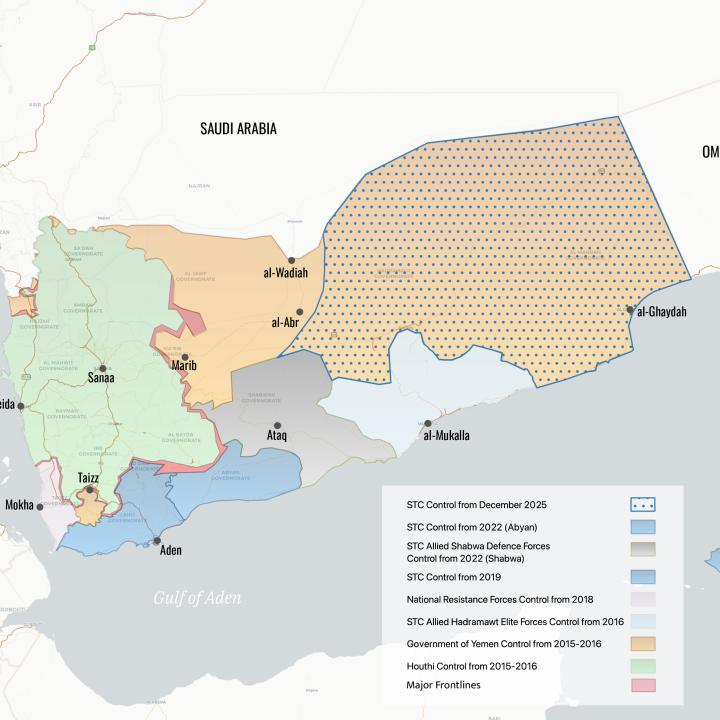
The situation in Yemen shifted dramatically this month when southern separatist forces aligned with the United Arab Emirates swiftly captured two large governorates that comprise nearly half of the country’s territory: the oil-producing region of Hadramawt, which borders Saudi Arabia, and al-Mahra, which borders Oman. The offensive gives the Southern Transitional Council (STC)—which has been uncomfortably part of the internationally recognized government for three years—effective control over most of the former “South Yemen,” an independent state prior to 1990. It also moves the group one step closer to its own goal of independence.
From a distance, this may appear to be a purely internal affair. It is not. Saudi Arabia views the 425-mile border and deep cultural ties it shares with Hadramawt as important elements of its national security, and Oman views al-Mahra in a similar vein. Riyadh is now demanding the withdrawal of UAE-backed forces, but the STC is refusing to comply. The standoff risks upending Yemen’s fragile three-and-a-half-year truce, renewing a war that has repeatedly played to the advantage of the Iran-backed Houthis. It could also further strain relations between key U.S. allies Saudi Arabia and the UAE, who are already at loggerheads in Sudan.
Events on the Ground
On December 3, STC-aligned forces seized military installations, government buildings, and oil facilities in central and northern Hadramawt from Yemeni tribal and military forces aligned with Saudi Arabia. Within days, they had taken over most of Hadramawt, moved into al-Mahra, and raised their flags at the Omani border.
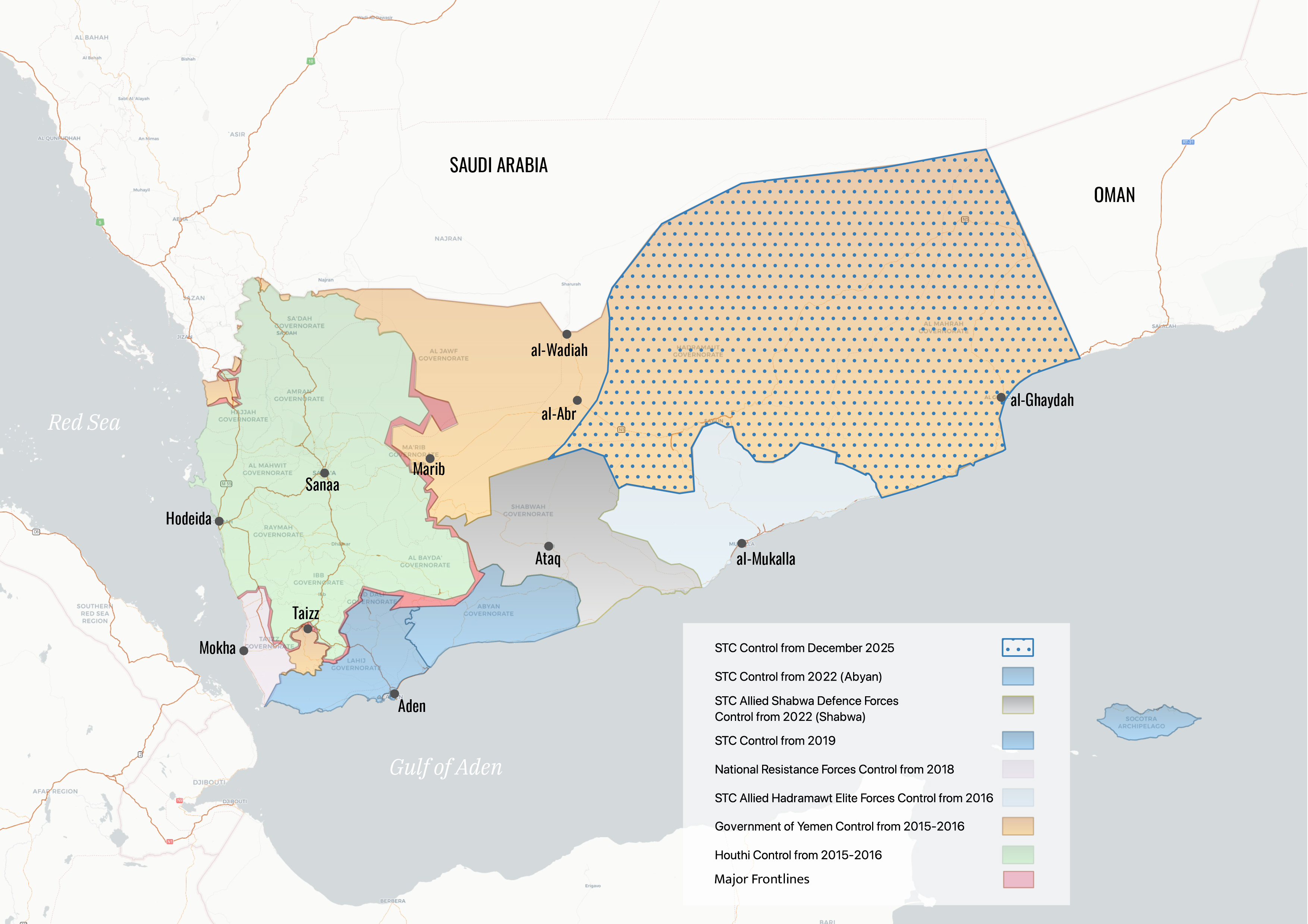

The speed of the takeover surprised most observers, even prompting speculation that the Saudis and Emiratis had reached an understanding to hand that entire part of the country to the STC. The chair of Yemen’s Presidential Leadership Council (PLC), Rashad al-Alimi, did not issue any public statements during the offensive, nor did he order the government’s First Military Region Command in Hadramawt to resist. Indeed, most government units handed over their camps without a fight, while the Saudi-trained National Shield Forces (NSF) mostly melted away.
As the dust settled, it became evident there was no deal between Riyadh and Abu Dhabi, while Alimi belatedly condemned the takeover as a dangerous unilateral action that undermines the legitimate government. Amid Riyadh’s public demands for a full withdrawal, Emirati officials privately acknowledged the need for de-escalation, and the two states sent a joint delegation to the Yemeni government’s temporary capital in Aden seeking a resolution.
On the ground, however, tensions continue to rise. The Saudis have mobilized troops from the NSF and the Yemeni Emergency Forces along the northern frontier and secured two key nodes: al-Wadiah border crossing and al-Abr junction further south, both of which are critical to supplying the vital Marib frontline against Houthi forces to the west. The Guardian reported that Riyadh has even threatened airstrikes on STC positions. The kingdom also evacuated its remaining military forces from Aden, signaling an effort to isolate the STC. (Alimi and some of his fellow PLC members are already based in Riyadh; only the southern members and ministers still operate out of Aden.)
In response, the STC has not only sought to consolidate control of Hadramawt, but also launched a new campaign in neighboring Abyan governorate as part of its proclaimed bid to “combat extremist threats” (see next section) and “reinforce security and stability in southern areas.” On December 21, several ministries and government bodies in Aden announced their support for STC expansion and “the aspirations of the people of the south.”
Why Now?
In retrospect, none of these developments should be too surprising because they are clearly rooted in longstanding local dynamics. Previously, control of Hadramawt was divided between STC forces along the coast and Saudi-aligned forces in the Wadi (interior desert zones). Although this geographical division has historical roots, the area has also maintained a strong overarching Hadrami identity supporting local autonomy for coastal and Wadi communities collectively—either within a unified Yemen or as part of a separate state.
Hadramawt is not a traditional STC stronghold, but the group’s leaders view the governorate’s oil resources as essential for a viable breakaway state. Riyadh prefers a unified Yemen, however, and many Hadramis oppose the STC out of fear that it will undermine their goal of self-rule and revive the repressive politics of the former South Yemen.
The tension between these competing aims has been growing over the past year. Saudi Arabia threw its weight behind tribal figures such as Amr bin Habreesh, who took control of key oil fields in January, while the STC prepared for confrontation. Shortly after the latest offensive, STC representatives told the author that they felt squeezed by a combination of Saudi-aligned military buildups in Hadramawt and their own declining popularity as part of a government that has been unable to deliver services or alleviate poverty. To counter these pressures and safeguard their long-term independence project, they acted preemptively. The timing may also reflect widespread anticipation of renewed Saudi-Houthi peace talks, which had made significant progress before being upended by the Gaza war. In particular, the STC may have sought to seize leverage regarding the Houthis’ known desire to obtain a share of Yemen’s oil, most of which lies in Hadramawt. Moreover, the offensive unfolded against a backdrop of growing Saudi-Emirati friction over various foreign policy matters—including the kingdom’s recent discussions with the Trump administration about ending the war in Sudan, where the UAE has faced mounting international scrutiny.
Another notable factor is the administration’s recent push to designate certain chapters of the global Muslim Brotherhood movement as Foreign Terrorist Organizations. The UAE and STC strongly oppose the Brotherhood’s influence in Yemen, including within Saudi-backed parts of the Yemeni government. (The Islah party contains Yemen’s version of the Muslim Brotherhood and is also part of the internationally recognized government. Its strongholds are in Marib, Taiz, and, to a lesser extent, northern Hadramawt.) Although the U.S. designation announcements were not a trigger, they did provide a permissive context for the STC to frame its offensive as a necessary crackdown on the Brotherhood, as well as on al-Qaeda’s influence in Hadramawt. According to STC representatives, both of these groups play a role in facilitating Houthi arms smuggling from Oman—something Islah would deny. By stating that it intends to confront them, the STC seeks to actively promote itself to Washington—and Israel—as an ally in the fight against both the Houthis and the Brotherhood.
Risks and Recommendations
The STC takeover has opened a Pandora’s box of possibilities, most of which point toward renewed conflict. If Saudi Arabia and the UAE fail to contain the tensions, fighting between Yemeni government factions will likely ensue, including in the Wadi Hadramawt. Although Riyadh was slow to act at first and has a less-institutionalized collection of armed groups at its disposal, its pockets are deep and its connections are wide, leaving the kingdom well-placed to take advantage of local opposition to the STC. One could see a similar dynamic play out in al-Mahra if Oman chooses to intervene.
In the end, any such fighting would benefit the Houthis. With government forces distracted, the group could decide to test its advantage in northeast Marib province (which includes oil fields) and/or along the Red Sea coast (where the UAE-aligned National Resistance Forces maintain a foothold). According to Basha Report, many STC forces have been redeployed from other governorates, leaving one of the south’s largest military installations, Al-Anad Air Base, dangerously exposed to a Houthi incursion. Territorial gains would give the Houthis additional resources for future confrontations with the United States, its Gulf partners, and Israel. Instability in Hadramawt would also create space for al-Qaeda and other extremist groups to pose wider threats in Yemen and beyond.
Another risk is the STC deciding to quickly declare independence, which could spur the Houthis and other northern forces to realign against the group. So far, STC leaders seem to realize that such a declaration would be met with international isolation, so they have framed and limited their statements and actions accordingly. Yet if Riyadh and the Yemeni government try to isolate the group and leave it with no other off-ramps, it may decide to take that chance.
In short, U.S. allies are on a collision course in Yemen—but this outcome is not inevitable. Timely, sustained, high-level American engagement can help avoid self-inflicted wounds. To this end, the Trump administration should take a two-pronged approach, urgently bringing Gulf allies together to de-escalate the current crisis while laying the groundwork for wider deals in the longer term:
Seek a compromise in Hadramawt that addresses Saudi Arabia’s core security concerns while recognizing the new power dynamics on the ground. One option could involve STC forces partially withdrawing and local Hadrami forces taking control of the Wadi. A handover to Hadrami elements in the Saudi-backed NSF—who are locally rooted and politically mixed—may be an option. Such an approach would enable the STC to claim credit for securing the area and removing the First Military Region Command (which many Hadramis rightly or wrongly view as a corrupt “northern” force closely associated with Islah), while providing Riyadh with assurance that its trusted Yemeni allies are securing the border.
Tackle the bigger challenge of bringing U.S. Gulf partners together on a common approach to Yemen. In his December 17 call with Emirati Foreign Minister Abdullah bin Zayed, Secretary of State Marco Rubio helped the situation by urging “stability” in the fight against the Houthis. Yet getting Saudi Arabia and the UAE on the same page will likely require direct intervention by President Trump, who is uniquely positioned to facilitate such progress given his close ties with the leaders of both nations. For his part, STC chief Aidarous al-Zubaidi has publicly stated that his troops are willing to support other forces against the Houthis, though he would likely require guarantees of southern autonomy or a path to independence in exchange.
In any case, exploring compromises that align Gulf and Yemeni partners is worth the effort. Ideally, the United States can unify the various pressures that these partners have to offer against the Houthis while simultaneously testing their willingness to accept a durable national political settlement—namely, a deal that secures the Red Sea region, reassures Yemen’s neighbors, and addresses internal demands for political balance and southern independence. With the right combination of U.S. pressure and engagement, the events in Hadramawt could serve as a long-needed wakeup call to contain Houthi ambitions, end the country’s protracted war, and limit its destabilizing regional spillover.
April Longley Alley is a senior fellow at The Washington Institute and former senior political advisor to the UN’s Yemen envoy (2020-24).
Share