- Policy Analysis
- PolicyWatch 4239
Previewing the Trump-Aoun Meeting: A Make-or-Break Moment for the Israel-Lebanon Agreement
Circumstances are ripe for a successful visit, but both presidents are looking for more than bonhomie—Aoun needs practical U.S. commitments of operational and financial support, while Trump needs additional evidence of Beirut’s seriousness on disarming Hezbollah.
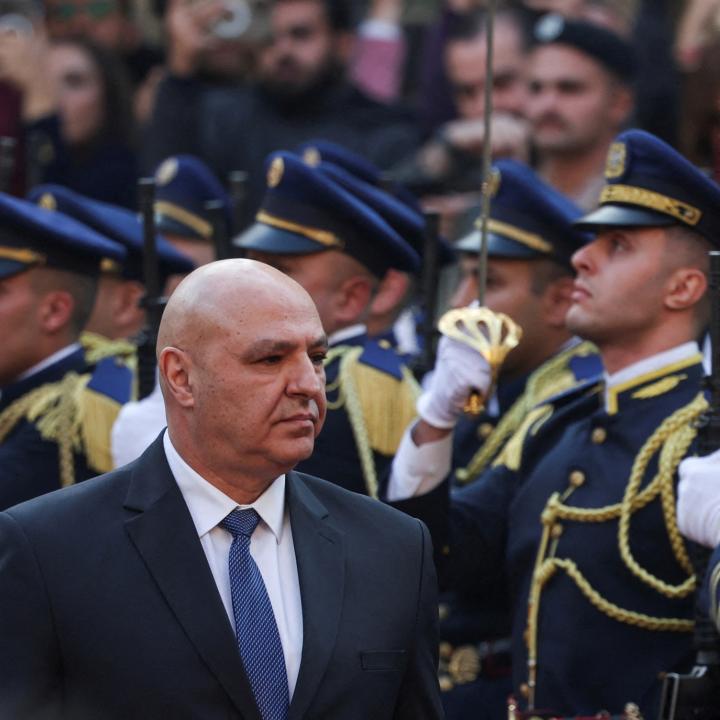
Stakes are high for the fledgling Israel-Lebanon framework agreement as President Joseph Aoun prepares to make his first-ever White House visit on July 21. The former army commander’s Washington meeting with President Trump—the first for a Lebanese president since 2009—is an opportunity for each leader to determine whether the other is serious enough to merit the substantial investment and risk needed to sever Lebanon from Iran’s orbit, disarm Tehran’s proxy Hezbollah, and pave a way toward Lebanon-Israel peace.
Diplomatic Context
Despite a history of U.S. assistance going back seventy-five years, close bilateral military ties, and a strong expatriate community in America, Lebanon was an afterthought for high-level White House engagement prior to the Iran war. During Aoun’s first year in office, Trump had no communication with him—no meetings, no phone calls, no letters. Aoun was granted just one high-level U.S. meeting—with Secretary of State Marco Rubio on the sidelines of the UN General Assembly last September. By contrast, Trump has had three face-to-face meetings with Ahmed al-Sharaa, the former jihadist who is now president of Syria.
Meanwhile, State Department officials and U.S. Central Command officers were facilitating the slow-moving process of implementing the November 2024 Israel-Lebanon “cessation of hostilities” agreement, a process that had stalled by the time the Iran war broke out this February. Two days after that eruption, Hezbollah launched a wave of missiles into northern Israel, opening a new front to support Tehran. In response, the Israel Defense Forces—which had until then limited their presence in Lebanon to five points near the international boundary—began a more extensive military operation.
Over the next three months, Hezbollah attacked Israeli communities and troops with more than 7,000 rockets, missiles, and drones, killing thirty-one people and wounding dozens more. Israel sent thousands of soldiers across the border and eventually created a buffer zone eight to ten kilometers deep into Lebanon. In addition to attacking Hezbollah weapons caches and facilities in the Beqa Valley and Beirut’s suburbs, Israeli forces fought to clear a broader area in the south up to and even beyond the Litani River. These operations left dozens of villages in ruins, thousands of Hezbollah fighters and civilians dead, and more than a million Lebanese displaced.
The focus turned to diplomacy shortly after a U.S.-Iran ceasefire was announced in April, with Washington brokering the first direct, public meeting between Lebanese and Israeli representatives. This was an unusual initiative from the beginning, since the government of Lebanon was not itself a combatant. Yet through diplomacy, Beirut hoped to reclaim from Hezbollah and Iran the capacity to make sovereign decisions about war and peace.
Subsequently, five rounds of talks produced the breakthrough “framework agreement” on June 26, thanks in part to Rubio’s personal intervention. The cornerstone of that deal is Lebanon’s agreement to disarm and dismantle all nonstate armed groups—code for Hezbollah—in exchange for Israel progressively redeploying from Lebanese territory. These efforts are expected to begin in “pilot zones” to be controlled by the Lebanese Armed Forces (LAF), and are wrapped in a broader commitment to reach full bilateral peace in the longer term.
The framework agreement was further complicated by the U.S.-Iran memorandum of understanding signed on June 17, which included an alternative path whereby Tehran and Washington could reach a “permanent termination” of the fighting in Lebanon while Israel played no role whatsoever. Hezbollah and its allies—including Lebanese Speaker of Parliament Nabih Berri—jumped on the MOU option, since it envisioned unconditional Israeli withdrawal and had no hint of broader peace between Beirut and Jerusalem.
Since then, President Trump has been silent on which path he personally endorses: the framework agreement or the MOU. While he called Aoun on June 27 to congratulate him on the deal with Israel and to extend the invitation to Washington, there was no White House readout of their conversation, nor any other public statement by Trump on the framework agreement.
Sizing Each Other Up
This muddied state of affairs will presumably be clarified once Aoun arrives. His visit will be a make-or-break moment for the framework agreement, an opportunity to evaluate each leader’s commitment to the deal, and a test of whether this path to security and peace is worth pursuing.
Trump already knows that Aoun “talks the talk” on bucking Iran and embracing the idea of eventual peace with Israel, which is what earned the Maronite president—the only Christian head of state in the Middle East—a meeting. Aoun’s path of least resistance would have been to close ranks with Berri and let Tehran carry Lebanon’s water by attempting to secure an Israeli withdrawal through U.S.-Iran talks. But that would have left the president a powerless figurehead in a Hezbollah-dominated political system, which he refused to accept.
At the same time, however, U.S. officials have legitimate doubts about Beirut’s willingness to follow through on promises to disarm and dismantle Hezbollah. The first round of such efforts—the LAF’s assertion of “operational control” over the sector south of the Litani in late 2025—was found to be insufficient following the subsequent discovery of substantial Hezbollah assets and infrastructure there. Since then, LAF commander Gen. Rodolphe Haykal has repeatedly prioritized “civil peace” over any showdown with Hezbollah, while Aoun has talked in general terms of disarmament having political, economic, and military components. Given that Lebanese leaders have promised and failed to disarm Hezbollah multiple times over the past thirty-five years—from the Taif Accord through the 2024 ceasefire—Trump will want Aoun to explain how this time is different and when Beirut will start “walking the walk” by using all means against the group, including military coercion.
For his part, Aoun is eager to learn whether the White House will be a reliable backstop as he pushes back on pressure from Iran’s allies inside Lebanon, who seek to jettison the framework agreement in the name of “national consensus.” In practical terms, Aoun will want to hear whether Trump will invest substantial resources to develop the LAF’s capabilities, organize international support for Lebanon’s reconstruction, and press Israel to help empower him through incremental withdrawals. Aoun also comes with a historical shadow—he is keen to avoid becoming a latter-day Amin Gemayel, the president under whom Beirut signed the U.S.-brokered May 17, 1983, peace accord with Israel that collapsed ten months later under Syrian pressure. He is likely wondering about the U.S.-Israel relationship as well, given the Trump administration’s willingness to negotiate an Iran MOU without Jerusalem’s input or approval. On all these points, Aoun will want to have his concerns allayed.
What to Expect
Circumstances are ripe for a successful meeting—the U.S.-Iran MOU is in tatters, leaving critics of the Israel-Lebanon agreement with no easy alternatives. Because Aoun rejected Tehran’s control over Lebanon’s fate, the country did not automatically revert to a major combat zone when fighting resumed between the United States and Iran last week. Instead, Beirut and Jerusalem set the table for the White House get-together with a round of “fruitful and positive” technical talks in Rome this week to prepare for the launch of two LAF-controlled pilot zones, as envisioned in the framework. On a personal level, Trump will likely warm to Aoun, a battle-tested, war-weary Lebanese patriot who has taken a strong stand against Iran’s regional ambitions for the sake of national honor and the pursuit of peace—just the type of national leader Trump admires.
But both presidents are looking for more than bonhomie. Operationally, Aoun needs practical U.S. commitments of support to complement a personal embrace and a strong endorsement of the framework agreement. These could include:
- offering to supply and train a Delta Force-style unit within the LAF that can conduct special operations against Hezbollah
- providing drones, sensors, and other tools to enhance Lebanon’s border security against Hezbollah’s rampant smuggling of weapons, drugs, and people
- organizing an international fundraising effort, both to begin the reconstruction of war-battered areas and to supplement the salaries of LAF troops so they are not woefully underpaid compared to Hezbollah fighters
- initiating a planning process for significant business-sector initiatives to rebuild Lebanon’s shattered economy, and to take advantage of the opportunities presented by potential peace with Israel
Such visible U.S. support could help convince Aoun that Trump is invested in both him and the strategy of direct talks with Israel. Moreover, it would solve the problem of how to show near-term benefits of the framework agreement at a time when Israelis are consumed with their upcoming domestic election—a political circumstance that will make Jerusalem even more likely to push back on any suggestion (even from Trump) of significant Israeli redeployments beyond the pilot zones.
In exchange for this package of incentives, however, Trump will no doubt want to hear additional evidence of Aoun’s seriousness. This could include specific details of his plan to disarm and dismantle Hezbollah; promises to cashier LAF officers found to be complicit with Hezbollah, especially in military intelligence; and a commitment to suspend draconian laws banning all civilian contact between Lebanese and Israelis. Most of all, Aoun will need to reaffirm that peace with Israel is his strategic objective—indeed, the more he highlights his commitment to peace, the more time, space, and support Trump will likely give him.
Finally, the White House meeting will also give Aoun an opportunity to put a stake through the heart of a dangerous idea that seems to have grabbed Trump’s imagination: empowering Syria to dispatch troops into Lebanon to supposedly quash Hezbollah. Aoun is all too aware that any Syrian military intervention would revive memories of the horrors committed during the Assad regime’s iron grip on his country, in the process igniting sectarian divisions and boosting Hezbollah’s popular support. Despite Sharaa himself ruling out the idea, Trump keeps returning to it. Hopefully, Aoun will present such a convincing case of his own commitment to dismantling Hezbollah that Trump will finally let the Syria option go.
Robert Satloff is the Segal Executive Director and Howard P. Berkowitz Chair in U.S. Middle East Policy at The Washington Institute.