Salma Annasse is a 2026 Soref Fellow at The Washington Institute.
Brief Analysis
Although the outcome is unlikely to affect core U.S. policy issues such as the Western Sahara dispute and Morocco’s participation in Gaza peacekeeping efforts, Washington should remain vigilant about the potential political impact of widespread disaffection, especially among the kingdom’s younger generations.
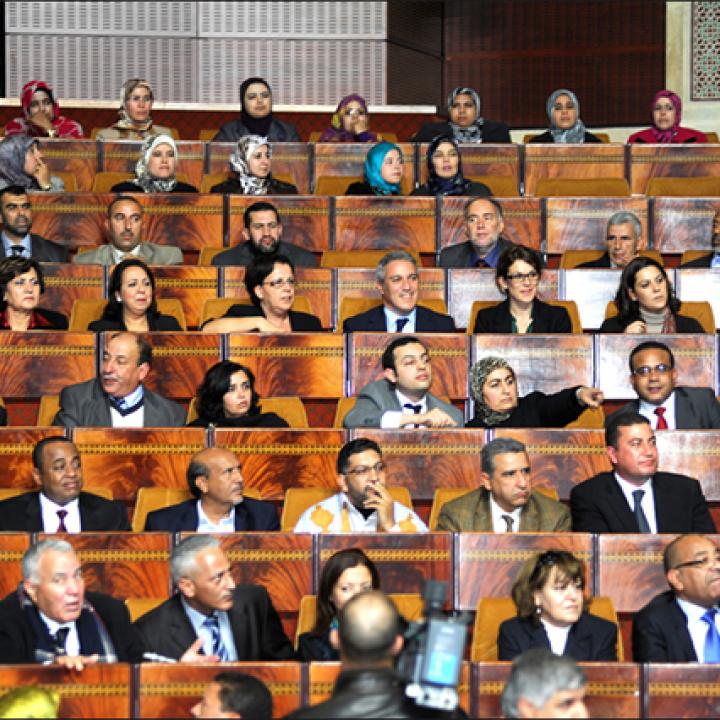
On September 23, Moroccans will elect their lower chamber of parliament, the House of Representatives, in the first national vote since the youth-led “Gen Z 212” protests that erupted a year ago. Even if an opposition-led government forms, the strategic files that the United States values most are unlikely to be touched. Yet the outcome will test whether elected officials can deliver on the demands that drove the protests. And whoever prevails, the next government will face a host of ingrained structural and political constraints that could complicate reform efforts.
Electoral Context
Since the mid-1990s, Morocco’s parliament has given citizens a limited avenue for political expression. The lower house comprises 395 representatives from 92 local districts and 12 regional districts. More than thirty political parties will likely compete in this year’s contest, and they do not need to surpass a minimum threshold of votes to gain a seat.
The king appoints the head of government, and although he must choose from the party that wins a plurality, he retains authority over the broader functioning of the executive branch. As such, while the elected government is mostly accountable to voters on economic and social policy, its independence is limited; the king retains control over the sovereign domains of national security, religious affairs, and the strategic direction of foreign policy.
In September 2025, public health failures in Agadir—where eight women died after cesarean sections—sparked the Gen Z 212 protest movement, so named after Morocco’s telephone country code. The movement’s slogans targeted the kingdom’s low-quality public education and health systems (especially in rural areas), as well as corruption and youth unemployment (especially among university graduates). The protests surprised the government, but the demands for better services and opportunities did not. Programs to expand healthcare access were already under way, yet outcomes have lagged. Data from the Court of Accounts, Morocco’s state audit institution, shows that the kingdom’s compulsory health insurance program (Assurance Maladie Obligatoire, or AMO) has not substantially lowered out-of-pocket costs, which still averaged 34% of total costs in 2024. Moreover, 91% of AMO reimbursements flow to private clinics even though most citizens seek care in public hospitals.
In addition, the government took steps to bring more young people into politics, allocating funds to cover up to 75% of campaign costs for under-35 candidates and requiring new parties to include younger individuals among their founding members. Even so, the Gen Z 212 movement persisted and has been weighing in on the imminent parliamentary contest.
What the Vote Will—and Won’t—Change
Despite the government’s promises, pre-election indicators do not suggest dramatic changes, and commentators expect increased voter abstention. In the 2021 election, around 50% of eligible voters cast ballots—by comparison, the most recent parliamentary contests in neighboring Algeria and Tunisia drew only 21% and 11%, respectively. This year, however, roughly 2.2 million fewer Moroccan voters are registered than in 2021, when turnout was likely boosted by concurrent local elections. Interior Ministry data shows that youth registration is particularly low: voters under 35 make up only 18% of the electorate, and the 18-to-24 age group comprises a mere 3%, despite the fact that about 25% of the kingdom’s population is between the ages of 15 and 29.
Moreover, most Moroccans realize that the demands driving the Gen Z 212 protests will take years to meet. For instance, of the 3.3 billion dirhams ($350 million) promised for hospital construction and renovation, only the 2026 tranche is programmed. And in Casablanca-Settat—the lone region with a published calendar—no renovations are scheduled to be completed before the vote.
Recent developments also indicate that policymakers are still struggling to find solutions to problems of inequality. For example, youth frustrations appeared to be on display again in late July when tens of thousands of people—mostly Moroccans—irregularly crossed into Ceuta, a North African city that Spain has controlled for nearly 450 years, though Rabat has long claimed it. The surge was largely driven by social media and interpreted as a renewed expression of the same grievances that gave rise to Gen Z 212. Some Spanish commentators alleged that Moroccan authorities allowed the surge, but Prime Minister Pedro Sanchez rejected the charge, telling lawmakers that no institution has provided Madrid with “solid evidence” that the kingdom was involved.
Reform struggles have persisted in the electoral realm as well. In 2011, authorities allocated a 30-seat quota in the 395-seat House of Representatives to candidates under forty years old following the youth-led “February 20 Movement.” Ahead of the 2021 parliamentary election, however, a 60-seat gender quota was expanded to 90 seats, and this came at the expense of the 30 seats previously allocated to young candidates. Similarly, the government sought to reform the legislative framework by including online candidate registration options and other digital tools, theoretically making participation more accessible to young people. In practice, however, such measures may wind up exacerbating inequalities between rural areas and more digitally connected urban areas.
Other reform efforts have run into the kingdom’s longstanding structural constraints, particularly in the health sector. For example:
A 2022 law created a new system for hospital governance in which regional health groups would take responsibility for services in their respective territories. The law was intended to decentralize healthcare and better integrate local services, thereby enabling care to be more streamlined and adapted to local needs. Yet the new regional groups have yet to begin operations, despite efforts by the cabinet—presided over by the king—to accelerate them earlier this year.
Following the Gen Z 212 protests, parliament introduced a new statute to improve working conditions, training, and equipment for public health workers. Yet its terms are still being negotiated with unions, and even after these technicalities are agreed, the program will require at least a decade to produce a new generation of better-trained, better-equipped health workers.
The high out-of-pocket costs that plague the AMO are remnants of a policy that the Health Ministry has left unrevised since 2006. The necessary fix is not technically difficult, but it would raise what the state and insurers must pay and has therefore been repeatedly deferred.
These examples suggest that improvements to services will remain slow even once a new government is in place, due to both structural obstacles and a likely absence of sufficient political will. In response to such delays, more Moroccans—especially younger citizens—have been mobilizing through protests and migration rather than formal political participation. This month’s vote is unlikely to reverse that trend.
Possible Government Reconfigurations
The outgoing government is a three-party coalition led by the National Rally of Independents (RNI), which won 102 seats in 2021 and governs with the Party of Authenticity and Modernity (87 seats) and Istiqlal (81 seats). RNI leader Aziz Akhannouch—one of the country’s wealthiest businessmen—stepped down as party head after the Gen Z 212 protests.
Observers expect the next government to be led by either Fouzi Lekjaa, the head of Morocco’s soccer federation, or Fatima Ezzahra El Mansouri, the housing minister and mayor of Marrakesh. Although either outcome—a government whose central focus would be successful delivery of the 2030 World Cup, or one led by a woman—would be unprecedented, neither would represent a break with the establishment bloc.
The election also raises the prospect of a rebound by the Justice and Development Party (PJD), the Islamist faction that won the 2011 vote but lost nearly 90% of its seats in 2021. Today, the PJD is once again led by Abdelilah Benkirane, the former prime minister who led the party into power in 2011, though he has stated that he will not stand as a candidate this year. Under his leadership, the party has campaigned on remedying protesters’ grievances. Yet given its disastrous losses in the previous election, it is unlikely to win enough seats to enter the next government.
Implications for U.S. Policy
Improving social services and expanding job opportunities will remain the biggest challenges weighing on Morocco’s next batch of parliamentarians. If they fail to meet them head-on, these issues could potentially destabilize a country in which the United States has invested nearly $700 million in Millennium Challenge Corporation funding and established close trade, defense, and counterterrorism relations.
With traditional U.S. foreign assistance now wound down, Washington’s ability to support its ally on these challenges will be limited to private sector investment. The Development Finance Corporation is already active in Morocco, where it has provided loans and committed to backing private development in the manufacturing, energy, infrastructure, agribusiness, and small-business sectors—a portfolio with significant potential to expand the number and range of projects that put educated young people to work.
Meanwhile, the strategic issues of highest concern for the United States will almost certainly be insulated from parliamentary changes regardless of the election’s outcome. This includes the disputed Western Sahara region and Morocco’s commitment of troops to the International Stabilization Force in Gaza, both of which are linked to Rabat’s 2020 resumption of ties with Israel. On paper, some parties may seem inimical to these U.S. interests—for instance, the PJD expressed support for Iran during the June 2025 war and invited a Hamas delegation to participate remotely in the party congress it held that April, while Benkirane has pledged to redouble the party’s backing for Palestine. Yet even if the PJD is somehow able to pull off an electoral surprise, it is unlikely to seriously challenge Morocco’s approach given that foreign policy sits in the sovereign domain directed by the monarchy. Indeed, it was under a PJD-led government that the kingdom resumed ties with Israel under the December 2020 tripartite declaration, over the objections of the party’s youth and religious wings.
Sabina Henneberg is a senior fellow at The Washington Institute and author of its new reportWhy Economic Reform Failed in Tunisia.Salma Annasse is a Soref Fellow at the Institute, focusing on Moroccan policy research, Middle East security, civil society engagement, and Track II diplomacy.