Souhire Medini is a 2024-26 Visiting Fellow at The Washington Institute, currently in residence from the French Ministry for Europe and Foreign Affairs.
Sabina Henneberg is a Senior Fellow at The Washington Institute and director of its Junior Research Program.
Articles & Testimony
Longstanding sensitivities between Algiers and Rabat mean that Washington will need to tread delicately in its renewed effort to resolve the dispute.
Earlier this month, the United States made public the facilitation of discussions between Morocco, the Polisario Front, Algeria and Mauritania in Madrid—an unprecedented shift away from the interminable UN-led search for a political settlement to the Western Sahara conflict. Led by President Donald Trump’s Envoy for the Middle East and Africa, Massad Boulos, and the US Representative to the UN, Mike Waltz, the Madrid talks appear to have concluded with few agreements but with strong indications that the Trump Administration is eager to continue talks in the coming weeks.
This implements the promise made in UNSC Resolution 2797, passed last October by the UN Security Council, which expressed “appreciation to the United States for its readiness to host negotiations in furtherance of the Personal Envoy’s mission to achieve a solution for Western Sahara and the region”. The US has thus taken the lead in attempting to resolve this largely frozen conflict, whose ceasefire collapsed in November 2020.
And by bringing Algeria to the negotiating table, the US has already accomplished a significant feat, as it was no easy task. As a non-permanent member of the UN Security Council, Algeria did not take part in the vote on Resolution 2797. Congressional threats to sanction Algeria for its weapons dealings with Russia and to list Polisario (whom Algeria supports) as a terrorist organisation undoubtedly played a role in convincing Algiers to participate in the talks despite the latter until now insisting on “regional observer” status and that it is not party to the conflict.
Yet it would be misleading to limit the resolution of the conflict to the United States’ ability to pressure Algeria to change its position. By acknowledging Algiers’ unique position and priorities, the Trump Administration likely persuaded Algeria to join the talks. Sustaining this approach will be key to ensuring Algeria’s ongoing, meaningful contribution.
Washington’s Reasoning
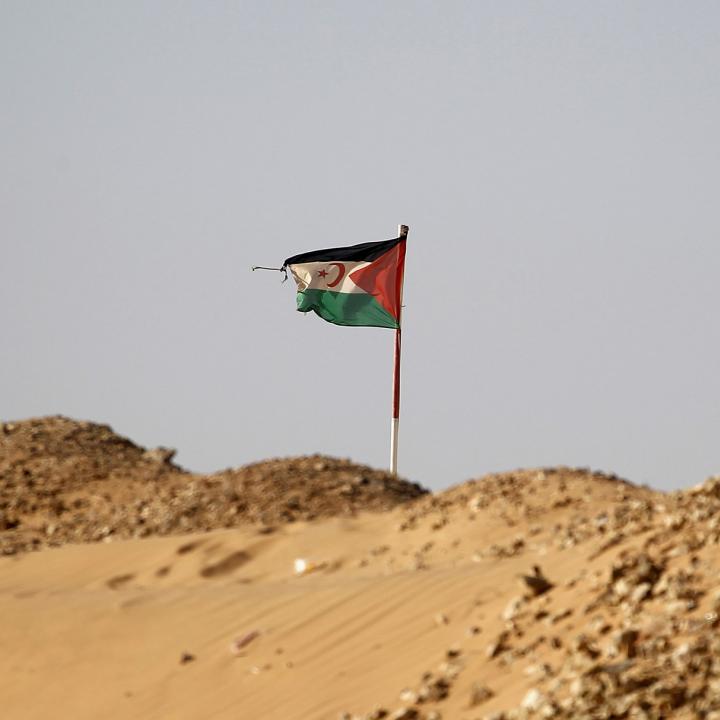
Washington’s insistence on including Algiers in the Madrid talks was fully justified by the Polisario Front’s increasing reliance on Algeria. Over the decades, diplomatic support for the Sahrawi Arab Democratic Republic (SADR)—the self-declared state of the Sahrawi people—has substantially weakened (in the 1970s, when the Polisario was formed, more than 80 countries recognised the SADR; since then, more than 50 of them have withdrawn their support). As countries withdrew their support for the SADR, Algiers’ support for the Polisario Front became increasingly valuable, both materially and symbolically.
Algeria also welcomes Sahrawi refugees in its own territory, indicating the extent to which it is willing to support the Polisario’s cause. The discrepancy in estimates of the number of refugees is wide: 174,000 according to the latest Sahrawi Refugee Response Plan (the coordinated compilation of the needs of all UN agencies in the refugee camps), and 40,000 according to other reliable sources regularly visiting the Tindouf camps. These statistics constitute a critical issue because in the event of a settlement, one of the most challenging steps will be gaining refugee acceptance of integration—even under genuine autonomy—into the Moroccan monarchy.
However, it would be a mistake to view Polisario as a mere proxy of Algiers. The Polisario Front was formed in 1973 in neighbouring Mauritania; Algeria quickly assumed a major supporting role for the movement. The country’s political elite has always viewed the Western Sahara conflict through the lens of their own history. Algiers does not believe it is supporting a “radical Islamic organisation” or “communist terrorists” but rather a post-colonial principle of self-determination. It has remained firm in its support ever since.
Moreover, the Algerian leadership also demonstrates a high level of sensitivity regarding its borders. It is no coincidence that the writer Boualem Sansal, a long-time critic of Algeria’s internal and foreign policy, was arrested following comments he made about border demarcation with Morocco. In fact, Algeria and Morocco’s history of border disputes predates the Western Sahara conflict, and Algerians may look favourably on having a territory separating them from their Moroccan neighbour.
Defining a Mechanism
In this context, one way to break out of the deadlock could be to define a mechanism for consulting the Sahrawi population, including the refugees in Tindouf—even if not through a referendum—to shift the Algerian position on the Moroccan autonomy plan. The organisation of a consultative/inclusive dialogue, including one consistent with Morocco’s new proposed 40-page autonomy plan, could be a starting point.
This would be consistent with the stance recently articulated by Algeria’s ambassador to Washington, Sabri Boukadoum. He indeed recently described Algeria’s position on the Western Sahara issue by emphasising that any solution should be the result of the decision of the concerned, meaning the Sahrawis. In other words, should the Sahrawis decide to be part of Morocco, Algeria would concede immediately.
Additionally, any solution or roadmap should take into account the Algerian elite’s perception of the inviolability of its borders. Any agreement—even one based on an autonomy framework—should include guarantees that Algeria’s post-colonial borders are not at risk. The Polisario’s announcement of a return to the ceasefire—which the group denounced nearly six years ago—could mark a turning point and set the stage for more constructive discussions going forward.
Continuing to bring all parties—including Algeria—to the table by addressing their core concerns will be key to yielding results. This will also require working to keep the talks discreet, as this is undoubtedly the best way to continue building trust between the parties and pave the way for a breakthrough.