Hanin Ghaddar is the Friedmann Senior Fellow at The Washington Institute's Rubin Family Arab Politics Program, where she focuses on Shia politics throughout the Levant.
Majd Harb, an attorney and legal activist residing in Beirut, has courageously sued Hezbollah in Lebanese courts, accusing the party of money laundering, customs law evasion, and other criminal offenses.
Brief Analysis
Beirut can’t just deploy troops and call it a day—it must give them the legal cover they need to actually dismantle the military capabilities that Hezbollah hides behind misused “private property” protections.
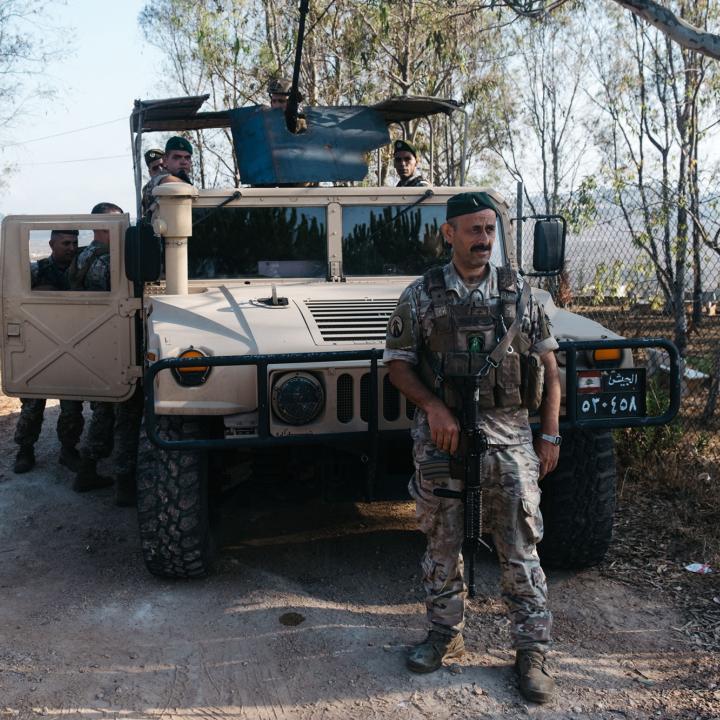
The October 20-22 Israeli-Lebanese military talks at U.S. Central Command headquarters in Tampa, Florida, are expected to address the tactical hurdles facing the June Trilateral Framework agreement, specifically its implementation of pilot zones. Yet these talks are also an opportunity to move beyond the technical details—the parties will have a chance to frankly discuss the lack of political will that Lebanon has shown so far on the core issue of disarming and dismantling Hezbollah, which in turn can help them reach a concrete plan for progress on the ground. Although the Lebanese Armed Forces (LAF) have deployed to the pilot zones, they have made no effort to take control of the group’s weapons or other military capabilities there; reports even suggest that Hezbollah personnel have returned to these areas. The Tampa talks provide a forum to get the failing framework back on track—but only if the parties are willing to untangle the Lebanese legal obstacles and excuses that have impeded inspections of Hezbollah’s “private property.”
A Legal Mechanism for Property Searches
Hezbollah has long embedded its military infrastructure within civilian communities, and private property has become the group’s most important remaining asset for preserving its dominance over Lebanon. Hence, the LAF cannot effectively dismantle this infrastructure without searching private dwellings, beginning in the pilot zones.Lebanese authorities argue that constitutional protections prohibit them from proceeding, but the law actually provides a mechanism for doing so when required—what is missing is the political will to use this mechanism.
Article 14 of the constitution makes Lebanese places of residence inviolable but provides an exception in cases “prescribed by law.” The question is therefore which legal authority would permit searching residences suspected of hiding Hezbollah military materiel.
As in the United States, private property searches in Lebanon require a warrant under normal criminal procedure, and various restrictions apply. For example, Article 47 of the Code of Criminal Procedure requires the prior approval of the Public Prosecutor’s office, while Article 33 restricts home searches to between 5 a.m. and 8 p.m. Any search that breaches such procedures is liable to be quashed, and the officers involved could face prosecution. These factors partly explain the current deadlock in the pilot zones—on July 29, chief prosecutor Ahmad al-Hajj stated that he had not authorized any home searches in these areas.
Critics have correctly argued that standard criminal warrants are not the right tool for clearing entire areas of concealed military infrastructure. Yet one proposed workaround—a judicial authorization for an entire zone—would create another legal vulnerability. The criminal code procedures are predicated on identifying a specific residence, having the occupants or their representative present, and legally documenting any seizures. Trying to fit a large-scale LAF operation under that type of authorization would open each individual location search to legal challenges, damage the prospects of prosecution, and give Hezbollah another method of obstructing the process.
Fortunately, a more robust statutory instrument is in place. Decree Law 52, issued by the president and Council of Ministers in August 1967, allows the cabinet to proclaim a state of emergency or military zone over any part of Lebanon in the event of imminent danger resulting from a foreign war, armed revolt, or disturbances threatening public order. Most or all of these conditions clearly apply today after three years of war and turmoil. Under such circumstances, Article 4 of this instrument gives the “Supreme Military Authority”—i.e., President Joseph Aoun—the power to approve property searches at any time and require the confiscation of weapons and ammunition. The decree explicitly refers to dwellings and provides powers beyond the ordinary criminal process. Lebanon has used location-specific, time-limited emergency declarations before (e.g., a two-week declaration confined to Beirut after the 2020 port explosion). Hence, using Decree Law 52 as a legal route for a Hezbollah dismantlement mission would not require placing the entire country under military authority.
To exercise this existing power, the cabinet should issue a declaration setting out the area, duration, and purpose of the operation, as well as the LAF’s powers in carrying it out. Article 65 of the constitution requires the approval of two-thirds of the cabinet, and Article 2 requires parliament to convene within eight days to discuss the measure, though solely in an advisory capacity. The alternative—seeking new authorizing legislation from parliament—would give Hezbollah and its allies yet another opportunity to block the mission.
The cabinet declaration must also include an inspection schedule, written authorization by a named senior LAF officer, a mechanism for recording every property searched, and a pledge to refer any civilians arrested during the operation to ordinary courts rather than military courts (essentially nullifying Article 5 of Decree Law 52). These safeguards would protect residents and help deflect any legal challenges. They would also prevent Hezbollah from credibly arguing that disarming the group requires arbitrary searches or the imposition of military rule.
Lack of Political Will
If the government does not want to use this emergency mechanism, then it must provide an alternative legal route for removing Hezbollah’s military capabilities—one with a clear and imminent timeframe. Simply continuing to talk about private property without resolving the issue is a nonstarter, since it would allow Hezbollah to keep its arsenal.
The authority is there. The decision to use it is not.
Lebanese officials have offered several excuses to avoid implementing the Trilateral Framework’s obligations beyond passive deployment of the LAF. In addition to private property concerns, they have warned about the threat of civil war if the LAF confronts Hezbollah. President Aoun has also argued that for disarmament to be successful, “We have to convince the mass base,” meaning the Shia community that includes Hezbollah’s core supporters.
Yet these excuses do not hold water. The threat of civil war is exaggerated, while the Shia community has repeatedly expressed disillusionment with Hezbollah, a desperate need for the government to exert authority on the ground, and a willingness to stand behind state institutions. In addition to ample media coverage of these sentiments, a recent poll found that the majority of Shia respondents across Lebanon trust the LAF and no longer believe that Hezbollah can protect them. Moreover, 66 percent of them favor transferring the militia’s weapons to the state in some form (compared to 29 percent who favor Hezbollah keeping them), while 51 percent cite the LAF as the greatest contributor to security (versus 17 percent who cite Hezbollah). These findings challenge the claim that Hezbollah’s weapons enjoy broad Shia support—leaders can no longer credibly adopt positions that treat the community’s interests as synonymous with the militia’s.
In short, if the Shia now stand behind the state, and if the government has an existing, constitutionally valid mechanism for searching private properties, what is preventing authorities from implementing the Trilateral Framework? This is the top question that should be asked at the Tampa talks.
The Risks of Delay
While technical discussions continue, Hezbollah has been busy rearming, bolstering its presence in Shia areas, empowering its allies within state institutions, and making sure it has enough funding to meet its military and political goals. (The last point holds regardless of whether or not the group actually received $200 million from Tehran last month as reported.)
Even more alarmingly, during an October 10 stop at a checkpoint in the Beqa Valley, the Internal Security Forces discovered 206 kilograms of C-4 explosive and 281 kilograms of PETN in a truck belonging to a Hezbollah operative, raising the possibility that the group is preparing to resume political assassinations given its past use of such materials for this purpose. The driver even presented a special card that the LAF Intelligence Directorate has issued to facilitate passage through security checkpoints, raising serious questions: Have other operatives already freely moved explosive cargoes around the country and stored them inside private properties? And why is LAF intelligence still allowing Hezbollah members to use these permits despite the military’s stated plans to restrain the group’s freedom of movement?
The other risks of inaction are sobering as well. If the Trilateral Framework fails, Lebanon could face wider, more destructive Israeli military escalation, an Iranian takeover of the Lebanon file if Washington reaches a deal with Tehran, or an indefinite stalemate that would leave the country isolated and weak.
Policy Implications
The Tampa meeting is an opportunity to pull down the Lebanese political obstacles that have prevented major progress since the framework agreement was signed. The most useful steps include the following:
Finalize the verification mechanism. The framework agreement pledged to “set out the requisite measures, security arrangements, and verification mechanisms to advance this process,” while its annex reportedly specified “the verification of clearance of all non-state armed groups and their military infrastructure by a mutually agreed-upon third-party entity.” Lebanon and Israel have yet to agree on this “entity,” however, pointing to the need for a more hands-on U.S. approach. Only objective third-party monitors can verify whether the LAF moves from deployment to disarmament in the pilot zones. Hence, the Tampa talks must establish which third-party countries will participate in the verification mechanism, and what types of assistance they will need to succeed in that mission.
Require Beirut to grant the LAF authority to search private properties. As described at length above, Lebanon already has this authority, so there is no credible excuse for further delay. To drive this point home, Secretary of State Marco Rubio could urge President Aoun and Prime Minister Nawaf Salam to declare a two-week state of emergency in the pilot zones, as permitted by Decree Law 52. During this period, the LAF need not enter and inspect every home and business in the area—the Israel Defense Forces have already shared intelligence on which locations Hezbollah is using to store weapons and equipment, including drone manufacturing workshops. Beirut must also provide assurances that the LAF will continue using such intelligence to keep these areas permanently demilitarized after Israel withdraws from each zone.
Tie additional assistance to enforcement of the framework agreement. To ensure progress,U.S. assistance needs to be conditioned on the dismantlement of Hezbollah. Meeting that goal will also entail cleansing military and security institutions of Hezbollah operatives, making sure they no longer have access to movement facilitation cards, and avoiding further excuses based on supposed civil war risks, Shia opposition, or insufficient legal authorization.
Hanin Ghaddar is the Friedmann Senior Fellow at The Washington Institute and coauthor of its 2025 “Roadmap for Israel-Lebanon Peace.” Majd Harb isa Lebanese attorney and legal activist who has spearheaded lawsuits against Hezbollah’s criminal activities.