- Policy Analysis
- PolicyWatch 4206
Lebanon After UNIFIL: Good Riddance, Not a “Vacuum”
Whether the UN and Europe agree to align with a limited, U.S.-led mechanism or insist on their own separate missions, Washington and Jerusalem need to contain and closely coordinate any outside involvement in order to safeguard the core goal of disarming Hezbollah.
With the final mandate for the UN Interim Force in Lebanon expiring at the end of this year, Israel and Hezbollah are still fighting, the militia is still threatening the Lebanese government, and unprecedented diplomatic negotiations are taking place between Jerusalem and Beirut. UNIFIL’s eventual withdrawal will hardly create the “security vacuum” that some fear—the force’s efficacy has been dubious for decades, and a more capable minilateral mechanism is already in place. Yet the current circumstances present an important opportunity to synchronize international efforts on both the country’s top security challenge and the top obstacle to Israeli-Lebanese peace: Hezbollah’s weapons.
UNIFIL’s Denouement
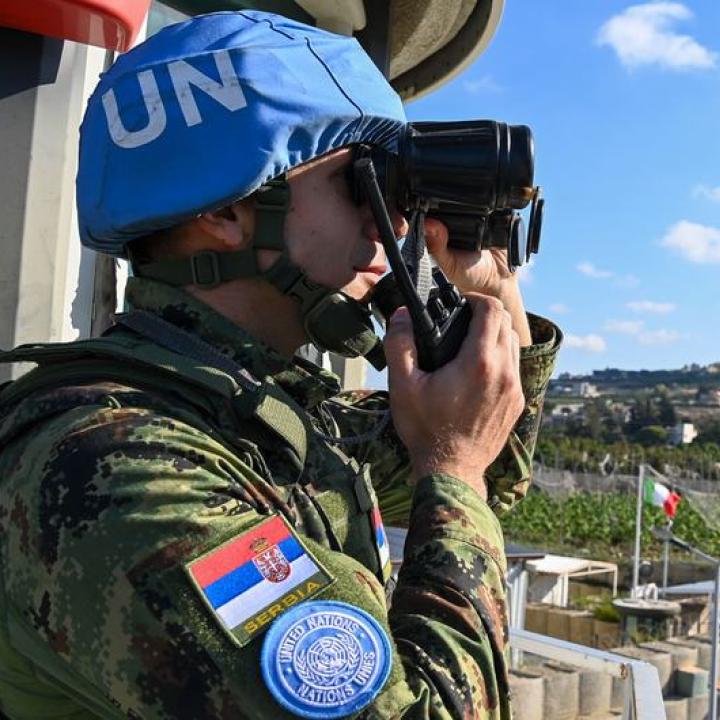
Last August, the UN Security Council adopted Resolution 2790 extending UNIFIL’s mandate for the last time. Once the December 31, 2026, expiration date passes, the force is required to draw down and depart within a year. Meanwhile, the resolution gave the UN secretary-general until June 1 of this year to explore different possibilities for implementing the existing Resolution 1701 (2006) after the force’s withdrawal, including UN assistance with security matters, monitoring of the Blue Line along the Israeli-Lebanese frontier, and deployment of the Lebanese Armed Forces (LAF) south of the Litani River. Officials at UN headquarters have begun mapping such options, as have European countries seeking to keep their military contingents in Lebanon once UNIFIL is disbanded.
In March, however, Hezbollah resumed large-scale attacks against Israel at the outset of the Iran war, leading to two developments that will necessarily affect international decisionmaking on Lebanon. Earlier this month, the Israel Defense Forces (IDF) declared security control up to the Litani River and established a security zone ten kilometers beyond the Blue Line. And on April 14, Secretary of State Marco Rubio opened talks in Washington between the ambassadors of Lebanon and Israel, leading to a ten-day ceasefire agreement (since extended) and joint efforts to promote conditions for peace. On the ground, however, fighting between Hezbollah and Israel continues to escalate.
What UNIFIL Tasks Need to Continue?
Resolution 1701 tasked UNIFIL with monitoring the 2006 ceasefire, coordinating with the two sides, assisting with humanitarian needs, and helping the LAF deploy in the south in order to establish a zone free of militia weapons. In the months since officials decided to terminate the force’s mandate, concerns have been raised about a potential “security vacuum” following its departure. Yet UNIFIL’s oversize presence has never translated into effectiveness on the ground, so little if anything will be lost by withdrawing it.
UNIFIL’s most important role—facilitating effective liaison and coordination between the parties—has already been filled by the U.S.-led “mechanism” established by the November 2024 ceasefire. The question is how best to meet the crucial goal of supporting the LAF in establishing a nationwide monopoly on weapons—something UNIFIL has never substantively helped with despite sizable UN resolutions tasking it with that very mission.
Alternative Architectures, Competing Preferences
After UNIFIL withdraws, the Lebanese government is interested in continued foreign support (preferably from the UN) to help ensure that it enjoys resources and legitimacy, thereby sharing the burden of responsibility for policies that it hesitates to implement. Similarly, the UN is interested in maintaining influence and a presence in Lebanon, as are France, Italy, and certain other European countries.
For its part, Israel prefers to minimize the international military presence in Lebanon, largely because foreign contingents limit its freedom of action against security threats there. It is specifically against a UN presence, as the organization has consistently demonstrated hostility and systemic bias toward Israel. Jerusalem prefers direct coordination with the LAF under U.S. auspices over indirect liaison sponsored by the UN or others. Washington agrees with this approach, as evidenced by the terms of the 2024 ceasefire it helped broker and its push for terminating UNIFIL. The current nadir in U.S.-Israeli relations with the UN and relevant European actors will not make it easier to agree on continuing—let alone expanding—their role in Lebanon.
Meanwhile, Hezbollah opposes foreign forces in Lebanon, but only if they are effective at fulfilling their mission. When said forces are ineffective like UNIFIL, the group actually benefits from their presence, as both a human shield against effective Israeli action and a source of economic perks. Hezbollah’s latest attack on a UNIFIL patrol, which killed two French peacekeepers, was a tragic reminder of how it has exploited such deployments for decades as leverage over the policies of contributing countries and the UN.
As these actors determine what to do next, they should focus on the fact that each of them (except Hezbollah) shares one central goal: strengthening the LAF so that it can establish state sovereignty and a monopoly over arms. Most of them also agree on the need to disarm Hezbollah; they mainly disagree on the feasibility of this mission and how it should be carried out. The Lebanese government has offered bold statements on the matter, but its execution has been limited so far. Going forward, officials must figure out how to coordinate—or, at least, deconflict—the following tracks:
United Nations. The UN will presumably seek to maintain its local political influence through the Office of the Special Coordinator for Lebanon (UNSCOL). It will also look to continue its operations there via the Observer Group Lebanon (OGL) from the UN Truce Supervision Organization (UNTSO), which currently operates under UNIFIL. Yet authorizing these observers or other UN units to operate in Lebanon post-UNIFIL would require a new Security Council mandate, which depends on the consent of the United States.
Europe and NATO. The European Union and some of its member states are discussing their own missions after UNIFIL. Any such mission would require a formal invitation from the Lebanese government; coordinating it with Israel and the United States would be vital as well. Proposals to replace UNIFIL with a NATO force are unlikely, as the alliance’s current focus—the Russian threat to Europe—is already stretching its capabilities thin.
The U.S.-led mechanism. The ongoing ceasefire implementation mechanism established in 2024 is led by the United States, supported by France, and includes Lebanon, Israel, and UNIFIL. In practice, it has effectively marginalized UNIFIL by creating a preferred platform for liaison, coordination, and information sharing between the IDF and the LAF, both to deconflict their operations and promote the demilitarization of southern Lebanon. Yet the latest wave of Hezbollah attacks and IDF findings has exposed gaps in the demilitarization effort—partly due to the LAF’s capability shortfalls and its evasion of government orders to disarm Hezbollah, but also because of gaps in the mechanism’s monitoring and documentation process.
Recommendations
Post-UNIFIL options should be judged by their potential contributions to Israeli-Lebanese security and prospective peace. The key to success is establishing true Lebanese sovereignty over all of its territory. The main hindrance is Hezbollah’s weapons—a problem abetted by interference from the group’s patrons in Iran, who have repeatedly steered it to use these weapons against Israel.
Ultimately, it is Beirut’s job to achieve this demilitarization. Although the government and its armed forces chronically suffer from limited capability, capacity, and political will, foreign assistance can help address these limitations by training relevant LAF units to handle missions related to disarmament, counterterrorism, border security, and arms trafficking. In parallel, political and economic levers must be used to effect behavioral change. Yet the operational footprint of this foreign support should be minimal—not only for the sake of empowering the LAF, but also to deprive Hezbollah of cover and leverage while maximizing freedom of action against it.
Because the U.S.-led mechanism is already coordinating and deconflicting between Israel and Lebanon, it is well-positioned to integrate and synchronize any additional parties who will be involved in post-UNIFIL Lebanon, including UN, European, or regional players. Donor countries and organizations should be invited to participate in training the LAF and assisting with specific missions related to engineering, disarmament, logistics, humanitarian aid, air operations, and, if needed, observer missions. In the immediate term, the parties could focus on a useful pilot project: training and equipping an elite LAF unit dedicated to disarmament-linked missions.
Given their recent tensions with the Trump administration, the EU and UN may still insist on pursuing separate military missions in Lebanon despite the above concerns. If so, they should be required to obtain Beirut’s consent and coordinate with Washington and Jerusalem in order to ensure synergy and deconfliction. The United States can also use its veto power to shape future UN activity in Lebanon; other parties will have to be engaged in more sensitive dialogue to address their concerns.
In the longer term, the U.S.-led mechanism could serve as the template for a future architecture. For instance, as diplomatic negotiations toward peace progress, the parties may be inspired by the model of the Multinational Force & Observers in the Sinai Peninsula, an entity that has strongly supported the Egypt-Israel peace treaty since 1982. The MFO’s keys to success are clear:
- American leadership.
- The force’s commitment to the main stakeholders only (in this case, Egypt, Israel, and the United States), and the stakeholders’ strong support for the force.
- Effective liaison and trust between the parties.
- Multinational participation in agreed missions.
- The absence of UN-related politicization and bureaucracy.
These principles could be applied in Lebanon already, even if the conditions for full implementation are a long way out.
Until then, and in parallel with the establishment of a U.S.-led architecture, Israel should work to repair its relations with Europe and advance contacts on the Lebanon issue with leading players such as Germany, the United Kingdom, France, and Italy. Although full rapprochement may require years of work and a change of government in Israel, the possibility of European forces operating in Lebanon means that Jerusalem must maintain good dialogue with donor countries on relevant political, military, and intelligence issues.
Finally, until UNIFIL leaves, the IDF must dramatically improve its conduct toward UN personnel. In the past year, Israeli forces have been involved in dozens of serious incidents, including casualties among peacekeepers. The IDF has explained most of them as mistakes, but they still reflect disciplinary and professional problems—not to mention a strategic shortsightedness that will only deepen the damage to Israel’s international standing in the world.
Brig. Gen. Assaf Orion, IDF (Res.), is The Washington Institute’s Rueven International Fellow, a senior research fellow at the INSS, and former head of the IDF Strategic Planning Division.