Michael Singh is the Managing Director and Steven D. Levy Senior Fellow at The Washington Institute.
Articles & Testimony
As protests grow, regime leaders have no clear options for scaring Iranians off the streets, intimidating foreign powers, or escaping their wider strategic crisis.
For all the military weapons remaining in the Iranian regime’s arsenal, it has finally been deprived of the one that authoritarians rely upon most: fear. For almost five decades, the Iranian regime has brutally repressed its own people while sowing mayhem in the Middle East and beyond. But the regime may have finally entered a strategic crisis from which it will not be able to escape.
To ensure its survival to this point, the regime in Tehran has sought to fend off what it perceived as its two greatest threats: Iran’s own relatively young, well-educated and politically engaged populace; and countries in the region and beyond, including especially the United States, that took umbrage with the Iranian regime’s nonstop threats to their interests and to regional stability. Fear has been the regime’s chief instrument: whether stoking Washington and others’ self-deterring fear that taking conflict with Iran too far would spark a regional war, or inspiring fear among the Iranian populace that protests would attract only regime reprisals rather than international support.
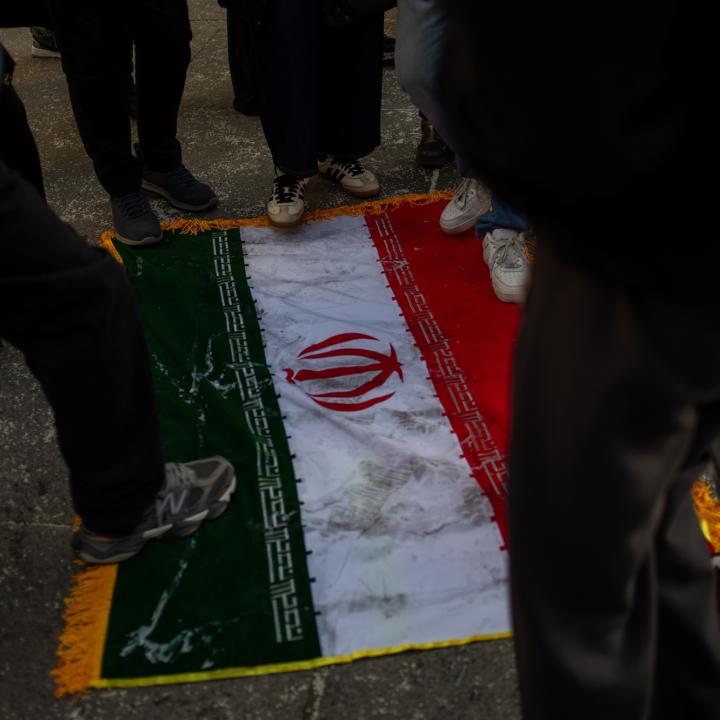
But there are clear signs that fear—and the regime strategy that depends on it—has been broken. The United States and Israel have overcome decades of hesitation to confront Iran directly and are threatening further strikes. Iranian protesters, buoyed in part perhaps by President Donald Trump’s promises of support, keep coming out to the streets despite the regime’s use of force. Whether Iranians will be able to weather the regime’s brutality and continue their protests remains to be seen, but it is clear that this uprising differs from those past in its size and in the type and range of drivers, both economic and political.
At home, Iran’s security services and judges have been merciless in crushing dissent, as their grim record of imprisonments and executions demonstrates and as the violent response to protests continues to show. In the region and abroad, Iran’s rulers have recklessly proliferated sophisticated weapons to groups such as Hezbollah in Lebanon, the Houthis in Yemen, and at times even the likes of al-Qaida and the Taliban. The point has been less to advance any ideological or geopolitical agenda—some of these groups are erstwhile enemies of Iran and of the Shia Islam that predominates there—than to keep Israel, Saudi Arabia, the U.S. and other foes preoccupied far from Iran’s own borders.
And for years it has worked. The Iranian regime has paid little for the blood it spilled. Iran was behind the bombing of the U.S. Marine barracks in Lebanon in 1983 and the deaths of thousands of American soldiers in Iraq from 2003 onward. It funded, trained and equipped groups including Hezbollah, Hamas and Palestinian Islamic Jihad, which have killed thousands of Americans, Israelis and Arabs. Yet Israel, the U.S. and Iran’s Arab rivals were unwilling to strike back directly for fear of unleashing a wider war—a worry that the regime in Tehran enthusiastically stoked. Instead, Iran’s foes have largely played by the regime’s rules: Iran attacked using proxies, and its enemies retaliated against those proxies but never directly against the regime.
This pattern was finally disrupted by Hamas’ Oct. 7, 2023, attack on Israel, which drove home the folly of allowing Iranian regime-sponsored threats to metastasize. After dealing with Hamas and Hezbollah, Israel finally called the regime’s bluff with direct strikes last summer, and Tehran managed scant response as its once-vaunted proxies, air defenses, missile arsenal and nuclear program were systematically destroyed.
For Iran, the exhaustion of its adversaries’ forbearance heralds not just a military loss but also a strategic dilemma. The U.S. and Israel have threatened strikes in response to the regime’s domestic crackdown, its efforts to rebuild its missile program and proxy network, and any moves—as yet undetected—to reconstitute its nuclear program.
Iran must deem these threats credible. Now that Israel and the U.S. have crossed the red line of direct attacks without triggering the long-feared regional war that Iran threatened, such military strikes will almost surely be part of both states’ toolkits for dealing with the regime. This will be true even after Trump and Israeli Prime Minister Benjamin Netanyahu leave office.
Yet for an Iranian regime desperate to preserve itself, no alternative strategies are readily apparent. Accepting U.S. and Israeli demands or tolerating popular dissent and calls for change are not merely difficult steps; they are anathema to the quixotic 1970s-era ideology to which the regime clings. Anti-Americanism and absolute clerical rule are not policy choices for Iran’s rulers; they are the regime’s identity and the pillars on which its rule rests.
As the Trump administration deliberates over how to respond to events in Iran, most vital is not to rescue the Iranian regime from its dilemma. Both President Trump and Vice President JD Vance have suggested that they are entertaining a regime offer of negotiations with Washington. But now is not the time for a new nuclear deal or other engagement that would alleviate pressure. Rather than allowing the regime to escape the existential question it faces—change or collapse—Washington should apply additional pressure on Iran’s rulers and offer support to its people.
Amid the threat of military strikes, this is a moment of danger for Iran’s adversaries and for its people. One cannot discount that in its desperation to survive, the regime could aim to dash for a nuclear weapon, commit major acts of terrorism or inflict further massacres against the Iranian people. But the very steps Iranian leaders might contemplate to save themselves would only increase the pressure against the regime—and likely invite new protests and potential military strikes, and perhaps hasten the regime’s demise.
Michael Singh is the managing director and Lane-Swig Senior Fellow at The Washington Institute. This article was originally published on the MS NOW website.