- Policy Analysis
- PolicyWatch 4232
Iran Is Still Intent on Preventing a Return to the Old Navigational Order
by
Noam Raydan
Jun 26, 2026
Also available in
About the Authors

Brief Analysis
Constricted traffic patterns, escalating warnings, uncertain mine threats, and a new drone attack all suggest that Tehran has no intention of willingly going back to business as usual in the Strait of Hormuz, regardless of diplomatic breakthroughs.
Since the United States signed a memorandum of understanding to halt the Iran war on June 17, an increase in commercial ship transits has been observed in the Strait of Hormuz. Days after the MOU was announced, the UN’s International Maritime Organization (IMO) announced a large-scale plan to evacuate hundreds of ships and thousands of seafarers stranded in the Persian Gulf. Yet these positive developments do not signify a return—imminent or gradual—to the traditional navigational order.
For one thing, transit numbers are still far below prewar levels. More important, the status of navigation in and around the strait remains volatile amid ongoing Iranian threats and naval mine risks along the traditional route. Since hostilities eased in the lead-up to the MOU, some vessels have been transiting through two alternative routes: one that hugs the Omani coast, and another through Iran’s waters. This week, however, Iranian forces attacked a ship and issued warnings against using routes not authorized by Tehran, indicating that even the Omani bypass is now at risk.
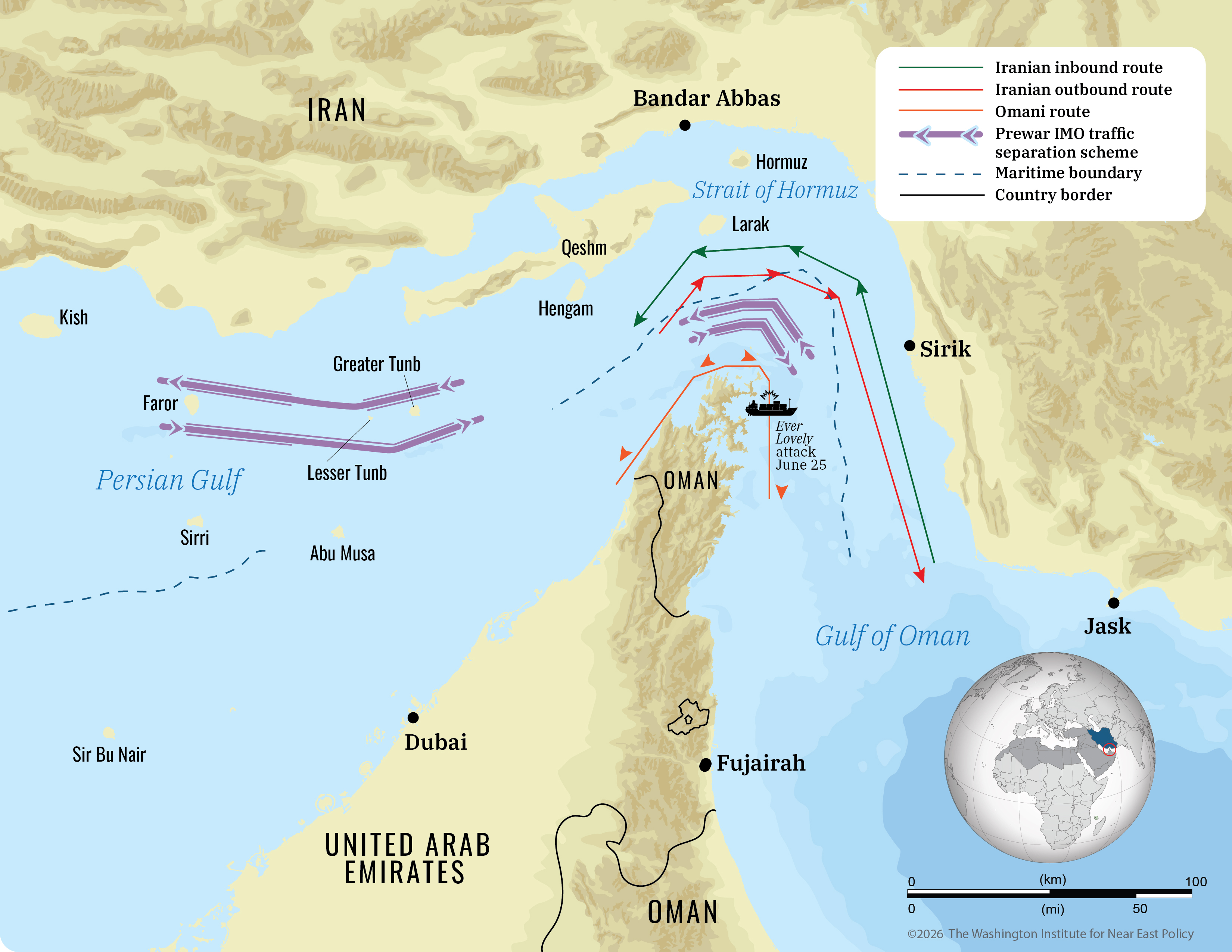

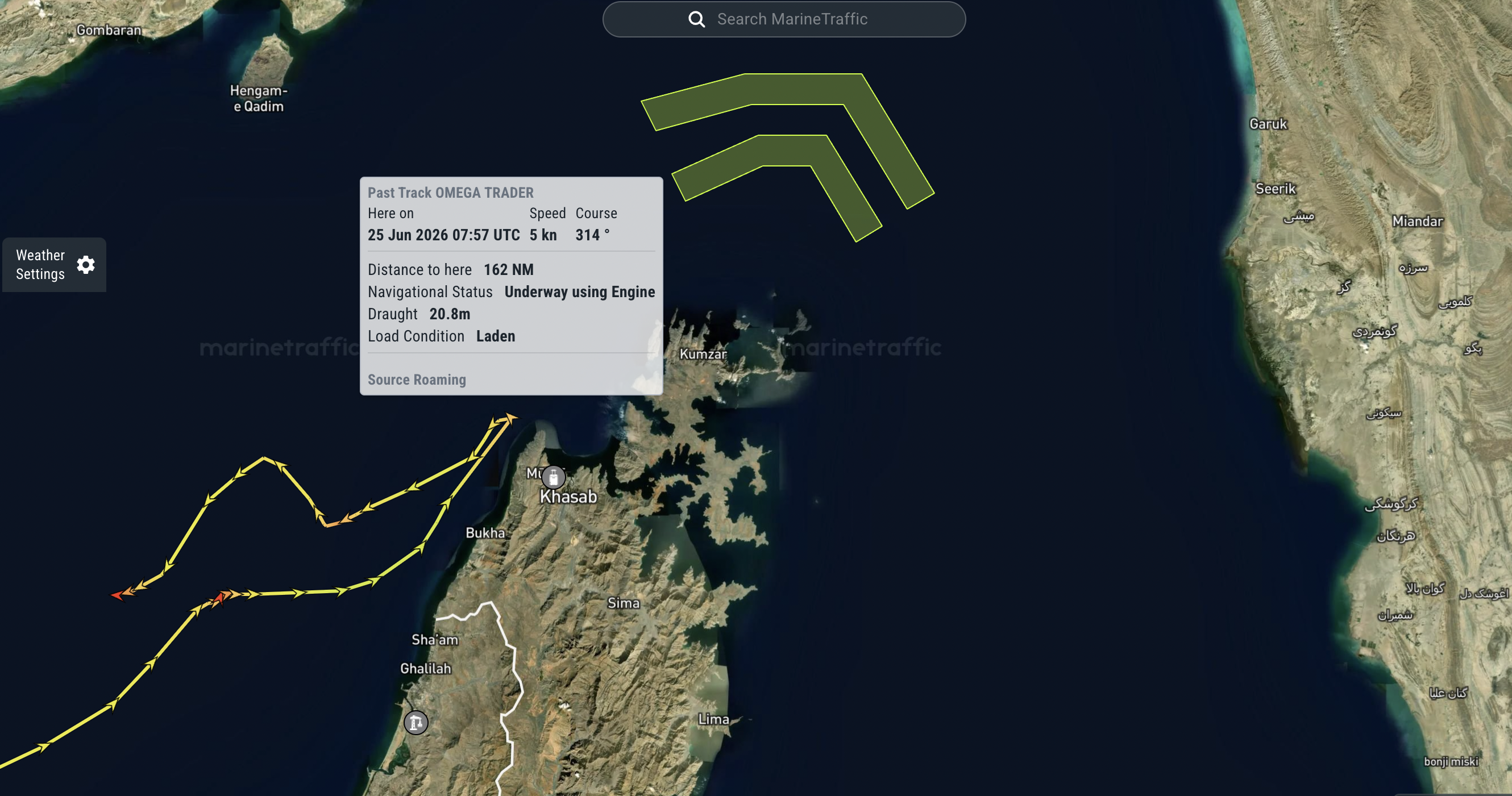
Yesterday, the container ship Ever Lovely (IMO 9629110) was reportedly hit by a drone while taking the Omani route (see map above for location; for full details on the incident, see The Washington Institute’s interactive map and attack tracker). In response, the IMO paused its evacuation plan, and at least one crude oil tanker (Omega Trader, IMO identification number 9567659) was seen aborting a likely transit and sailing back into the Persian Gulf.

That same day, the United States and the Gulf Cooperation Council issued a joint statement reemphasizing the importance of unrestricted navigation through this critical waterway. Yet Tehran’s actions demonstrate that traditional arrangements in Hormuz have collapsed and a new system is taking shape aimed at cementing Iranian control there. And unless circumstances change significantly, this shift may not be temporary. Returning to the prewar navigational order would deprive Iran of its strongest remaining source of leverage—one that has allowed it to exert pressure on regional countries and global energy markets alike.
The question now is not how Iran will facilitate a return to a status quo that does not serve its objectives. Rather, policymakers must prepare for the justifications Tehran will put forward to ensure that it plays a central role in the new maritime system, and the barriers it will put in place to impede any alternative systems.
The Two-Route System Under Threat
As noted above, once the military situation began de-escalating, some vessels resumed transits but generally bypassed the traditional routes into and out of the Strait of Hormuz—that is, the traffic separation scheme (TSS) proposed decades ago by Iran and Oman and adopted by the IMO in 1968. The long-established TSS routes in the center of the strait are currently unsafe—and will be for the foreseeable future—reportedly due to the presence of mines. Phil Belcher, the marine director at the International Association of Independent Tanker Owners (INTERTANKO), stated last week, “The latest figure we had was that there’s 80 mines in the strait…It’s an enormous amount and it’s going to take some time to clear.” A recent advisory by the Joint Maritime Information Center stated that “active mine clearance operations” were ongoing.
The uncertainty surrounding this mine risk will necessarily keep vessels using the two new routes that emerged during the war. The first path runs through Iranian waters and is being referred to as the “northern route.” Iran’s Persian Gulf Strait Authority (PGSA)—a U.S.-sanctioned entity that the regime established during the war to help legitimize its transit schemes—recently publicized the coordinates of this path (see map above), calling it the “new safe navigation route” for entering and exiting the strait.
The second path—the so-called “southern route”—hugs the Omani coast. Several vessels have used this route to exit and enter the region with U.S. guidance.
Prior to yesterday’s attack, the IMO evacuation scheme was to be implemented in cooperation with Iran, Oman, all other coastal states in the region, the United States, and the maritime industry. Based on a document issued by Muscat, ships departing the strait under the IMO plan can use either the Omani or Iranian “temporary routes,” so long as they contact the relevant coastal state of their selected route to ensure they can proceed. Yesterday, however, Iran warned that all routes but its own—implicitly including the Omani route—are “unacceptable” and pose “serious safety risks,” adding that vessel coordination with the Islamic Revolutionary Guard Corps (IRGC) is “mandatory.” Hours later came the attack on the Ever Lovely.
Tracking Transits Post-MOU
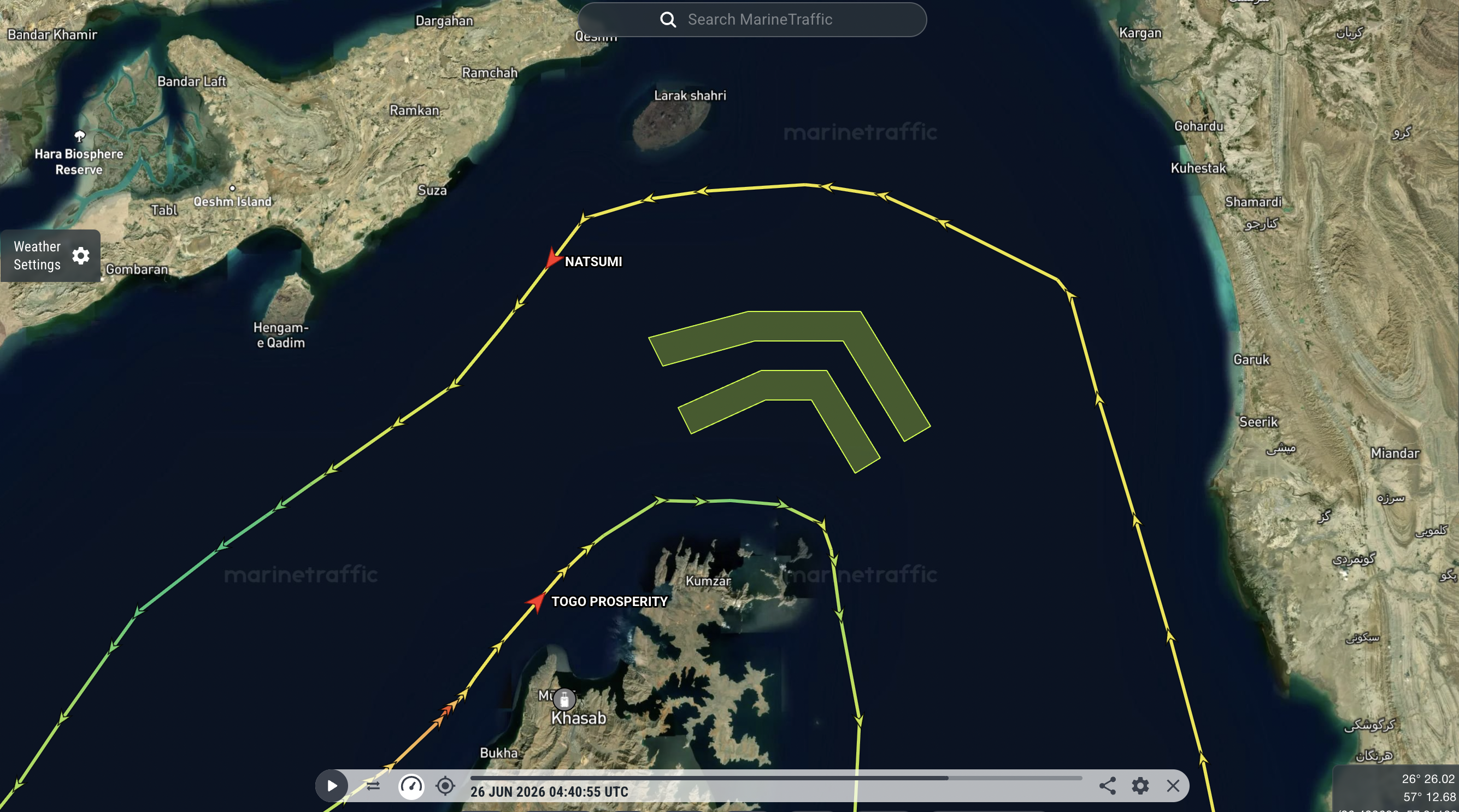
So far this week, ship tracking data shows that vessels have been using both the northern and southern routes. For example, the tracking image below shows two tankers using these routes earlier today: the laden crude tanker Togo Prosperity (IMO 9411032) leaving the region via the Omani route, and the empty crude tanker Natsumi (IMO 9331244) entering via the Iranian route.

Again, though, neither of these new routes is handling the number of transits seen through the prewar TSS routes, which averaged around 138 vessels per day. And tankers cannot be expected to return to the traditional lanes without assurances that all mines have been cleared, particularly given the environmental consequences of a major oil spill if a tanker were to hit one. It remains uncertain if Iran is willing to cooperate with international mine-clearance missions (whether U.S. or European).
The shifts in transit numbers during the Iran crisis confirm this limitation. According to market intelligence firm Kpler, the transit of tankers carrying liquids—that is, crude oil, liquefied petroleum gas, liquefied natural gas, and oil products—has seen a limited recovery in recent days (container ships and dry bulk vessels are excluded from this data). On June 17, 7 such vessels crossed the strait (5 inbound, 2 outbound), including tankers that transited with their Automatic Identification System (AIS) switched off. On June 18, the day after the MOU was signed, the number climbed to 27 transits (14 inbound, 13 outbound). And by June 24, the number had reached 32. The next day—when the Ever Lovely was attacked—the total was 29 (5 inbound, 24 outbound). Yet all of these numbers fell well short of the level seen just before the war broke out on the night of February 28; liquid tankers made 59 transits that day (18 inbound, 41 outbound).
Transits may soon fall again because Iran has stepped up its efforts to threaten vessels over marine radio channels. On June 24, for example, an alert issued by the British firm Ambrey Intelligence reported that the IRGC had instructed an oil products tanker sailing from Qatar to Pakistan to change course to “north of Larak Island,” stop there, and await approval. “You are in range of my missiles and [we may] fire on you,” the IRGC warned, even though the vessel was already taking the Iranian route.
Given that a return to the traditional route will not be possible anytime soon, this aggressive behavior will likely continue. And the idea of curbing these threats by arranging future management of the strait between Iran and regional states lacks clarity at the moment, particularly regarding potential fees for the “maritime services” provided to commercial vessels once the sixty-day “no charge” window identified in paragraph 5 of the MOU ends.
Policy Implications
Iran has seen the impact of controlling ship traffic through a vital international waterway, and even before the war, it repeatedly demonstrated its ability to harass and attack commercial vessels in the Persian Gulf, Strait of Hormuz, Gulf of Oman (including off Fujairah), and out to the Arabian Sea. Based on this track record and its observed effects on commercial traffic, Tehran will almost certainly continue using the Hormuz lever during its upcoming negotiations with Washington, aiming to firm up the new navigational order it has imposed and make the old navigational order more difficult to revive.
Countering this strategy will require more than joint statements. The United States and its regional partners will need new policies and measures to ensure that Iran is not the only authority dictating rules in the strait.
First and foremost, seafarers require clear guidance on safety and security in the Strait of Hormuz. Fears of Iranian retaliation if ships do not obey IRGC orders are real. Iran has been taking advantage of the uncertainty and chaos created by the collapse of the prewar maritime order, so acknowledging the enormous challenges involved in returning to that order is the first step. Washington and its partners must also devise the right set of nonmilitary efforts to navigate these challenges, since confronting Iran militarily inside the waterway would only worsen the crisis. In the short term, at least, this means maintaining clear communication with vessels using the Omani route about what to expect, the risks involved, and what to do in the event of an Iranian warning or attack. Seafarers should not be expected to possess prior knowledge about operating in a war zone.
Second, publicly identifying where mines are present in the strait and providing a timeline for clearing them should be a top priority. The uncertainty surrounding reported mines will delay any return to the prewar shipping route, and Iran will take advantage of that to keep its preferred navigational order in place. In the meantime, vessels will continue using the existing “northern” and “southern” bypass routes until the mine threat is completely resolved, leading to new developments that will need to be addressed as they emerge.
One such development is already appearing: Oman is reportedly making the case for future “service fees” related to pollution in the strait and the assistance provided to ships navigating it. Iran has proposed something similar, raising concerns about setting a precedent for such fees in other waterways around the world—an idea the United States has rejected. To avoid long-term disruption—especially after the MOU’s sixty-day negotiating period expires—fees should only be accepted on a temporary basis and levied specifically in response to individual ships requesting assistance or an accident leading to pollution. Once the traditional maritime route is restored, these fees should end.
Noam Raydan is the Sudhaus Senior Fellow at The Washington Institute and co-creator of its interactive map project Maritime Attacks in the MENA Region.
Share