- Policy Analysis
- PolicyWatch 4247
The UK, Turkey, and Europe Must Do More to Dismantle Hamas Financial Networks
Despite recent high-profile arrests, transatlantic authorities won’t be able to meet their longer-term goals of stabilizing and rebuilding Gaza unless they take broader action against still-rampant Hamas fundraising.
On July 31, authorities in the United Kingdom arrested Mohammad Yousef Hasna based on U.S. charges that he was providing material support to Hamas. A Turkish national, Hasna is accused of serving as the global director of an international humanitarian organization that allegedly was actually involved in raising and transferring funds on behalf of Hamas. This law enforcement action—which should result in Hasna’s extradition to the United States to face terrorism-related charges—was an important step in cracking down on Hamas’s extensive, longstanding networks in Europe. Yet far more still needs to be done to address the group’s illicit transatlantic financing activities, particularly in Turkey and the UK but also in many other locales. Washington should therefore continue pressing European governments to prioritize this issue and crack down more aggressively against Hamas activity on their soil.
The Charges
The U.S. indictment does not name Hasna’s international organization, instead referring to it as a “sham charity” registered in the UK. Some sources point to Al-Khair Foundation as the charity in question, but the organization denied that Hasna is on their staff and referred to him as “an employee of one of our implementing partner organizations overseas.” In any case, Hasna allegedly worked closely with the highest echelons of Hamas to ensure that humanitarian contributions to the charity directly benefited Hamas activities inside the Gaza Strip. The indictment describes a scheme in which food and other supplies were delivered to warehouses controlled by Hamas and then concealed from other authorities. Notably, the charity’s officially reported revenues rose dramatically after the October 7 attacks, from approximately $42 million in fiscal year 2023 to $82 million in FY 2024.
Hasna’s close ties with senior Hamas official Ghazi Hamad lend particular weight to the significance of this operation. Hamad was designated by the U.S. Treasury Department in November 2024 after playing several key roles for the group over the years. He currently heads Gaza’s Ministry of Social Development, which the indictment describes as “an agency nominally part of the Gaza governing apparatus that is in fact controlled by Hamas.” And in an interview this week, he made clear that even though Hamas has signed the latest Gaza deal negotiated by the U.S.-led Board of Peace, “resisting the occupation” remains the group’s “holy mission.”
Hamas and Europe
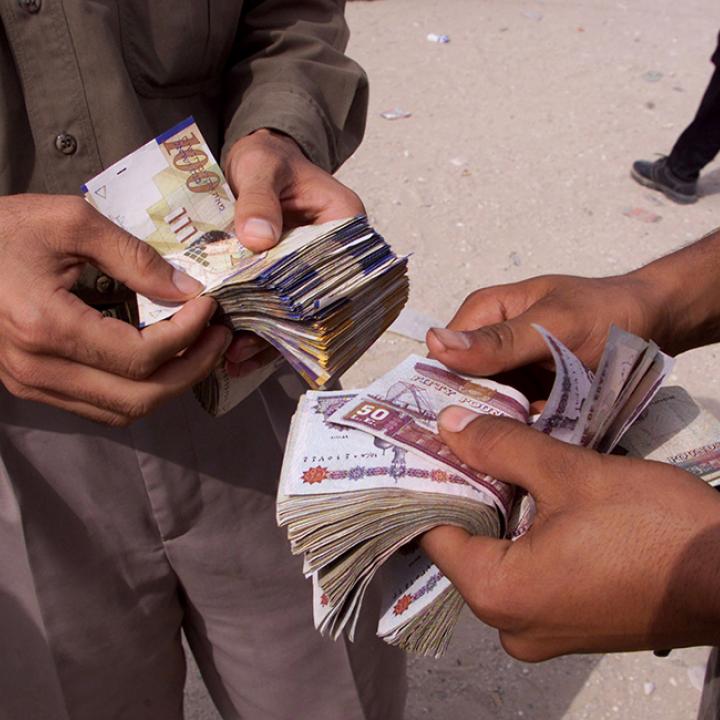
Europe has been a major Hamas funding source for decades, with sham charities usually featuring in these efforts. In September 2024, an Israeli government report noted that the group had been operating a “network of activists and organizations” in Western Europe for more than twenty years. The U.S. government made similar assertions a month later, claiming that Hamas was receiving approximately $10 million per month in donations through charities in Europe and elsewhere—a sum that rivals what its patrons in Iran were providing at the group’s peak funding levels in the lead-up to October 7.
Within days after the Gaza war erupted, Hamas launched several new global fundraising campaigns, primarily under the guise of alleviating genuine humanitarian suffering in the Strip. Long-time leader Khaled Mashal called on supporters to take part in a “financial jihad” by giving “aid, money, and all that you have” to these campaigns. The group’s European networks have leveraged his plea with considerable success—U.S. and Israeli officials believe that Hamas’s European fundraising has increased significantly since October 7.
Yet it is important to remember that European networks of this sort date back much further—to at least the start of the second Palestinian intifada in 2000, when Hamas leaders established the “Union of Good” to facilitate overseas financing. Encompassing more than fifty sham charities in Austria, Belgium, Germany, Italy, Switzerland, the UK, and other locales, this umbrella organization was led for many years by Yusuf al-Qaradawi, an influential extremist ideologue and senior figure in the Muslim Brotherhood. The Treasury Department eventually designated the union in 2008 for its ties to Hamas; many of its members have been listed as well. More recently, a 2025 Treasury designation of a Netherlands-based NGO confirmed that the union is still very much in operation and reporting “directly to the Hamas military wing.”
Hamas and Turkey
Turkey is undoubtedly Hamas’s most important financial hub in the region, and perhaps globally. This is hardly surprising given President Recep Tayyip Erdogan’s well-known ideological alignment with the group. Less than two months after the October 7 attacks, he made this position crystal clear, declaring, “No matter what anybody says, I cannot accept Hamas is a terror group.” And just last week, newly chosen Hamas leader Khalil al-Hayya visited Turkey and met with Foreign Minister Hakan Fidan, who expressed his strong support for the group. He also met with National Intelligence Organization chief Ibrahim Kalin—another indication of the high-level access Hamas is accorded in Ankara.
Notably, U.S. Treasury officials sanctioned the Turkey-based trading company El-Kahira a few days before Hayya’s visit, accusing it of transferring hundreds of thousands of dollars to Hamas. Several months earlier, Treasury designated a number of other Turkey-based charities for their ties to Hamas, including the Palestinian White Hands Assistance and Solidarity Association. The country also hosted Hamid al-Ahmar, a Yemeni national who allegedly helped supervise Hamas’s once-secret $500 million overseas investment portfolio.
Erdogan’s government has taken no visible actions against such entities despite U.S. sanctions. To the contrary, he has frequently repeated that he does not view Hamas as a terrorist organization.
Moreover, the U.S. indictment against Yousef Hasna describes how the accused worked with the Turkish Diyanet Foundation (TDV)—which is controlled by the government’s Directorate of Religious Affairs—to organize a conference on “Gaza the Day After” in Istanbul. This activity took place even as he was allegedly coordinating Hamas financial transactions and Gaza shipments with Ghazi Hamad.
European Government Actions
The UK’s cooperation on the Hasna case is a promising development that builds on previous joint U.S.-British sanctions against Hamas entities. This includes the March 2024 designation of the organization Gaza Now and its Europe-based founder, Mustafa Ayash, as “key financial facilitators” for Hamas. Ayash was later charged by the Austrian government, which requested his extradition from the Netherlands to face prosecution for alleged terrorist financing crimes. Germany, Italy, and the Netherlands have also brought their own law enforcement cases against individuals tied to Hamas—a step they would have been very reluctant to take prior to October 7.
Yet given how central the continent has been to the group’s financial operations, European governments still have much more to do—including in the UK, where Hamas has deep roots and networks. The U.S. Justice Department and the Israeli government both issued statements praising British cooperation on the Hasna investigation, but London has not publicly commented yet—likely a signal that officials are not eager to advertise their role in this domestically controversial space.
Elsewhere, countries like Belgium and Ireland have done relatively little to address the Hamas financing threat. And the European Union has added too few Hamas-linked entities to its designation lists despite having expanded authority to target such groups since early 2024—an authority that was recently extended for another year. So far, the EU has used this authority primarily against Hamas entities outside Europe, with only one designation targeting a company based on the continent. This focus should change.
Next Steps
The Trump administration should make clear to European governments that cutting off Hamas financing must be a high priority if they hope for progress on stabilizing Gaza and reducing the terrorist threat there. This means applauding countries when they take significant actions while still pushing them—particularly the UK and Belgium, which has publicly acknowledged Hamas’s presence on its soil—to ramp up their efforts. Washington should also ask the EU to expand its sanctions against organizations and individuals tied to Hamas, including the group’s many sham charities. Europol should be playing a more robust role as well by helping to coordinate the many cross-border Hamas investigations.
Although Turkey is unlikely to assist much with these efforts, U.S. officials should nonetheless press Ankara—both publicly and privately—for action. Given President Trump’s strong relationship with President Erdogan, Washington has more leverage now than in the past on this difficult issue. Ankara will not stop Hamas from operating on Turkish soil, but even scaling this activity back somewhat would be helpful. If President Trump is serious about his ambitious plans to disarm Hamas, cracking down on the group’s transatlantic funding sources is essential.
Michael Jacobson is the Mark and Wayne Levy Senior Fellow at The Washington Institute and former director of strategy, plans, and initiatives in the State Department’s Counterterrorism Bureau. Matthew Levitt is the Institute’s Fromer-Wexler Senior Fellow, director of its Reinhard Program on Counterterrorism and Intelligence, and former deputy assistant secretary for intelligence and analysis at the Treasury Department.