- Policy Analysis
- PolicyWatch 4251
Five Years of Taliban Diplomacy: Recognition Without Concessions
Aug 18, 2026
Also available in
About the Authors

Brief Analysis
The Taliban has learned that it can reap substantial international rewards without budging on key security and human rights issues, but Washington can still exert pressure on crucial soft spots such as UN credentialing, Treasury Department licensing, and Central Asian project financing.
Five years after seizing Kabul on August 15, 2021, the Taliban government has won broad diplomatic gains, including formal recognition from a permanent member of the UN Security Council, accredited ambassadors in a widening set of capitals, and economic and security agreements with its neighbors. Yet none of this recognition has been conditioned on its leaders making significant concessions regarding issues of international concern, from its treatment of women to its ties with al-Qaeda and another U.S.-designated terrorist organization, Tehrik-e Taliban Pakistan (TTP). In a New York Times interview on the eve of this anniversary, Foreign Minister Amir Khan Muttaqi sought to continue the streak by calling on the United States to reopen its embassy and invest in Afghan mines, dams, and roads, all while ruling out any return of American forces or offering anything else in return.
The Taliban does indeed hold much more leverage than it did five years ago, as illustrated by the author’s comprehensive data on Kabul’s diplomatic activity. Yet Washington still has ample sway that it can and should exert, mainly via four levers: UN credentialing, U.S. Treasury Department licensing, financing for regional infrastructure, and the ongoing Qatari channel. The risk is no longer engagement, but engagement strictly on Kabul’s terms.
What Five Years of Data Show
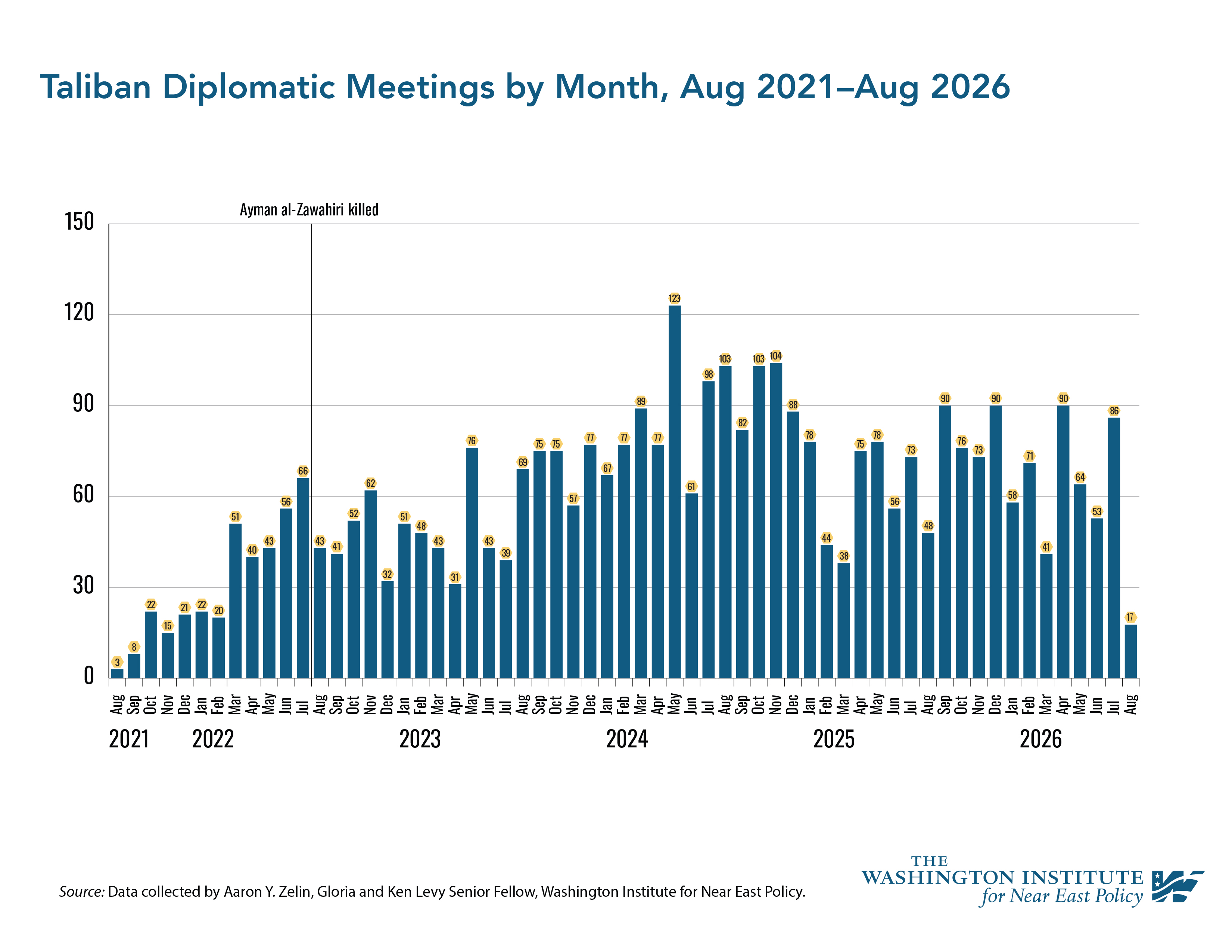
The Taliban’s diplomatic project has peaked and consolidated. Announced engagements climbed for three years after the fall of Kabul, crested in late 2024, and have since settled rather than declined. The list of countries that had yet to be engaged shrank rapidly, and Kabul has gradually shifted from meetings to mechanisms (e.g., consulates, joint commissions, trade councils). The broadening phase is over; the deepening phase is in motion, and far harder to reverse.
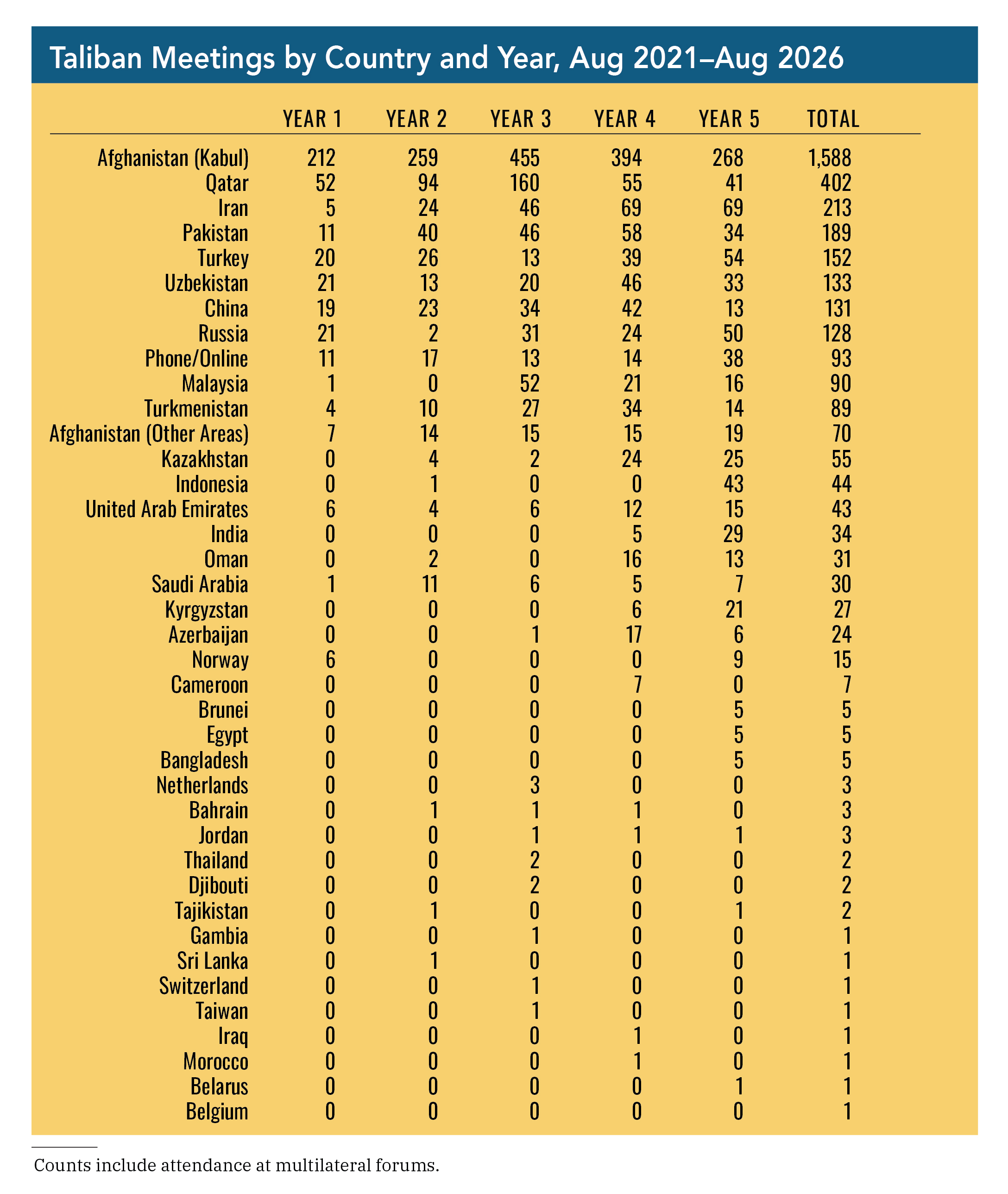

The map of Taliban outreach has been redrawn as well. Iran has displaced China as Kabul’s principal interlocutor, while Turkey, Qatar, and Uzbekistan anchor the tier below. India moved from token contact to the eighth-most-frequent diplomatic partner. Pakistan ran a complete cycle from patron to adversary, and Kabul now issues demarches to Islamabad the way any state would.
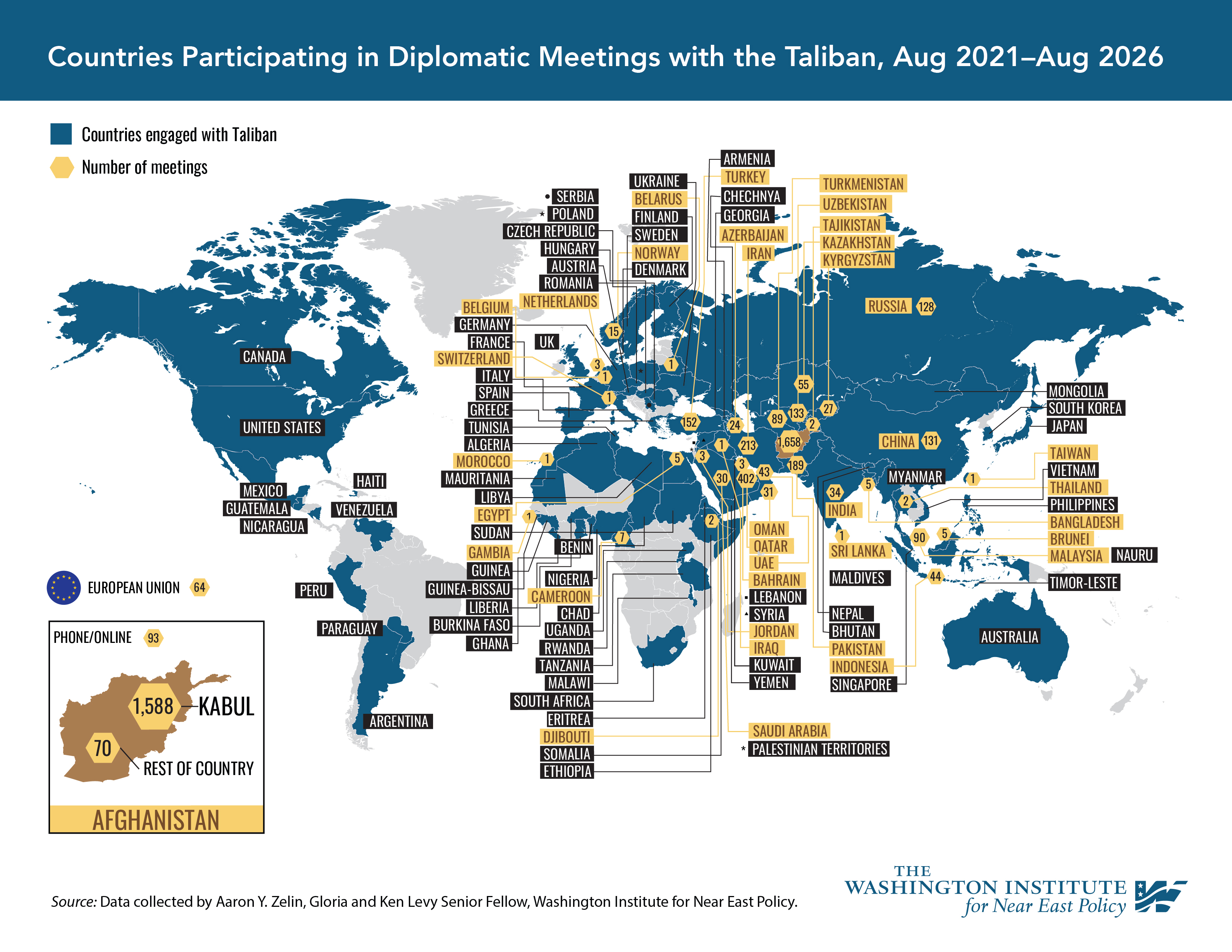

The through line is that access to the new Afghanistan has been determined by proximity and material interest, not ideological affinity: the most frequent partners are the least inclined to raise anything that the United States and like-minded countries want raised. Since 2021, Western engagement with Kabul has collapsed from roughly one-sixth of the Taliban’s annual diplomatic activity to one-twentieth—a deliberate choice by these countries following bans on girls’ education and women’s employment.
As a result, however, these governments have almost no recurring access to the Afghan officials who set policy, and Western priority issues have largely vanished from the diplomatic record, including references to females and to counterterrorism as Washington frames it. Russia and China still raise the latter issue, but only its narrowest form: fighting the Islamic State’s Khorasan “province” (ISKP) inside Afghanistan. The al-Qaeda, TTP, and transnational terrorism files largely went away with the West; military-technical cooperation with Moscow filled the vacuum.

The Threshold Already Crossed
Russia has taken the biggest diplomatic step toward the Taliban government, becoming the only country to formally recognize it in July 2025. Since then, it has granted Kabul ministerial participation as a “recognized member” at the eleven-nation Moscow Format consultations, along with a military-technical cooperation agreement signed this May.
Meanwhile, an accreditation cascade unfolded across the Persian Gulf states, Turkey, and Central Asia, as governments accepted Taliban-appointed diplomats without formally recognizing its rule. This was accompanied by economic statecraft unthinkable five years ago: groundbreaking on the Turkmenistan-Afghanistan-Pakistan-India Pipeline (TAPI), a $10 billion investment memorandum from the United Arab Emirates, DP World’s agreement to operate two border crossings, and a $500 million railway commitment from Kazakhstan. Governments made these moves for their own reasons (e.g., border security, refugee returns, transit, minerals) and conditioned none of them. The lesson Kabul drew is correct: unconditional engagement can be pocketed, and each recognition costs less than the previous one.
What these bargains could not supply is sufficient capital at scale, which is why the Taliban is now making imperious but revealing overtures to Washington. Roughly half of Afghanistan’s forty-five million people need humanitarian assistance; around four million returnees have made their way back from Pakistan and Iran since early 2025; Islamabad has closed the border; and billions in central bank reserves remain frozen. Muttaqi’s pitch is built around that capital gap, with an emphasis on potentially lucrative mineral deals.
Meanwhile, Washington’s recent engagement has been episodic rather than evolutionary. Last year, former Special Representative Zalmay Khalilzad met with Taliban officials in March, and delegations led by Special Envoy for Hostage Response Adam Boehler met with Muttaqi and First Deputy Prime Minister Abdul Ghani Baradar in September. Yet this channel is largely transactional—it helped free detained Americans but produced nothing durable on other top U.S. policy issues such as counterterrorism, consular services, or treatment of females. Access is spent without accumulating; new delegations inherit no agreed agenda, no record of Kabul’s commitments, and no benchmarks. Washington’s public requests—such as reestablishing U.S. control of Bagram Air Base, recovering abandoned weapons, and freeing another prisoner the Taliban denies holding—have all been flatly refused, while Kabul’s public requests are patently one-sided, suggesting that no one is building toward compromise through ongoing discussions.
The Syria Contrast
The fall of Syria’s Assad regime produced a natural comparative experiment: three years after the Taliban takeover in Afghanistan, how would another jihadist-originated government fare in seeking international acceptance? The answer is rather astonishing: in just twenty months, the new Syrian government has logged more engagements than the Taliban’s entire five-year total. Moreover, the geographic sphere of this diplomacy is almost perfectly inverted, with Western states, Japan, and South Korea accounting for nearly a third of engagement with Damascus but only a small fraction of engagement with the Taliban. Syrian President Ahmad al-Sharaa has met with President Trump multiple times and addressed the UN General Assembly; the Taliban’s Emir Hibatullah Akhundzada has not left Kandahar.
How to account for this difference? Damascus took the fast track by rejecting global jihadism, foreclosing its territory as a launchpad for attacks against neighboring states, and reforming its institutions. Kabul is on the slow track by choice. When Muttaqi was asked last week whether gender restrictions obstruct diplomatic recognition, he waved the question away and repeated that the closure of girls’ secondary schools is “temporary”—the same word the Taliban used in 1996. The Syria contrast is the most useful leverage Washington has acquired over Kabul since 2021, but U.S. officials have used it rhetorically rather than operationally.
Some might argue that this says as much about Washington as about Kabul, with the United States embracing a former al-Qaeda affiliate in Damascus while holding the Taliban at arm’s length. That charge would hold if the two were being asked for different things. They are not. Syria’s new leaders began shifting away from their most problematic practices while they governed Idlib province years before Assad’s fall, then continued this shift after taking power, even before the largest tranches of U.S. relief arrived; Kabul has been asked for less and conceded nothing. The difference lies in handling: Syria policy has followed a sequence and been coordinated with Turkey, the Gulf, and Europe, while Afghanistan policy has had neither. In response, Kabul has banked recognition from Moscow, accreditation from Gulf states, and detainee talks with Washington, with none of these gains contingent on the others.
Policy Recommendations
To fix this disconnect, flex its leverage more effectively, and start building a relationship that meets wider American interests, Washington should take the following steps:
- Publish the price for UN credentialing. Seating at the General Assembly is the last gate the Taliban government has not passed, and the silent U.S. hold on this decision may expire if Washington’s influence on the Credentials Committee wanes (e.g., if another permanent committee member like Russia pushes for inclusion and enough other rotating members agree). The State Department and the U.S. Mission to the UN should convert this silent deferral strategy into a short, published list of benchmarks that Kabul is required to meet before entry: namely, reopening girls’ secondary schools and universities, with enrollment verified by the UN Assistance Mission in Afghanistan (UNAMA) and UN Children’s Fund (UNICEF); allowing Afghan women to work for the UN and NGOs; and extraditing foreign fighters.
- Charter the Qatari channel. The Trump administration should designate a new Special Envoy for Afghanistan with a Doha-based deputy and a written charter covering detained Americans, consular services for Afghan nationals, counterterrorism deconfliction regarding ISKP, and counternarcotics efforts. It should also start talking about what Kabul has now publicly asked for—a U.S. diplomatic presence and investment—making clear that both are obtainable but only if certain benchmarks are met. In addition, the administration should ask the Senate and House Foreign Affairs Committees to require quarterly reporting on these issues so the channel outlives the individuals who built it.
- Use Treasury licensing as a scalpel. The department’s Office of Foreign Assets Control should issue narrow, time-limited general licenses whose renewal is conditioned on observable outcomes: for example, telecom and electricity assistance contingent on access for female subscribers and employees, correspondent banking relief after verified school reopenings, and carve-outs for women-owned enterprises. The same logic should govern Muttaqi’s mineral invitation—any American work on surveying, extracting, or processing Afghan rare earths and similar resources should require Treasury authorization conditioned on specific benchmarks. Reversible instruments give Washington something to withdraw; blanket easing of restrictions gives it nothing.
- Compete in Central Asia, not Kabul. Washington should use the C5+1 platform with Kazakhstan, Kyrgyzstan, Tajikistan, Turkmenistan, and Uzbekistan to put forth competing offers on various regional connectivity projects, leveraging the fact that these governments would prefer not to finance such projects on Chinese and Russian terms alone. For example, the Trump administration could direct the International Development Finance Corporation (DFC) and Export-Import Bank of the United States (EXIM) to offer financing for cross-border rail, transmission, and customs modernization initiatives that involve Afghanistan, but conditioned on transparency standards and the participation of women in the Afghan-facing workforce of any such ventures.
- Deliver the Syria roadmap in writing for comparison. The State Department should produce a short, unclassified document setting out what Damascus has done since the fall of Assad and what it has received at each step. It should pair this document with a roadmap of expectations for Afghanistan: for example, a first tranche of relief in exchange for verified school reopenings and repatriation of foreign fighters; a second tranche for institutional inclusion of women; a third tranche for verifiable severance from al-Qaeda and the TTP. Washington could then share these documents with Abu Dhabi, Ankara, Doha, New Delhi, Riyadh, and the Central Asian capitals so that the states currently financing normalization can see what they are underwriting for free.
- Restore the evidentiary baseline. Western absence has left the United States too dependent on Kabul’s readouts of diplomatic meetings. Congress should mandate an annual, public State Department report on Afghan foreign engagement and the status of women and girls. Similarly, the administration should fund open-source monitoring and press for a robust reporting mandate in the next UNAMA renewal. Without an independent baseline, conditionality is unenforceable.
The Taliban has spent its past five years in power demonstrating that patient diplomacy works. Washington’s task in the coming years is to attach a cost to these gains while it still has leverage. Kabul has now named its price; the United States should name its own.
Aaron Y. Zelin is the Gloria and Ken Levy Senior Fellow at The Washington Institute and founder of the acclaimed website Jihadology.
Appendix: Data Notes
Between August 15, 2021, and August 15, 2026, the Taliban publicly announced 3,651 diplomatic engagements with 103 countries and entities. Below are some notable details from the data:
Trajectory. Engagements rose from 387 in year one to a peak of 952 in year three, then declined to 844 in year five—a roughly 12 percent contraction from the peak.
New partners. In years one and two, the Taliban engaged 35 and 37 countries for the first time, but this number fell to 8 in year four and 3 in year five.
Institutionalization. References to consulates in Taliban readouts rose from 2 percent in year one to 14 percent in year five. The past year also saw first-ever mentions of standing mechanisms, including an Afghan-Kyrgyz working group, a Kazakh inter-ministerial commission, and an Afghan-Uzbek joint trade council.
Top five partners. Iran tops the list at 494 total engagements over five years, followed by China (432), Turkey (394), Qatar (347), and Uzbekistan (316). Beijing’s annual total peaked at 135 in year three before falling to 46 in year five.
Risers and fallers. India rose from 2 engagements in years one and two to 21 and 39 in years four and five. Pakistan surged to 86 in year four before collapsing to 33 amid open hostilities between the two governments. The European Union fell from 20 engagements at its peak to 7.
Venue shift. Kabul hosted roughly 55 percent of overall meetings in year one but only around 32 percent by year five. Doha has collapsed as an Afghan diplomatic venue, from 160 engagements to 41.
Agenda shift. Trade and investment language appeared in more than 40 percent of Taliban readouts in years four and five, nearly double the first-year share. Mentions of females fell from thirteen in year three to two in year four; counterterrorism references have nearly disappeared.
Western share. Engagement by Western countries fell from roughly 16 percent of the total in year one to just 5 percent in year five.
Syria comparison. The post-Assad government has logged at least 4,000 engagements with almost 100 states in roughly twenty months. Western states, Japan, and South Korea account for 32 percent of that activity, compared with 7 percent of Taliban engagement over the same period.
Note: The engagement metrics count each meeting once, while the country-level metrics count each participating country separately.
Share