- Policy Analysis
- Articles & Op-Eds
Christians in the New Syria: Accepted, But At-Risk
Also published in Caravan
Although some Christians have been targeted post-Assad, these incidents are hardly an attempted "genocide," but rather part of the broader internal security challenge affecting all communities in Syria, including the majority population.
Syria is home to one of the oldest Christian communities in the world. In Maaloula, locals still speak the ancient language of Aramaic to this day. After the dawn of Islam in the Levant, generally speaking, Christians were allowed to practice their faith without much harassment, but were second-class “citizens” politically. In modern history, there was the infamous massacre of Christians in Damascus in 1860. However, since then, they have been relatively free and safe.
Since the fall of the Assad regime a year ago, many have been worried about the fate and future of Christians in the new Syria. Overall, they are allowed to live and worship, but there have been a number of incidents where they have been targeted. These greater risks must be confronted by the new authorities but should be seen in concert with broader risks to all communities in Syria, including the majority population. No one is safe from vigilante attacks in Syria nowadays. Therefore, it is a complex picture worth unfolding to better understand the current situation.
HTS and Christians Prior to the Fall of the Regime
Prior to the fall of the Assad regime, the current authorities were an insurgent group that controlled northwest Syria under the name Hayat Tahrir al-Sham (HTS). In the years prior to the fall of the regime, HTS began to reconcile with minority communities under its rule that they previously either ignored or had adversarial relations with. In particular, the current Syrian president Ahmad al-Sharaa (at that time Abu Muhammad al-Jawlani) first openly engaged with Christians in the Idlib region in July 2022. Prior to this, living under HTS rule was deeply unpleasant for minorities. HTS had previously confiscated at least 550 properties from Christians, including homes and shops; the practice originally began in 2015.
Following the detente in 2022, Christians were allowed to resume religious ceremonies and fix/rebuild their churches. Plus, a majority of Christian property disputes were resolved and property was returned to its original owner. The biggest changes for Christians initially under this more friendly approach by HTS were the improvement in the security situation, ejection of foreign fighters from their neighborhoods, and being able to administer their own courts again. That being said, politically, Christians—as with other minorities in HTS areas—were second-class citizens insofar as not having any political representation in the General Shura Council and only being represented by the Directorate of Minority Affairs, which wasn’t run by a minority.
Engagement Following the Fall of the Regime
In the offensive that led to the fall of the Assad regime, the aforementioned Directorate of Minority Affairs signaled in a statement that Christians would remain safe under a new Syrian government. Since the fall of the regime, the community continues to be an engaged partner with the transitional authorities. Christian leaders met with al-Sharaa as early as late December 2024 and included representatives from many denominations: Greek Orthodox, Roman Catholic, Syriac Orthodox, Syriac Catholics, Armenian Catholics, Maronite, National Evangelical, and Latin. This engagement has continued throughout the first year of the transition, including the recent visit in late October 2025 by al-Sharaa with Patriarch John X Yazigi, Greek Orthodox Patriarch of Antioch and All the East, at the Patriarchate. Both reaffirmed each other’s duties toward one another in safeguarding Syrian Christianity and supporting the state. The Patriarch presented al-Sharaa with an alleged ancient Muslim document granting safety to and a covenant with the Christians of Damascus. Patriarch John X Yazigi then told al-Sharaa “we uphold the covenant,” and al-Sharaa responded “and we uphold the covenant of our ancestors.”
This also plays into a theme of Umayyadism that Syrian Sunnis and the state have pursued since the fall of the regime. At least for some Christians, who are buying into this new Syrian project, they feel they have a part to play in this as well and can rely upon the historical support Christians gave to the Umayyad state as a way to wrap themselves in the new state of affairs. For example, Nawar Najmeh, a Christian and spokesperson for the parliamentary elections committee, explained in a video about Christian contributions to building the Umayyad state, noting that this is why he seeks to help the new Syrian state.
Targeting and Violence Against Christians Since the Fall of the Regime
While the Christian community has generally been safe security-wise since the fall of the regime, there have also been a number of larger incidents. These are definitely dynamics to be concerned about. However, within certain online circles they have been turned into fabricated stories about a genocide against Christians, which is simply not true. This is one example where disinformation campaigns have warped outsiders’ understanding of the reality on the ground. That does not mean the local community or those outside of Syria should not raise awareness and advocacy if there are legitimate issues, but pushing claims of genocide for political reasons is detrimental.
For example, during the Coastal massacre against Alawites in March, disinformation filtered into some Western and Israeli online echo chambers that morphed into false reports about a massacre against Christians. A few Christians were indeed killed, but it was more a circumstance of being at the wrong place at the wrong time. Most of the victims killed during the Coastal massacre were Alawites and Sunnis. Christian churches in Latakia even put out a joint statement urging individuals not to be swayed by rumors. Unfortunately, months later when there was a massacre against Druze in Sweida in mid-July, the Greek Melkite Church of St. Michael in the village of al-Sura was attacked and set ablaze.
Outside of those events, there was also the following: during Christmas 2024, the burning of a Christmas tree by foreign fighters; on February 17, a group of youth destroyed crosses in a cemetery in rural Homs; on April 6, assailants attempted to burn down a church in Damascus; on May 17, the car of a Christian family in Hama city was burned, and threatening leaflets were left in the area; and on June 8, a church in Homs city was shot at.
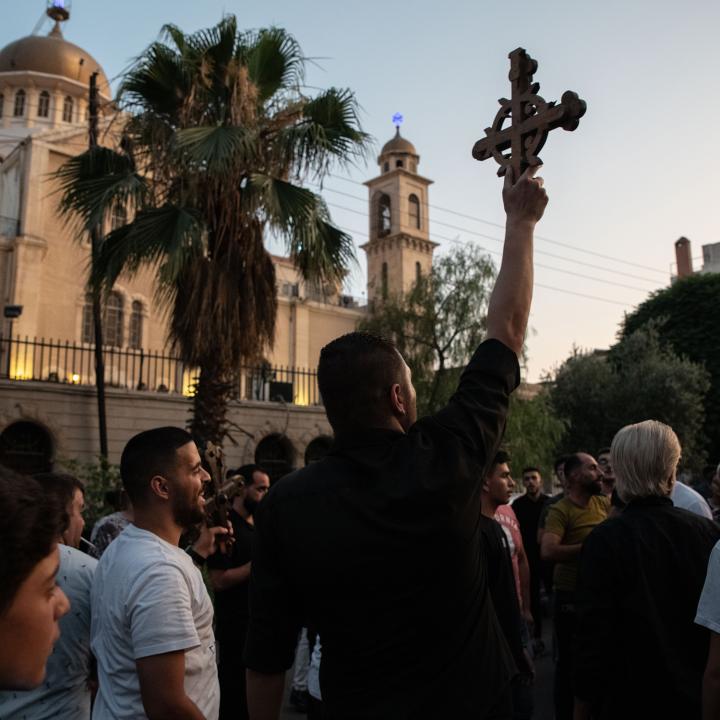
In addition, the Christian community has been a huge target for the Islamic State (IS) since the fall of the regime. According to the Syrian Ministry of Interior, IS suspects confessed that they were planning to conduct a car bombing attack against a church in Maaloula on New Year’s Day. Most notable was the June 22 suicide attack targeting the Mar Elias Greek Orthodox church in the Damascus neighborhood of Dweila, killing at least twenty-five people and injuring sixty-three—the largest attack against Syria’s Christian community since 1860. It was claimed by a shadowy group called Saraya Ansar al-Sunnah, which is an IS front group.
The Syrian government was swift and united in condemning the Damascus church attack. In addition to appropriate statements from top political and religious officials, civil defense units quickly assessed the damage at the site, while Damascus Governor Maher Marwan (al-Sharaa’s brother-in-law) and Social Affairs Minister Hind Kabawat (a Christian herself) visited the church and met with neighborhood residents. Al-Sharaa also offered condolences over the phone to Greek Orthodox Archbishop Romanos al-Hannat. While Syria’s government viewed the steps it took as sufficient, many Christians and other minorities suspect that Damascus was somehow complicit in the attack. Such beliefs are prevalent even after the government visibly enhanced security in Christian neighborhoods in general and around churches during Christmas, Good Friday, and Easter.
Christian Issues With the Syrian Democratic Forces
Outside of the Syrian government-controlled areas, we have also recently seen Christians in the SDF-controlled areas attempting to use the new Syrian government’s school curriculum so that students can sync their education with the new authorities. However, due to the continued issues and negotiations between Damascus and the SDF, the Autonomous Administration has shut down these churches since they go against the local administration. Highlighting the worries over Christians in Syria should not solely be focused on government-controlled areas, even though in this instance the SDF ended up backing down weeks later.
The above highlights that the situation for Christians in this new Syria is complicated, although it is not the same as if the Islamic State or al-Qaeda was ruling the area. Damascus has made a concerted effort to engage with the Christian community. At the same time, the community has been targeted by vigilantes and the Islamic State in particular. This has created an atmosphere within the community of unrest and suspicions regarding whether the new authorities are truly willing to protect them, even while the Syrian government has provided better security at its churches. Therefore, the only way forward is to build more trust and for the new Syrian government to continue to show it takes the safety of the Christian community seriously. Otherwise, similar to Iraq, an ancient community might decide to become refugees in the West and leave a historic legacy behind.
Aaron Y. Zelin is the Gloria and Ken Levy Senior Fellow at The Washington Institute and author of its new study “Institutions and Governance in the New Syria: Continuity and Change from the Idlib Model.” This article was originally published on the Hoover Institution website.